
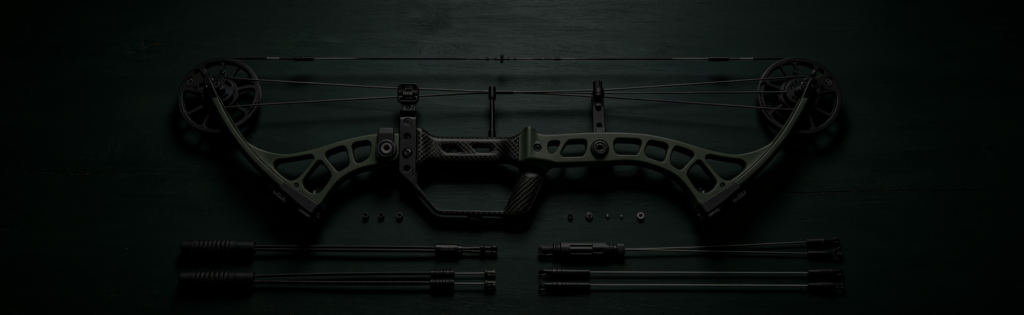
A compound bow is built around four core parts: the riser (the central frame you grip), the limbs (the flexing arms that store energy), the cams (the pulleys at each limb tip that create let-off), and the bowstring and cables (which connect the cams and drive the arrow). Everything else – arrow rest, sight, stabilizer, D-loop, peep sight, and cable guard – is an accessory or sub-component that helps you aim and shoot accurately.
Fletchwise guides are independent and hype-free – we are not sponsored by any archery brand.
The Core Structure
Riser
The riser is the rigid central frame of the bow, usually machined aluminum or carbon. You grip it in the middle, and the limbs, arrow rest, sight, stabilizer, and quiver all attach to it. A stiff, well-designed riser is the backbone of an accurate bow. Aluminum and carbon are not just a weight trade-off – our riser guide covers what the material actually changes and whether the extra cost is worth it.
Limbs
The limbs are the flexible arms extending from the top and bottom of the riser. They bend as you draw and snap back to launch the arrow, storing and releasing the bow’s energy. Most compound limbs are “split limb” (two thin blades per end running parallel) rather than one solid piece, and that split solves a specific engineering problem beyond speed and weight: a solid limb concentrates stress in the V-groove where the cam mounts, which is where solid limbs are most likely to crack under repeated stress or a dry fire – exactly the spot to check closely when inspecting a used bow. Splitting the limb into two thinner blades removes that single stress-concentrated groove entirely. Modern manufacturing has closed much of the old speed and weight gap between the two designs, so a solid-limb bow today is not automatically less durable than the numbers once suggested – check the specific model rather than assuming from limb type alone.
Cams
The cams are the oval pulleys at the tip of each limb – the defining feature of a compound bow. As you draw, the cams rotate and roll over to create let-off, dropping the holding weight by 75-90%. Cam design controls the bow’s speed, smoothness, and draw length.
Bowstring & Cables
The bowstring is what you draw and what pushes the arrow; you nock the arrow onto it. The cables run between the cams and synchronize them. Together, the string and cables turn your draw into stored energy and keep the cams timed. Replacing either one means putting the bow in a bow press – unlike a recurve, you cannot unstring a compound by hand.
One Cam, Two Cams, or a Hybrid - Why It Is Not Just a Speed Choice
Cam type is usually sold as a speed decision. It is really a maintenance decision, and the trade-off is the same one across every version: the more independent cams a bow has, the faster it can be, and the more precisely those cams have to stay synchronized with each other.
- Single cam – one elliptical power cam on the bottom limb, a round idler wheel on top that does no work. Nothing to synchronize, because only one cam is actually driving the system. This is the lowest-maintenance layout and the reason many hunting bows still use it.
- Hybrid cam – the idler wheel is replaced with a smaller control cam, linked to the power cam by a yoke cable and a control cable. It aims to split the difference: speed closer to a twin-cam bow, upkeep closer to a single cam. It still needs to be timed correctly, just not as fussily as a full twin-cam setup.
- Binary cam – both cams synchronize directly to each other rather than to the limbs, which removes split yokes entirely. Because neither cam can run out of time with the other on its own, this is largely self-synchronizing and keeps nock travel level through the shot.
- Twin (dual) cam – identical elliptical cams on both limbs, tied together by a split-yoke cable and the string. Properly timed, this delivers the highest speed and the firmest wall of the four – and the most maintenance, since the two cams can drift out of sync with each other over time.
Every compound bow with more than one working cam ships with timing marks – small reference marks near the cam – so a bow tech can confirm both cams reach the same point in the draw cycle at the same time. If your bow ever starts shooting differently than it used to with no other change, cam timing drifting out is one of the first things worth having checked, particularly on a twin-cam bow.
Aiming & Shooting Components
Arrow Rest
The arrow rest supports the arrow on the riser as you draw and shoot. Drop-away rests fall clear at release for maximum clearance and accuracy; containment rests (like a whisker biscuit) fully hold the arrow, which is forgiving for beginners and hunters.
Bow Sight
The bow sight mounts to the riser and gives you aiming pins (or a single adjustable pin) set for different distances. Fiber-optic pins gather light for visibility in low light, and the fiber diameter – commonly .010 or .019 – decides how much of the target the pin covers.
Peep Sight
The peep sight is a small ring set into the bowstring. You look through it to line up with your sight pins, creating a consistent rear reference point – like the rear sight on a rifle. If it will not face you at full draw, that is a string problem rather than a peep problem.
D-Loop
The D-loop is a small loop of cord tied onto the bowstring above and below the nock. You attach your mechanical release to the D-loop instead of the string itself, which improves consistency and protects the string.
Release Aid
Though not part of the bow, a mechanical release aid clips to the D-loop and lets you trigger the shot cleanly, dramatically improving accuracy over fingers for compound shooters.
Stabilizing & Support Parts
Cable Guard & Slide
The cable guard is a rod that holds the cables off to one side so they do not block the arrow’s path, and where the cables ride on that rod comes in two designs with a genuine trade-off, not a strictly-better option. A slide is a fixed contact surface the cables drag across, which is simpler and cheaper but the friction frays cables and collects gunk over a few hundred shots even when waxed. A roller guard mounts the cables on a rotating wheel instead of dragging them across a fixed surface, which noticeably cuts cable wear – but the roller also imparts a small amount of extra torque into the cables that a slide does not. That is why target bows, where torque-free consistency matters most, still often run slides, while hunting bows more often run rollers for the lower maintenance in the field.
Stabilizer
The stabilizer is a weighted rod that screws into the front of the riser. It balances the bow, reduces hand torque, and dampens vibration and noise after the shot for a steadier aim. The steadying comes from weight held out at a distance, which is why end weight matters more than length.
Grip
The grip is the part of the riser your bow hand rests on. A consistent grip is critical – even small changes in hand pressure can throw off accuracy.
Brace Height & Axle-to-Axle
These are measurements rather than parts: brace height is the distance from the string to the grip at rest, and axle-to-axle is the distance between the cam axles. Both shape how fast and how forgiving the bow is.
Frequently Asked Questions
The four core parts are the riser (central frame), the limbs (flexing arms), the cams (pulleys that create let-off), and the bowstring and cables. Common add-ons include the arrow rest, sight, peep sight, D-loop, stabilizer, and cable guard.
The cams are the pulleys at the limb tips. As you draw, they rotate and roll over to create let-off, removing 75-90% of the draw weight at full draw so you can hold and aim with little effort. They also determine the bow’s speed and draw length.
A D-loop is a short cord loop on the bowstring that you clip your mechanical release to. It gives a consistent anchor and release point and protects the string from wear, improving accuracy.
The bowstring is what you draw back and what propels the arrow – you nock the arrow on it. The cables run between the two cams to synchronize them and help store energy. The string touches the arrow; the cables do not.
They are not strictly required, but nearly all compound target and hunting setups use both because they make shooting far more consistent. A bow shop can install them quickly when you set up your bow.
A single cam has one working elliptical cam and a round idler wheel that does no work, so there is nothing to keep synchronized – the lowest-maintenance option. A dual (twin) cam puts a working cam on both limbs for the highest speed and firmest wall, but the two cams can drift out of time with each other and need periodic checking. Hybrid and binary cams sit between the two, trading some of that speed for less maintenance.
It means the two cams are no longer reaching the same point in the draw and let-off cycle together, which shows up as inconsistent arrow flight or a bow that suddenly feels different with no other change. Bows with more than one working cam ship with small timing marks so a bow tech can check and correct this. It mainly affects twin-cam and, to a lesser extent, hybrid-cam bows – a single cam bow cannot go out of time with itself.
Depends what you value more. A roller guard cuts cable wear noticeably by rolling instead of dragging the cables, but it adds a small amount of torque into the system. A slide is simpler and torque-free but the friction frays cables and picks up gunk faster, even waxed. That is roughly why target bows lean toward slides for consistency and hunting bows lean toward rollers for lower field maintenance.
Mostly to eliminate a specific failure point, not just for speed or weight. A solid limb concentrates stress in the V-groove where the cam mounts, which is where solid limbs are most likely to crack under repeated stress or a dry fire. Splitting the limb into two thinner parallel blades removes that stress-concentrated groove entirely. Modern manufacturing has closed much of the old speed and weight gap, so a solid-limb bow today is not automatically less durable – it depends on the specific model.
Submit the Form to Get Our Product Catalog
What We Can Offer
- ✅ Low MOQ – from 1 piece, no minimum order
- ✅ Full customization – names, initials, club crests & team logos
- ✅ Mockup before production – see it before we make it
- ✅ Production time about 2 weeks after mockup approval
- ✅ Free remake on defects within 14 days of delivery
We reply to every inquiry within 1 business day.
Email: [email protected]
WhatsApp: +1 770 157 5807
Keep Reading
Compound Bows: Full Guide
How let-off, cam type and axle-to-axle actually work, and every spec worth caring about before you buy.
Compound Bows: Full GuideTypes of Archery Bows
Recurve, compound, longbow and crossbow compared side by side so you can pick the right style, not just the popular one.
Types of Archery BowsArchery Tools
What a home arrow-building bench actually costs at three budget tiers, and the one tool most archers over-buy.
Archery Tools