
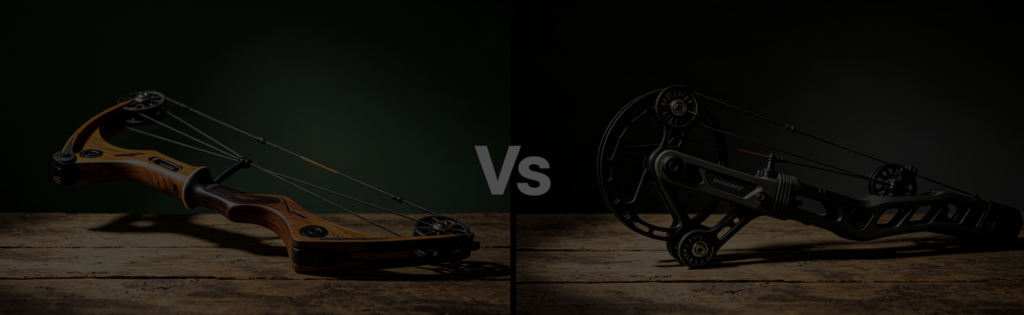
A recurve bow stores energy only by bending its limbs, so you hold the full draw weight while aiming – it is simpler, cheaper, lighter, and the standard for learning form and for Olympic target archery. A compound bow uses cams to “let off” 75-90% of the draw weight at full draw, making it easier to hold steady and shoot accurately, and it accepts sights and a release – which is why it dominates bowhunting. Choose a recurve to learn form, travel light, or shoot traditionally; choose a compound for maximum accuracy, power, and hunting.
Fletchwise guides are independent and hype-free – we are not sponsored by any archery brand.
How They Work
The core difference is mechanical. A recurve is a single pair of limbs that bend and snap back; the harder you pull, the more weight you hold, right up to the moment of release – you hold 100% of the peak draw weight the entire time you aim. A compound adds cams (pulleys) at the limb tips connected by cables. As you reach full draw, the cams roll over and drop most of the holding weight – the “let-off” – so you hold only 10-25% while you aim.
That one mechanical difference drives almost every other difference between them. Because a recurve gives you no help at full draw, it punishes hesitation: you draw, aim quickly, and release within seconds, because holding tires you. That is why recurve shooting is built around a fast, committed release rather than a long, settled aim. A compound, by contrast, lets you settle the pin and wait several seconds – through a gust of wind, through an animal taking one more step, through a moment of doubt – before you shoot. That is the core trade-off, and every spec on the comparison table below flows from it.
Side-by-Side Comparison
Recurve vs Compound at a Glance
| Factor | Recurve Bow | Compound Bow |
|---|---|---|
| Holding weight at full draw | 100% — full peak weight the whole time | 10-25% (75-90% let-off) |
| Typical arrow speed | ~180-220 fps (hunting weight) | ~280-300+ fps (real hunting setup) |
| Ease of accurate aiming | Harder — aim and release quickly, no mechanical help | Easier — hold steady, settle the pin, wait |
| Learning curve | Teaches pure form; mistakes show immediately | Faster to hit the target; hardware masks some errors |
| Complexity and maintenance | Simple — limbs, riser, string. No press needed | More complex — cams, cables, timing; needs a bow press |
| Realistic cost to start | ~$200-400 for a decent takedown + arrows + tab + guard | ~$400-600 for a ready-to-hunt package, or more parted out |
| Upgrade path | ILF riser + heavier limbs over time, no new bow | Module swap for draw length/weight, or a different bow |
| Portability | Light; takedown packs into a slim case | Compact but heavier; hard case adds bulk |
| Noise at the shot | Quieter — no cams or cables to buzz, though string slap and limb vibration still need tuning | Louder — cam and cable movement adds mechanical noise even when well tuned |
| Best for | Learning form, Olympic target, traditional shooting | Bowhunting, maximum precision, holding for the right moment |
Speed figures are for real hunting setups, not manufacturer IBO ratings. Costs are approximate US street prices as of 2026.
One caveat on the noise row: quieter is not the same as silent, and sound reaches game roughly three-quarters of a second before the arrow does regardless of which bow you shoot – at typical hunting ranges, that head start matters more than the noise gap alone would suggest. A recurve’s quiet is real, but it will not save a bad shot at an already-alert animal.
What a Recurve Teaches That a Compound Hides
The philosophical argument for starting on a recurve is not about tradition. It is about feedback. On a compound, let-off, a release aid and a sight with a peep all work together to give you a clean, repeatable shot even when your form is not particularly clean or repeatable – which is exactly the point of them, and why compounds are easier to shoot accurately. But a recurve strips all three away. If your release is inconsistent, the arrow tells you. If your bow arm collapses at the shot, the arrow tells you. If you torque the grip, the arrow tells you. Nothing hides the error.
That is why archers who learn on a recurve and later switch to a compound often find they are better compound shooters than people who started there: the compound gives them the hardware advantages, and the recurve already taught them the form. None of this means starting on a compound is wrong – plenty of excellent compound archers have never touched a recurve. But if you start on a recurve, the form habits you build carry to any bow; if you start on a compound, the habits the hardware covers for you do not carry the other way.
The Cost Question Is Not Just the Price Tag
Comparing the first purchase alone tells a misleading story. A takedown recurve costs less to start with – roughly $200-400 gets you a decent riser, limbs, half a dozen arrows, a finger tab and an arm guard, and the only thing you will ever replace is the limbs when you want to move up in weight (about $90 a set). A compound ready-to-hunt package runs closer to $400-600 and that is just the bow with basic accessories fitted; a release aid, arrows, a case and a target add more. But once you have it, a compound stays where it is, while a recurve archer may buy heavier limbs every year or two as they build strength.
The honest total-cost comparison over five years is closer than the first-receipt comparison makes it look. A recurve archer who upgrades limbs twice might spend roughly as much as a compound archer who bought a mid-range package and never changed a thing. The difference is which one spreads that cost out in smaller, voluntary lumps versus paying it mostly on day one. See our compound bow and archery bows guides for the full breakdowns on each side.
Why Only Recurve Has Been an Olympic Event - and Why That Is Changing
The comparison table above says "Olympic target" only in the recurve column, and that has been true for the entire history of archery at the Games – compound bows have never carried an Olympic medal. The reasoning is not about performance. A compound’s cams and let-off do real mechanical work a recurve does not, so allowing it into the Olympic bracket would shift the competition further toward equipment and further from the archer’s own strength and consistency, which is the standard the sport has been judged on. Cost and access play a role too: recurve equipment is cheaper and more available worldwide, which matters for a Games built around global participation.
That is changing, though, by addition rather than replacement: a compound mixed team event makes its Olympic debut at the LA28 Games in 2028 – the first Olympic medal event for compound archery, a 72-arrow qualifying round at 50 metres with 12 mixed teams, and it will actually open the archery medal schedule ahead of the recurve events. If competing on the sport’s biggest stage matters to your choice, it is no longer a reason to rule out compound – it just was one until recently.
The One That Wins Is the One You Will Actually Shoot
Every comparison table pushes you toward a clear winner. In practice, the bow that wins is whichever one gets you out to the range more often. If you pick a recurve because the internet told you it teaches better form, but you find it frustrating and stop shooting after a month, the recurve was not the right choice. If you pick a compound and spend the whole session fiddling with hardware adjustments you do not enjoy, the compound was not right either. Try both if you can, pick the one that makes you want to shoot again tomorrow, and treat everything else on this page as context rather than a verdict.
Frequently Asked Questions
Both work. A recurve is cheaper and teaches pure form, which is why clubs often start beginners on one. A compound is more forgiving to aim and gets new shooters hitting the target faster. Choose based on your goal – form and tradition (recurve) or accuracy and hunting (compound).
For most shooters a compound is easier to shoot accurately because let-off lets you hold steady and it accepts sights and a release. Skilled recurve archers are extremely accurate too, but it takes more practice to get there.
Generally yes. The power, speed, and steady hold of a compound suit the long, still moment before a shot at game, and most bowhunters use one. Recurves and traditional bows are used for hunting too, but demand more skill and shorter ranges.
Yes, in the sense that you hold the full draw weight while aiming and there is no let-off or built-in rear sight. That makes a recurve more demanding of form, which is also why it is such a good teacher.
Many archers find it does, because a recurve gives you nowhere to hide. Let-off, a release aid and a peep-sight system all clean up a less-than-perfect release and make a compound forgiving; a recurve gives you direct, immediate feedback on every form error, which trains habits that carry over. Plenty of excellent compound archers have never shot a recurve, so starting on a compound is not a mistake – but the form skills a recurve teaches are transferable in a way the compound’s hardware advantages are not.
Closer than the first receipt makes it look. A recurve kit starts at about $200-400 against a ready-to-hunt compound package at $400-600, but a recurve archer often upgrades limbs every year or two ($90 a set) while a compound archer typically buys once and stays there. Over roughly five years the totals can land in the same range – the difference is that the recurve spreads the cost in smaller voluntary steps, while the compound concentrates it on day one.
Generally yes – a recurve has no cams or cables to add mechanical noise, though string slap and limb vibration still need tuning to keep it quiet. The catch is that the advantage matters less in the field than it sounds: sound reaches game roughly three-quarters of a second before the arrow does regardless of which bow you shoot, so at typical hunting ranges the noise gap alone will not save a shot at an animal that is already alert.
Historically it has not been – only recurve has competed at the Olympics, because a compound’s cams and let-off do real mechanical work that shifts the competition toward equipment rather than the archer’s own strength and consistency, and recurve gear is cheaper and more globally accessible. That is changing: a compound mixed team event debuts at the LA28 Games in 2028, the first Olympic medal event for compound archery, and it opens the archery schedule ahead of the recurve competition.
Submit the Form to Get Our Product Catalog
What We Can Offer
- ✅ Low MOQ – from 1 piece, no minimum order
- ✅ Full customization – names, initials, club crests & team logos
- ✅ Mockup before production – see it before we make it
- ✅ Production time about 2 weeks after mockup approval
- ✅ Free remake on defects within 14 days of delivery
We reply to every inquiry within 1 business day.
Email: [email protected]
WhatsApp: +1 770 157 5807
Keep Reading
Compound Bows Guide
How let-off, cam type and axle-to-axle actually work, and every spec worth caring about before you buy.
Compound Bows GuideTypes of Archery Bows
Recurve, compound, longbow and crossbow compared side by side so you can pick the right style, not just the popular one.
Types of Archery BowsBest Compound for Beginners
Why target panic is largely a gear choice, and the fit and adjustability checklist for a first bow.
Best Compound for Beginners