
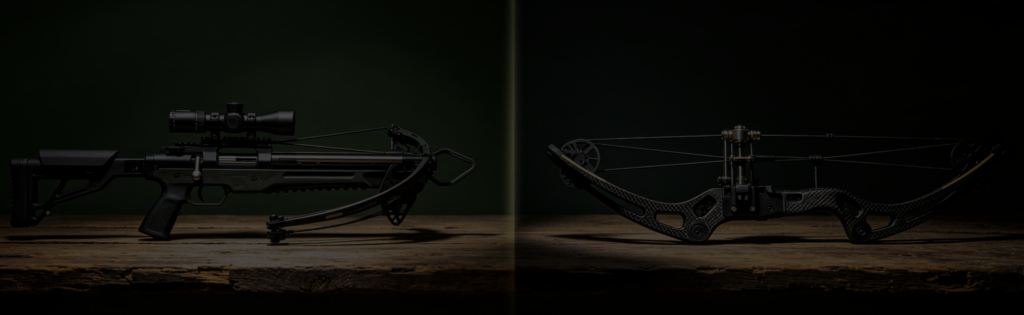
A crossbow is cocked once, held mechanically, and fired through a scope like a rifle – so it is easy to shoot accurately with little practice and requires almost no holding strength. A compound bow is drawn and aimed for each shot, demands more skill and practice, but is lighter, faster to reload, and offers a more active, traditional bowhunting experience. Choose a crossbow for rifle-like ease or physical limitations; choose a compound for a lighter, more engaging, quicker-shooting setup.
Fletchwise guides are independent and hype-free – we are not sponsored by any archery brand.
How They Differ
A crossbow mounts a short bow horizontally on a stock. You cock it once (often with a rope or crank), it stays cocked, and you aim through a scope and pull a trigger – no holding the draw. A compound is a vertical bow you draw, hold at let-off, aim, and release for every single shot. That core difference drives everything else: skill needed, reload speed, weight, and feel.
Why a 200 lb Crossbow Isn't Actually Harder to Cock Than a 60 lb Compound
The draw weight numbers look lopsided – crossbows commonly run 150-225 lbs versus 50-80 lbs for a compound – but that comparison is misleading on its own. A compound’s power stroke (the string’s travel from full draw to rest) is long, typically 18-24″, while a crossbow’s is short, only 10-14″. A short power stroke has to be driven by much more force to launch a bolt at a useful speed, which is exactly why crossbow limbs are rated so much heavier.
The reason cocking a 200 lb crossbow doesn’t feel like lifting 200 lbs is the cocking device itself: a rope cocker or crank trades force for distance, spreading that same peak weight over a much longer pull so your hands never feel the full number. Compare that to a compound, where your hand and shoulder feel the true peak weight for the first half of the draw before let-off kicks in. That is the real reason a crossbow needs almost no shooting strength while a compound does – not the weight rating, but who (or what) is absorbing it.
Because crossbow draw weight is so much higher, a well-tuned crossbow can out-energy a compound despite the shorter power stroke: a 400-grain bolt at 370 fps carries around 121 ft-lbs, versus roughly 75 ft-lbs for a 350-grain compound arrow at 310 fps. That is a real energy advantage, but it comes from raw draw weight, not superior engineering – and it is the same physics that makes crossbows the louder of the two, covered next. That extra energy also changes broadhead choice: our mechanical broadhead guide covers why crossbow hunters rarely hit the energy ceiling that limits compound shooters.
The Trade-Off Almost Nobody Advertises: Crossbows Are Louder
A crossbow shot commonly measures 80-90 decibels at the muzzle – roughly the level of heavy traffic or a window AC unit – while a well-tuned compound is closer to the low 40s. The gap comes from the same numbers above: crossbows combine much higher draw weight with shorter, stiffer limbs and typically launch a bolt at a lower grains-per-pound ratio than a compound (often under 3 gr/lb versus a compound’s 5+ gr/lb). Lighter projectile plus more stored energy means more of that energy has nowhere to go but into vibration and noise instead of the bolt.
For hunting, this matters most on a shot that doesn’t connect immediately – at real hunting distances, a loud crossbow shot can spook game before the bolt arrives, an effect compound shooters worry about far less. The practical fix is the same lever that helps accuracy too: a heavier bolt absorbs more of the stored energy into forward motion and leaves less to shake the stock, so shooting on the heavier end of your crossbow’s rated bolt weight is both quieter and more consistent.
Crossbow-Specific Safety: The Rail Is Not Optional
A cocked crossbow carries risks a vertical bow does not, because the string and cables travel horizontally along a rail instead of moving through open air. Fingers or a thumb resting anywhere near or above the rail are in the string’s path, and at crossbow speeds that contact causes serious injury – keep hands well below the rail at every stage of loading and shooting, not just at the moment of the shot.
Two more rules with no equivalent on a compound. Never leave a crossbow cocked overnight or for extended periods – the limbs are engineered for short-duration stored energy, and prolonged cocking can crack or weaken them. And never dry-fire a crossbow to uncock it; unlike easing a compound down, firing a crossbow with nothing on the string risks shattering the limbs and snapping the string back toward you. The safe way to discharge a cocked crossbow you did not end up using is to shoot a field point into a target or soft ground, the same as any normal shot.
Crossbow vs Compound at a Glance
| Factor | Crossbow | Compound Bow |
|---|---|---|
| Holding strength needed | None (cocked & held) | Draw & hold each shot |
| Learning curve | Fast – rifle-like | Steeper – real practice |
| Reload speed | Slow (re-cock) | Fast (re-nock) |
| Weight / bulk | Heavier, bulkier | Lighter, compact |
| Shots before fatigue | Many | Fewer (draw effort) |
| Experience | Rifle-like | Active, traditional |
| Draw weight | 150-225 lbs (cocking device absorbs it) | 50-80 lbs, felt at full peak |
| Power stroke | Short, 10-14″ | Long, 18-24″ |
| Shot noise | Louder, ~80-90 dB | Quieter, roughly low 40s dB |
| Regulations | Often separate rules/seasons | Standard archery seasons |
Hunting regulations for crossbows vary widely by state and season – always check local laws.
Frequently Asked Questions
Yes, for most people. A crossbow is cocked once and aimed through a scope like a rifle, so it takes little strength and minimal practice to shoot accurately. A compound must be drawn and aimed for each shot, which takes more skill.
Both are effective. Crossbows suit hunters who want rifle-like ease or have physical limits; compounds suit those who want a lighter, faster-reloading, more active setup. Local regulations may also steer the choice, since crossbow rules vary by state.
Often, yes – a well-tuned crossbow can produce more kinetic energy than a compound (roughly 121 ft-lbs from a 400-grain bolt at 370 fps versus around 75 ft-lbs from a 350-grain compound arrow at 310 fps), because crossbow draw weights run so much higher (150-225 lbs vs 50-80 lbs). But that extra energy comes from raw draw weight, not better engineering, and effective performance still depends more on tuning, bolt/arrow choice, and shot placement than on the number on the limb.
Because you never pull the full weight with just your hands. A rope cocker or crank trades force for distance, spreading that peak weight over a longer pull so it never feels like 200 lbs. A compound, by contrast, has you feel the true peak weight yourself for the first half of the draw before let-off reduces it – which is why the compound, despite its much lower rated weight, is the one that actually challenges your arms.
Yes, noticeably. A crossbow shot commonly runs 80-90 decibels versus roughly the low 40s for a well-tuned compound. The higher draw weight, stiffer limbs, and typically lower grains-per-pound bolt weight all push more leftover energy into vibration and noise rather than the projectile. Shooting a heavier bolt within your crossbow’s rated range reduces this.
Yes – crossbows are beginner-friendly because of their rifle-like operation. If you want to learn archery skills and shoot more often, though, a compound is more engaging and builds transferable technique.
No. Crossbow limbs are engineered for short-duration stored energy, and leaving one cocked overnight or for extended periods can crack or weaken the limbs. If you did not get a shot, discharge the crossbow safely by shooting a field point into a target or soft ground – never dry-fire it, which risks shattering the limbs and snapping the string back toward you.
Submit the Form to Get Our Product Catalog
What We Can Offer
- ✅ Low MOQ – from 1 piece, no minimum order
- ✅ Full customization – names, initials, club crests & team logos
- ✅ Mockup before production – see it before we make it
- ✅ Production time about 2 weeks after mockup approval
- ✅ Free remake on defects within 14 days of delivery
We reply to every inquiry within 1 business day.
Email: [email protected]
WhatsApp: +1 770 157 5807
Keep Reading
Compound vs Recurve
The real tradeoffs beyond traditional vs modern – let-off, cost, learning curve and what each teaches you.
Compound vs RecurveTypes of Archery Bows
Recurve, compound, longbow and crossbow compared side by side so you can pick the right style, not just the popular one.
Types of Archery BowsCompound Bows Guide
How let-off, cam type and axle-to-axle actually work, and every spec worth caring about before you buy.
Compound Bows Guide