
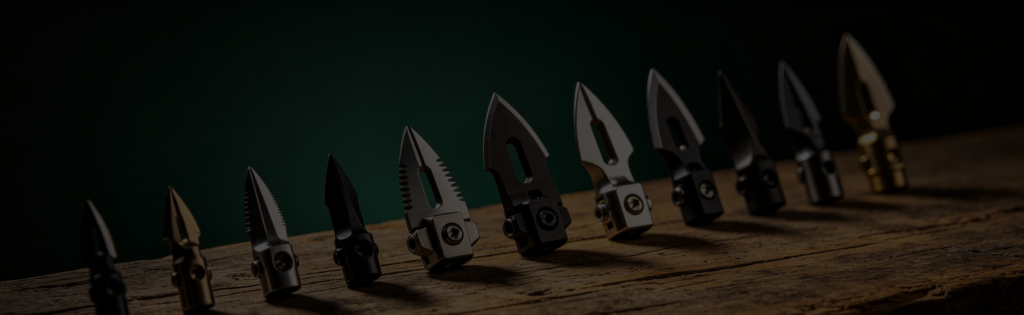
A mechanical (expandable) broadhead flies with its blades folded and opens on impact, so it groups like a field point but spends part of the arrow’s energy deploying. Commonly cited minimums are around 45 ft-lb of kinetic energy for whitetail and 55 ft-lb for elk, and the usual advice is to add roughly 10 ft-lb on top when you switch to a mechanical – some makers ask for 65 ft-lb on deer. Below about 40 lb of draw weight, most technicians steer you to a fixed blade instead. Check your regulations too: many states set a minimum cutting diameter of 7/8 inch, Iowa requires 1 inch, and Alaska bars mechanicals outright for several big-game species.
Fletchwise guides are independent and hype-free – we are not sponsored by any archery brand and we do not sell broadheads.
Broadhead rules are set by each state or province and are revised regularly – a head that was legal last season may not be this one. Treat everything below as a starting point and confirm against your state wildlife agency’s current regulations before you hunt.
How a Mechanical Broadhead Works
A mechanical, or expandable, broadhead carries its cutting blades folded against the ferrule in flight. Because almost nothing sticks out into the airflow, it behaves in flight much like a field point – which is the entire appeal. On impact the blades swing out and lock open, cutting a wound channel wider than the head could ever be if the blades were fixed.
Deployment comes in two broad styles. Over-the-top heads pivot the blades forward from the rear, while rear-deploying designs sweep them back from the tip. Both rely on some mechanism – an O-ring, clip, collar or detent – to hold the blades shut until impact. That mechanism is the part that can fail, and the reason mechanicals get inspected more carefully than a fixed blade ever needs to be.
The trade-off is unavoidable physics: opening those blades takes work, and that work comes out of the arrow’s energy budget rather than out of penetration. That is why the whole question starts with energy.
Do You Have the Energy to Run One?
This is the part most buying guides skip, and it is the part that decides whether a mechanical is a reasonable choice for you at all.
| Game | Commonly cited KE minimum | With a mechanical |
|---|---|---|
| Whitetail deer | ~45 ft-lb | ~55 ft-lb (some makers ask 65) |
| Elk, caribou | ~55 ft-lb | ~65 ft-lb |
| Under 40 lb draw weight | – | Use a fixed blade |
Forty pounds of draw weight is the usual threshold for whitetail, and it is also roughly where mechanicals stop making sense. Below it, the energy spent forcing the blades open is energy that was going to be needed to reach the vitals. Manufacturers are candid about this: several state plainly that under 40 lb you should be shooting a fixed blade.
Energy is not the only factor – arrow weight, front-of-center balance and shot placement all matter, and a heavy, well-matched arrow carries momentum that raw kinetic energy figures do not capture. But if your setup is near the line, that is the signal to stay fixed rather than to shop harder.
Crossbow Hunters Rarely Hit the Energy Ceiling
Everything above is written from a compound-bow draw weight, and if you hunt with a crossbow the energy math looks completely different. A typical 150+ lb hunting crossbow produces roughly 80-135 ft-lb at the muzzle – comfortably clear of the 55-65 ft-lb mechanical thresholds for deer and elk before the bolt has even left the rail. For most crossbow hunters, energy simply is not the limiting factor a mechanical broadhead runs into.
That does not make legality any less strict. State rules on cutting diameter and species restrictions apply to crossbow bolts exactly the same as compound arrows – a crossbow’s extra power buys you margin on the energy question, not an exemption from the regulations below.
Where Mechanicals Are Restricted
Legality is the second gate, and it catches people who assume a head sold in their local shop must be legal in their season.
- Alaska permits mechanicals for black-tailed deer, wolf, wolverine, black bear, Dall sheep and caribou – but requires a fixed or replaceable-blade head for mountain goat, moose, elk, brown/grizzly bear, musk ox and bison.
- Idaho prohibited mechanical broadheads outright until 1 July 2022, when the rule was changed to allow them – a useful reminder that these rules do move.
- Minimum cutting diameter is the most widespread rule: a large number of states require at least 7/8 inch for big game, and Iowa requires a full 1 inch. For a mechanical this is measured deployed, so a head that opens to 1.5 inches clears both easily – but a compact one may not.
- Barbed heads are broadly illegal, which is why blades must be able to withdraw the way they entered.
Industry roundups such as Wasp Archery’s state-by-state summary are a reasonable orientation, but they are not the authority – your state wildlife agency’s current regulations booklet is. Read the equipment section before the season, not after you have bought a dozen heads.
Cut Diameter, Blade Count and Grain
- Cut diameter – the width of the wound channel when deployed. Bigger cuts leave better blood trails but cost penetration, and this is the number your state regulation applies to.
- Blade count – two blades penetrate best, three cut more. More blades means more resistance, which loops back to the energy question.
- Grain weight – 100 grain is the default and matches most factory arrow setups; 125 grain moves balance forward for heavier, deeper-driving arrows. Match whatever your arrow setup was tuned around.
- Blade retention – the O-ring, clip or collar that keeps the head shut in your quiver. Inspect it every time; a head that opens in the quiver is both dangerous and useless.
Where You Should Aim Changes With the Head You Shoot
The broadhead debate usually treats shot placement as fixed and the head as the variable. In practice, the right shot placement changes depending on which head is on the arrow, because what each one does when it meets the animal is genuinely different.
There are two schools, and each pairs naturally with one broadhead type:
- The “Vital V” — tight to the front leg, a few inches above the elbow joint. The deer’s leg bones and scapula form a sideways V, and the arrow goes into the middle of it through nothing but muscle into the heart and major pulmonary vessels. This is the deadliest single place to shoot a deer — a hit here drops them inside 20 seconds and under 100 yards — but the margin on the forward side is a shoulder blade. This aim point suits fixed blades because if the shot drifts slightly high or forward into the scapula, a fixed head punches through it, while a mechanical can deploy on the bone and stop short.
- Behind the crease — a few inches behind the shoulder, into the rear lungs or liver. It is a larger target area with more margin, and the wider cutting diameter of a mechanical (up to 2+ inches) creates a more extensive wound channel and a better blood trail here. This aim point suits mechanicals because it keeps the blades away from heavy bone entirely, using the cut width to do the work rather than requiring the head to breach anything hard.
Steep quartering-toward shots are where the gap between them is widest. A fixed blade can break through the leg bone and still reach the vitals; a mechanical is almost never recommended for this angle, and a large share of experienced bowhunters say to pass on it altogether regardless of equipment.
The practical answer is not that one aim point is right — it is that the choice of broadhead also chooses which aiming mistake is cheaper. If you tend to miss slightly forward toward the shoulder, a fixed blade buys you insurance a mechanical does not. If you tend to miss slightly backward, a mechanical’s larger cut buys you a better blood trail and more forgiveness on a liver or gut hit. Pick the head that pairs with your most common miss rather than the one that won a forum thread.
The Maryland Recovery Rate Study and Why It Is Not Quite What It Looks Like
A widely circulated 2019 study from Maryland’s Naval Support Facility Indian Head tracked over 1,500 deer shot between 1989 and 2018 and reported a 90.7% recovery rate for mechanical users against 82.3% for fixed-blade users. It gets cited as proof that mechanicals kill more reliably, full stop.
It is worth being specific about what the study does and does not control for. Draw weight, arrow weight, shot distance and equipment era are all unaccounted for — the data covers three decades during which both bow and broadhead technology changed enormously, and a shooter running a modern high-energy compound with modern mechanicals is not an apples-to-apples comparison with every fixed-blade entry across that period. It is an observation, not a controlled experiment, and an 8.4 percentage point difference in a dataset that spans thirty years and does not control for the archer’s own setup is more of a data point than a verdict.
Take it as one piece of information among several rather than the closing argument. The honest read is: both types recover deer at a high rate when matched to an adequate setup and placed well, the study’s margin is real but its confounds are too, and the one you trust and can tune is going to outperform the one you read about in a study.
When a Mechanical Is the Right Call
Good fit: you shoot a modern compound comfortably above the energy thresholds, you hunt deer-sized game, you value the fact that a mechanical usually hits where your field points hit, and you have confirmed the head is legal in your state.
Poor fit: you shoot under about 40 lb, you hunt heavy-boned game like elk or moose, you hunt somewhere that restricts expandables, or you are hunting a species where a shoulder hit is likely and you want every foot-pound going into penetration.
For a direct comparison of the two designs rather than a deep dive on expandables, see our dedicated guide to fixed vs mechanical broadheads. If you are shopping rather than deciding, the broadhead roundup and the turkey-specific guide go further on individual use cases.
Never shoot broadheads into a bag target – the blades destroy it. Use a dedicated broadhead target, and shoot each head you intend to hunt with at least once to confirm it flies with your field points. See the full archery targets guide for what stops what.
Frequently Asked Questions
Commonly cited minimums are about 45 ft-lb for whitetail and 55 ft-lb for elk, with roughly 10 ft-lb added when you shoot a mechanical – so about 55 ft-lb for deer and 65 for elk. Some manufacturers ask for 65 ft-lb even on deer-sized game. These are guidelines rather than law, but if you are near the line, a fixed blade is the safer choice.
No. Alaska requires a fixed or replaceable-blade head for mountain goat, moose, elk, brown/grizzly bear, musk ox and bison, while permitting mechanicals for several other species. Idaho banned them entirely until 1 July 2022. Many states also set a minimum cutting diameter – commonly 7/8 inch, and 1 inch in Iowa. Always check your current state regulations, which change between seasons.
It is right at the edge. Forty pounds is the usual minimum draw weight for whitetail, and opening a mechanical’s blades consumes energy that a marginal setup needs for penetration. Most technicians and several manufacturers recommend a fixed blade below 40 lb. If you are at exactly 40, favor a compact two-blade mechanical or simply shoot fixed.
It happens, though it is uncommon with a well-maintained head. Deployment depends on a retention mechanism – an O-ring, clip or collar – holding the blades shut until impact and then releasing cleanly. Inspect that mechanism before every hunt, replace O-rings as the maker specifies, and never re-use a head that has already deployed unless it is designed to be rebuilt.
Mechanicals come closest, because the blades are folded in flight – that is their main selling point. Fixed blades expose surface area that can steer the arrow, so they often need tuning to group with field points. Either way, shoot the actual head you plan to hunt with before the season rather than assuming.
100 grain is the default and matches most factory arrow setups; 125 grain shifts weight forward for a heavier arrow that drives deeper. The right answer is whatever your arrow was tuned around – changing head weight changes spine behavior and point of impact, so retune if you switch.
Not into a bag target – the blades cut the woven shell and loose fill and destroy it quickly. Use a broadhead-rated foam or layered target designed to be cut rather than to grip. Shooting a mechanical into the wrong target also deploys the blades, which can ruin the head.
The head changes which aiming mistake is cheaper. The tight “Vital V” spot in line with the front leg suits fixed blades because a forward drift into the shoulder blade still penetrates, where a mechanical may not. The larger area behind the shoulder crease suits mechanicals because it avoids heavy bone and lets the wider cutting diameter do the work. Pick the aim point that pairs with your most common miss direction rather than treating the two heads as equal at every angle.
A frequently cited Maryland study tracking over 1,500 deer reported roughly 91% recovery for mechanical users against about 82% for fixed blades, but the study did not control for draw weight, arrow weight or shot distance across its thirty-year span, so it is more of a data point than a closing argument. Both types recover deer at a high rate when matched to a capable setup and placed well. The one you trust and can tune is going to outperform the one you read about in a study.
Rarely. A typical 150+ lb hunting crossbow produces roughly 80-135 ft-lb of energy – well above the 55-65 ft-lb mechanical thresholds for deer and elk – so energy is not usually the limiting factor it can be for a compound shooter near 40 lb draw weight. Legality is unaffected by the extra power, though: cutting-diameter and species rules apply to crossbow bolts the same as compound arrows.
Submit the Form to Get Our Product Catalog
What We Can Offer
- ✅ Low MOQ – from 1 piece, no minimum order
- ✅ Full customization – names, initials, club crests & team logos
- ✅ Mockup before production – see it before we make it
- ✅ Production time about 2 weeks after mockup approval
- ✅ Free remake on defects within 14 days of delivery
We reply to every inquiry within 1 business day.
Email: [email protected]
WhatsApp: +1 770 157 5807
Keep Reading
Fixed vs Mechanical
The real tradeoff between the two – not marketing claims, but recovery rates, wind drift and legal cutting diameters.
Fixed vs MechanicalArrows & Broadheads
Spine, grain weight and FOC explained as one system – and why cutting a shaft is the step you cannot undo.
Arrows & Broadheads GuideBroadhead Targets
Why the FPS rating on the label matters more for crossbow shooters than the word broadhead printed on it.
Broadhead Targets