
The arrow and the broadhead are one system, not two purchases. Here is how spine, point weight and FOC pull on each other – and why cutting shafts is the one step in the whole build you cannot take back.
Quick answer
An arrow is a shaft, a point, fletching and a nock. Two specs decide whether it flies: spine (shaft stiffness, matched to draw weight and length and point weight) and total weight, which must never fall below 5 grains per pound of draw weight – that is the manufacturer floor that protects your bow and your warranty. The catch that costs people money: point weight changes dynamic spine, roughly one spine group per 25 grains, and spine charts assume a 100-grain point. So decide your broadhead weight before you cut shafts, because you can always cut more and you can never cut less.
Fletchwise guides are independent and hype-free – we are not sponsored by any archery brand.
Cutting Is One-Way: Decide the Point Weight First
Almost every other decision in archery is reversible. Wrong sight, sell it. Wrong release, try another. Wrong rest, unbolt it. Arrow length is the exception – once a shaft is cut, the only direction left is shorter, and there is a hard floor below which you must stop.
That would not matter much if arrow length were independent of everything else. It is not. Three things push dynamic spine around, and they push against each other:
- Longer shaft = acts weaker. More unsupported length flexes more.
- Heavier point = acts weaker. Roughly one spine group per 25 grains of point weight added. Going from a 100-grain field point to a 125-grain broadhead is not a detail – it is a spine change.
- More draw weight = the shaft acts weaker relative to the force being applied.
And here is the part the spine chart does not say out loud: almost every published chart assumes a 100-grain point. If you build to that chart, cut to length, and then screw on the 125 or 150-grain broadhead you actually intend to hunt with, you have quietly moved a spine group weaker after the irreversible step.
You can fix a too-weak arrow by cutting it shorter. You cannot fix a too-stiff arrow by making it longer. So the order is not optional:
- Choose the broadhead weight first – 100, 125 or 150 grains. This is a hunting decision, not an arrow decision, and it belongs before the saw. The broadhead guide covers how energy and regulations narrow that choice.
- Run the spine chart with that point weight, not the default.
- Buy shafts full length and cut in stages – a quarter inch at a time, shooting between cuts. An arrow saw or a proper arrow cutter makes staged cutting practical; a pipe cutter does not, because carbon has to be ground through rather than pinched.
- Stop at the safety floor. At full draw the arrow must still extend past the rest – about an inch of shaft beyond it is the usual working minimum. An arrow that can come back off the rest at full draw is how people put a broadhead through their bow hand. This floor is not negotiable, and it is what caps how much you can cut your way out of a spine problem.
If you are having someone else cut your shafts, tell them the broadhead weight you are going to hunt with. Most shops cut for a 100-grain point unless told otherwise.
The Weight Floor: 5 Grains Per Pound
Total finished arrow weight – shaft, insert, point, fletching, nock, wrap, everything – must not drop below 5 grains for every pound of draw weight. This is not a preference, it is the number bow manufacturers publish as their minimum, and shooting under it is treated much like a dry fire: it can damage limbs and cams, and it typically voids the warranty.
Almost nobody breaks this by accident with a hunting arrow. It gets broken by people chasing speed with an ultralight shaft and a 75-grain point on a heavy bow.
| Draw weight | Absolute minimum arrow (5 gr/lb) | Typical finished hunting arrow |
|---|---|---|
| 40 lb | 200 grains | 330-400 grains |
| 50 lb | 250 grains | 380-430 grains |
| 60 lb | 300 grains | 400-470 grains |
| 70 lb | 350 grains | 420-500 grains |
| 80 lb | 400 grains | 450-550 grains |
Minimum column is the manufacturer floor, not a target. Most hunting builds sit comfortably above it – if yours does not, that is the finding.
FOC: Where the Weight Sits, Not Just How Much
Two arrows can weigh exactly the same and fly completely differently, because front-of-center – the share of the arrow’s weight carried ahead of its physical middle – decides how well the front end leads. More forward weight steadies a broadhead in flight and drives penetration; it also drops the trajectory, so ranging errors punish you harder.
The AMO calculation, which you can do on a kitchen table with a tape and a pencil:
- Measure L – the arrow from the throat of the nock to the back of the insert.
- Balance the finished arrow (point, insert, fletching and all) on a pencil edge. Measure A from the nock throat to that balance point.
- FOC% = 100 x (A – L/2) / L
| FOC | What it is | Trade-off |
|---|---|---|
| 7-10% | Target and indoor builds | Flattest trajectory; not enough front bias for broadheads |
| 10-15% | The standard hunting band, and where most factory arrows land | The balanced default – start here |
| 15-19% | High FOC – heavier inserts or a 150-grain head | Better broadhead flight and penetration; noticeably more drop |
| 19%+ | Extreme FOC, usually a deliberate heavy-arrow build | Rainbow trajectory; every yard of range error costs more |
Note the loop: the heavier point you add to raise FOC is the same weight that weakens dynamic spine. FOC is not a free upgrade – it is spent from the same budget.
When Broadheads Do Not Hit With Your Field Points
This is the most common complaint in bowhunting, and the most commonly mis-diagnosed. The instinct is to blame the broadhead and buy a different one. That almost never fixes it.
A field point is a smooth cone. A broadhead has blade area out front, and that area behaves like a wing: it steers the arrow in whatever direction the shaft is already pointing at launch. If your arrow leaves the bow slightly nose-left, the field point mostly ignores it and the fletching cleans it up downrange. The broadhead flies the error and plants the group off to the side.
So a broadhead group that sits apart from your field-point group is not a verdict on the broadhead – it is a readout of a tuning error you already had and could not see. Work through these in order before buying anything:
- Centre shot and nock travel – paper tune or bare-shaft tune first.
- Rest timing and clearance – a drop-away falling late will slap a vane. See the arrow rest guide.
- Spine – go back to the section above with the broadhead’s real weight in the chart.
- Broadhead alignment – spin-test each arrow on a flat surface; a head that wobbles has a bent insert or a crooked ferrule, and no amount of tuning cures it.
- Blade sharpness and rotation – resharpen fixed blades rather than replacing heads, using the sharpening guide.
There is one shortcut that appears to work and is worth naming: switching to mechanicals. They have far less steering surface in flight, so they mask the error and group closer to your field points. That is convenient, and it is why the fix gets recommended so often – but the underlying tuning problem is still there, and it will show up again at longer range or in wind. If you want the honest comparison rather than the marketing one, read fixed vs mechanical broadheads.
Practise with the same heads you hunt with, and practise into something built for it – broadheads destroy bag targets, so use broadhead targets instead.
The Parts of an Arrow
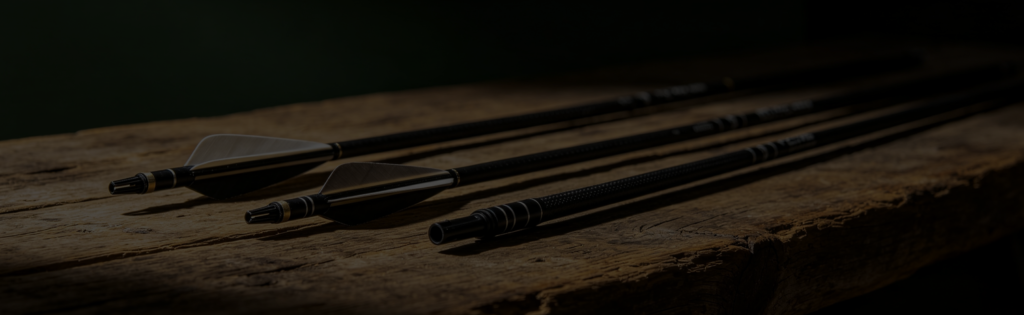
Every arrow is built from the same four components. The shaft is the body and the single biggest factor in performance. The point – a field point for practice or a broadhead for hunting – threads into an insert at the front. The fletching, three or more vanes or feathers near the back, spins and stabilises the arrow in flight. The nock is the slotted plastic tip that snaps onto the bowstring. The insert is worth naming separately, because it is the cheapest way to change FOC without changing your broadhead weight.
Choosing an Arrow Shaft
Material
Carbon is the modern standard – light, strong, consistent, and durable. Aluminum is cheaper and very straight but bends more easily, and a bent aluminum shaft is finished. Carbon-aluminum hybrids are premium target and hunting shafts. Wood and bamboo are for traditional bows. For most archers, carbon arrows are the best all-round choice.
Spine
Spine is how much the shaft flexes – the most important arrow spec, and confusingly a lower number means a stiffer shaft. It must be matched to your draw weight, your arrow length and your point weight together, using the maker’s chart. The table below is a starting point only, and it assumes a 100-grain point.
Weight (GPI)
Grains-per-inch is the shaft’s own weight per inch, and it is how you steer total arrow weight. Heavier arrows carry more momentum, penetrate better and are quieter; lighter arrows fly flatter and faster. Hunters generally favour weight, target archers favour speed – and everyone stays above the 5 gr/lb floor.
Diameter
Micro-diameter shafts are marketed hard on wind drift and penetration, and the physics behind the claim is real but smaller than the marketing suggests. Going from a 5mm to a 4mm shaft measures out to roughly a 5% reduction in wind drift – genuine, but your vanes and broadhead profile influence wind drift more than 1-2mm of shaft diameter does. Penetration is similarly oversold: once a broadhead has already cut the hole, the shaft is mostly following that channel through soft tissue, so the diameter advantage that shows up on a foam target is harder to see on an animal. The trade you are actually making is practical, not ballistic – standard-diameter shafts tune more forgivingly and have more insert and component options, while micro-diameter shafts are pickier to tune and often need proprietary inserts. Buy diameter for fit with your rest and components, not for a penetration edge the marketing overstates.
Choosing a Broadhead
The two families are fixed-blade (blades permanently open – tough, fewer failure points, less forgiving of a poorly tuned bow) and mechanical or expandable (blades closed in flight, opening on impact for a wider cut, at the cost of moving parts and some energy spent deploying them). Which one you can responsibly shoot is partly an energy and regulations question, not a preference – the broadhead guide works through the thresholds, and how to choose a broadhead covers what to look for in the head itself.
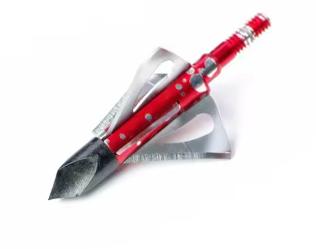
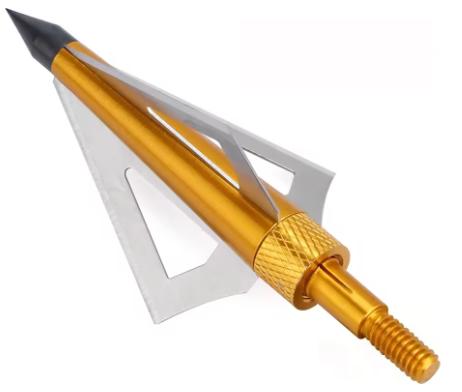
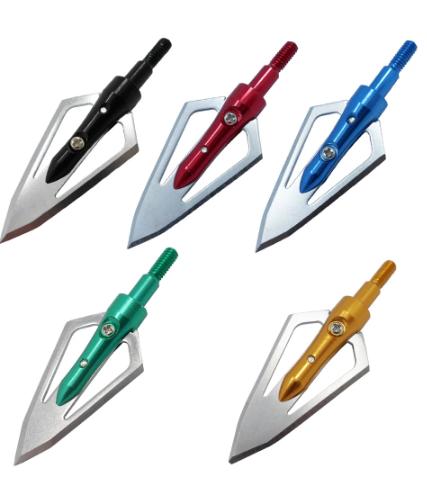
Turkey is the exception worth reading separately: the vital zone is roughly softball-sized, so turkey broadheads are chosen for cut width rather than penetration.
Explore Our Arrow & Broadhead Guides
- Arrows for a compound bow – matching spine and length to your setup.
- Broadheads explained – fixed vs mechanical and how to choose.
- Fixed vs mechanical – the head-to-head, without the marketing.
- How to sharpen a broadhead – getting fixed blades shaving-sharp again.
- Carbon arrows – why they are the modern standard and how to pick a spine.
- Arrow saws – cut your shafts to the right length cleanly.
- Broadhead targets – what to practise into once the field points come off.
| Draw weight | Starting spine (100 gr point) | If you run a 125 gr head | If you run 150 gr |
|---|---|---|---|
| Under 40 lb | 500-600 | Move one group stiffer | Two groups stiffer |
| 40-50 lb | 400-500 | Move one group stiffer | Two groups stiffer |
| 50-60 lb | 340-400 | Move one group stiffer | Two groups stiffer |
| 60-70 lb | 300-340 | Move one group stiffer | Two groups stiffer |
Starting points only, and they assume a mid-range draw length. Longer arrows act weaker too. Always confirm on the shaft maker’s own chart with your real draw length and real point weight before you cut.
The mistake that cannot be undone
Buying a dozen shafts, cutting them all to length on day one, and then deciding which broadhead to hunt with. You can cut a weak arrow stiffer, but you cannot make a short arrow longer, and the safety floor – about an inch of shaft past the rest at full draw – is where cutting stops being an option. Decide the head, then cut, and cut one shaft first.
Frequently Asked Questions
What spine arrow do I need for my draw weight?
As a starting point with a 100-grain point: under 40 lb use a 500-600 spine, 40-50 lb a 400-500, 50-60 lb a 340-400, and 60-70 lb a 300-340. Remember that a lower spine number means a stiffer shaft. Longer arrows and heavier points both act weaker, so run the shaft maker’s own chart with your real draw length and the point weight you will actually hunt with – most charts default to 100 grains and will quietly under-spine you if you shoot a 125 or 150-grain head.
Does broadhead weight change arrow spine?
Yes, and this is the step most builds skip. Adding point weight makes a shaft behave weaker in dynamic spine – roughly one spine group per 25 grains. Moving from a 100-grain field point to a 125-grain broadhead is about a one-group change, and 150 grains is about two. Since published spine charts assume a 100-grain point, choose your broadhead weight before you select and cut shafts, not after.
How light can my arrow be?
Never below 5 grains of total finished arrow weight per pound of draw weight – so 350 grains on a 70 lb bow, 300 on a 60 lb bow. That is the floor bow manufacturers publish; going under it is treated much like a dry fire, can damage limbs and cams, and usually voids the warranty. Most hunting arrows land well above it, between about 400 and 500 grains. The floor gets broken by chasing speed with an ultralight shaft and a light point.
Why don't my broadheads hit with my field points?
Because the broadhead has blade area at the front that acts like a wing and steers the arrow in whatever direction it is already pointing at launch, while a field point largely ignores that error. A separated group is therefore a readout of an existing tuning problem, not a bad broadhead. Check centre shot and nock travel by paper or bare-shaft tuning, check rest timing and vane clearance, re-check spine with the broadhead’s real weight, and spin-test each head for a bent insert. Switching to mechanicals hides the symptom rather than fixing it.
What is arrow FOC and what should mine be?
Front-of-center is how much of the arrow’s weight sits ahead of its physical middle. Calculate it as FOC% = 100 x (A – L/2) / L, where L is the arrow from nock throat to the back of the insert and A is the distance from the nock throat to the balance point of the finished arrow. About 10-15% is the standard hunting band and where most factory arrows sit; 15-19% is high FOC for better broadhead flight and penetration; above 19% is a deliberate heavy-arrow build with a much steeper trajectory. Remember the weight you add up front to raise FOC also weakens dynamic spine.
Should I shoot 100 or 125 grain broadheads?
Both kill cleanly with good placement, so decide on the build rather than the head. 100 grains suits lighter setups and gives a flatter trajectory; 125 or 150 adds front-of-center for penetration and steadier broadhead flight, at the cost of drop – and requires a stiffer shaft. The decision that matters is making it before you cut shafts, and then practising with the same weight you hunt with so field points and broadheads share a point of impact.
How short can I cut my arrows?
Until the safety floor: at full draw the arrow must still extend past the rest, with roughly an inch of shaft beyond it as a working minimum. An arrow that can slip back off the rest at full draw is how a broadhead ends up in a bow hand. Because you can only ever cut shorter, buy shafts full length, cut a single test shaft in quarter-inch stages, and shoot between cuts before committing the rest of the dozen.
Does arrow diameter really affect penetration?
Less than marketing suggests. Micro-diameter shafts do cut wind drift measurably – roughly 5% less than a 5mm shaft when you drop to 4mm – but vanes and broadhead profile influence wind drift more than 1-2mm of shaft diameter does. On an actual animal the shaft is mostly following the channel the broadhead already cut through soft tissue, so the penetration edge that shows up on a foam target is harder to see in the field. Standard-diameter shafts also tune more forgivingly and have more insert options; buy diameter for component fit, not for a penetration advantage the marketing overstates.
Submit the Form to Get Our Product Catalog
What We Can Offer
- ✅ Low MOQ – from 1 piece, no minimum order
- ✅ Full customization – names, initials, club crests & team logos
- ✅ Mockup before production – see it before we make it
- ✅ Production time about 2 weeks after mockup approval
- ✅ Free remake on defects within 14 days of delivery
We reply to every inquiry within 1 business day.
Email: [email protected]
WhatsApp: +1 770 157 5807