
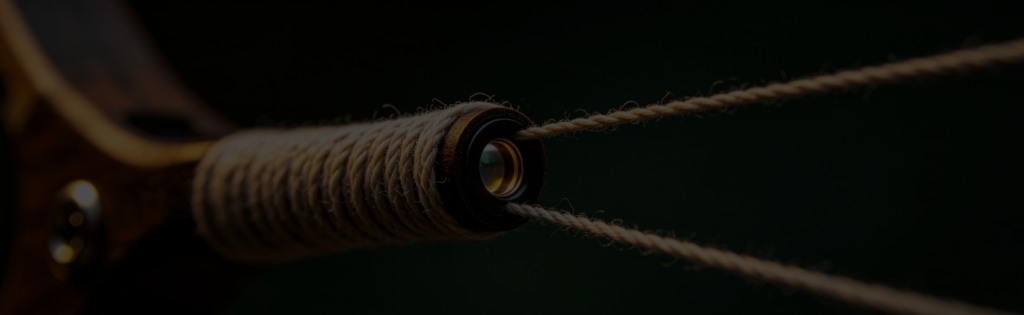
A peep sight is a small aperture set into the bowstring that gives you a rear reference, so your eye lands in the same place every draw. Size it to your sight housing rather than by preference: housings under about 1.75 inches pair with a 3/16 inch peep or smaller, housings of 2 inches or more with a 1/4 inch. Bigger apertures pass more light for dawn and dusk; smaller ones sharpen the sight picture. If the peep does not face you at full draw, do not buy another one – a new string needs roughly 100 shots to settle, and after that the fix is twisting the string or rotating the D-loop.
Fletchwise guides are independent and hype-free – we are not sponsored by any archery brand and we do not sell peeps.
What a Peep Sight Does
A bow sight is only the front half of aiming. It tells you where the bow is pointed, but not whether your head is where it was last time. The peep supplies that missing reference – the same job the rear sight does on a rifle.
Look through the peep, center your sight housing inside it, put the pin on the spot, and you have three points in a fixed relationship. Remove the peep and the third point disappears: your anchor can drift half an inch and the pin will still look correct while the arrow goes somewhere else.
That is why a cheap peep set correctly beats an expensive sight set on top of a bad one, and why peep problems show up as mystery accuracy problems.
Peep Size Is Decided by Your Sight Housing
Most guides tell you to balance light against precision and leave you there. There is a more useful rule: the peep should frame your sight housing, so the housing diameter decides the size.
| Sight housing | Peep aperture | Effect |
|---|---|---|
| Under about 1.75″ | 3/16″ or smaller | Sharper sight picture; less forgiving in low light |
| 2″ or larger | 1/4″ | More light for dawn and dusk; slightly looser alignment |
| Target shooting, good light | Smaller end of the range | Precision is worth more than brightness |
| Hunting first and last light | 3/16″ to 1/4″ | A peep you cannot see through is worth nothing |
The failure mode is real: hunters who size down for a crisp target picture then find that at legal shooting light they are staring into a black hole. If you hunt the edges of the day, err large. If you shoot targets in daylight, err small.
Peep Rotation Is a String Problem
A peep that sits square at rest but turns away from your eye at full draw is the single most common peep complaint – and buying a different peep almost never fixes it.
First, check whether the string is broken in. The usual cause is new string fibers still stretching and settling. A fresh string needs roughly 100 shots before it stops moving. Chasing rotation before that means you will only have to redo it.
Once the string has settled, work through these in order:
- Twist the string. Add half a twist at a time in the direction the peep needs to turn, and check at full draw. The goal is not a peep that looks straight at rest – it is a peep that does not change position between rest and full draw.
- Rotate the D-loop. If the peep sits left, hold the serving and push the D-loop knots right; if it sits right, rotate the loop left. Small corrections only.
- Move single strands. Rather than twisting the whole string, shift individual strands from one side of the peep to the other, keeping the count even on each side.
- Do it properly in a press. The clean version is to set peep height first, put the bow in a bow press, twist the top and bottom of the string until the peep is right, then set the D-loop to match.
If it still will not hold, the string itself may be the problem rather than your adjustment – a poorly built or worn string can keep creeping.
Peep Height: Set It With Your Eyes Closed
Peep height is where most people quietly go wrong, because they set it while looking at it. Drawing back and then hunting for the peep with your head means you have moved your anchor to suit the peep, which defeats the point of having one.
Do it the other way round. Come to full draw with your eyes closed, settle into a natural, repeatable anchor, then open your eye. Wherever the peep is relative to your sight housing is the error you need to correct – move the peep, not your head. Repeat until the housing sits centered without you searching for it.
Anchor is the reference the whole system hangs on, which is why it appears near the top of the list on our bow sight guide as a cause of missing that no sight can fix.
Self-Aligning vs Tube Peeps
Self-aligning peeps rely on the string being twisted so the peep naturally faces you at full draw. Nothing attaches to the bow, so there is nothing to fail. This is the standard modern setup and what most shops will fit.
Tubed peeps use a length of surgical tubing running to the limb or cable to pull the peep straight as you draw. They solve rotation mechanically, which is why they persist on some setups. The trade-offs are that the tubing perishes, can snap, and sits between the string and your face when it does. Many shooters and shops have moved away from them for that reason.
If you can get a self-aligning peep to behave with a properly twisted, broken-in string, that is the simpler and more reliable answer.
Installation
- Have the bow pressed, or have a shop do it – the string has to be separated to seat the peep.
- Split the string strands evenly and set the peep between them, keeping the strand count equal on each side.
- Set rough height from your anchor, using the eyes-closed method above.
- Serve the peep in once you are confident in the height. Serving too early means undoing it.
- Shoot it in and re-check after about 100 shots, when the string has settled.
We do not sell peeps and there are no affiliate links here. Fitting a peep needs the string separated, which on a compound means a press – if you do not own one, this is a job worth handing to a shop rather than improvising.
Frequently Asked Questions
It gives you a rear aiming reference set into the bowstring, the same job a rear sight does on a rifle. Looking through it and centering your sight housing inside it fixes the position of your eye, so your anchor is repeatable rather than approximate. Without one, your head can drift and the pin will still look correct.
Size it to your sight housing. Housings under about 1.75 inches pair with a 3/16 inch peep or smaller; housings of 2 inches or more suit a 1/4 inch. Beyond that, larger apertures pass more light for dawn and dusk while smaller ones sharpen the sight picture. If you hunt the first and last half hour of light, err on the larger side.
Nearly always the string rather than the peep. A new string is still stretching and needs roughly 100 shots to settle, so alignment moves. After that, add half twists to the string in the direction the peep needs to turn, or rotate the D-loop slightly. The goal is a peep that does not change position between rest and full draw.
With your eyes closed. Draw, settle into a natural anchor, then open your eye and see where the peep sits relative to the sight housing – then move the peep to match, not your head. Setting it while looking teaches you to distort your anchor to find the peep, which removes the benefit of having a peep at all.
They solve rotation mechanically by pulling the peep straight with surgical tubing, which is a real advantage on a string that will not behave. But tubing perishes and can snap, and it sits between the string and your face. Most shooters now prefer a self-aligning peep on a properly twisted, broken-in string.
You can, and some hunters deliberately do for low-light shooting, but you give up the rear reference that makes anchor repeatable. Alternatives such as anchor-reference sights exist. For most shooters, most of the time, a correctly sized and correctly set peep is the cheaper and more consistent answer.
The bow has to be pressed so the string strands can be separated, the peep seated between an even number of strands, the height set from your anchor, and the peep served in once you are sure. Then shoot it in and re-check after about 100 shots. Without a press, this is a shop job.
Submit the Form to Get Our Product Catalog
What We Can Offer
- ✅ Low MOQ – from 1 piece, no minimum order
- ✅ Full customization – names, initials, club crests & team logos
- ✅ Mockup before production – see it before we make it
- ✅ Production time about 2 weeks after mockup approval
- ✅ Free remake on defects within 14 days of delivery
We reply to every inquiry within 1 business day.
Email: [email protected]
WhatsApp: +1 770 157 5807
Keep Reading
Bow Sights
Single-pin vs multi-pin by shot distance, and why pin diameter matters more than pin count.
Bow SightsBowstrings
When to actually replace a string, and why creep (permanent) and stretch (recoverable) are two different problems.
BowstringsBow Accessories Guide
The order you buy accessories in decides what you pay twice for – draw length first, stabilizer last.
Bow Accessories Guide