
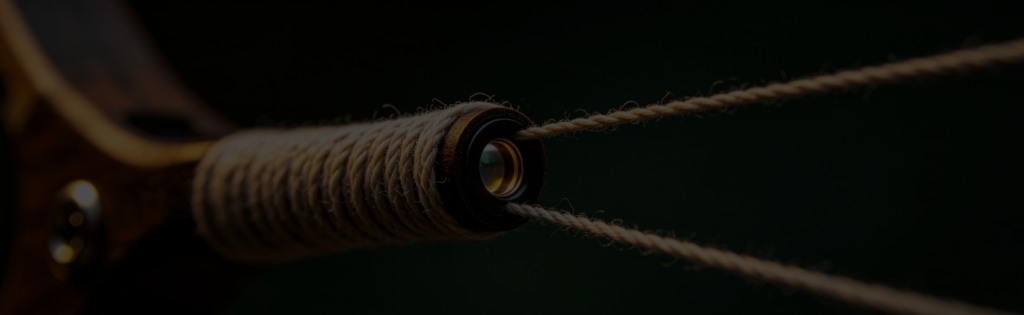
A compound bow string (and its cables) should be replaced roughly every 2-3 years of regular use, or sooner if you see fraying, fuzzing, separating strands, serving gaps, or stretching that changes your peep alignment and draw length. Quality strings use modern materials (like BCY fibers) and are well-served and pre-stretched so they hold tune. Replacing a compound string requires a bow press, so most archers have a shop do it – then re-tune.
Fletchwise guides are independent and hype-free – we are not sponsored by any archery brand.
Signs Your String Needs Replacing
- Fraying or fuzzing along the string or cables.
- Separating or broken strands.
- Serving separation – gaps in the wrapped serving, especially around the nock or cam.
- Peep rotating or moving, or your peep no longer lining up – a sign of stretch.
- Draw length or let-off feeling off as the string creeps.
- Wax gone / dry, dull string.
How Often to Replace
As a rule of thumb, plan on a new string and cables every 2-3 years with regular shooting, and sooner for heavy use or any visible damage. Strings stretch and wear with every shot, slowly shifting your tune – so even a string that looks okay benefits from replacement on a schedule if you shoot a lot.
What to Look For in a Replacement
- Quality fibers (e.g. BCY material) that resist stretch and creep.
- Pre-stretched, well-served strings that hold tune out of the box.
- Correct length and strand count for your exact bow model.
- Matched set – replace string and cables together for consistent tune.
Maintenance Between Replacements
Wax the string regularly (not the served sections) to keep the fibers protected and resist fraying, and inspect it before each session. Good maintenance extends string life and keeps your bow shooting consistently. Replacing a string requires a bow press and a re-tune.
Creep vs Stretch: Only One of These Fixes Itself
“Resist stretch and creep” gets printed on every string label, but they are two different problems and only one goes away. Stretch is recoverable elasticity in the braid – it is why a new string needs roughly 100 shots to settle, as our peep sight guide covers, and a bit of it is not a flaw; it is part of what makes a string shoot quiet and fast. Creep is different: it is permanent, non-recoverable elongation of the fiber itself under sustained tension, and it keeps happening slowly for the life of the string, not just during break-in. Creep is what shows up months later as a slightly longer draw length, a shifted let-off, or a peep that has rotated again after you thought it was settled. This is also exactly what “quality fiber” is actually buying you: blends built around low-creep materials such as Vectran (used in blends like BCY’s 450 Plus and 452X) hold their length under tension far better than cheaper braids – the real reason a name-brand string costs more than a generic one, not the color options.
Heat Is a Separate Threat to Your Tune
Creep happens slowly over months regardless of temperature; heat can shift your tune far faster than that. Modern string and cable material is ultra-high-molecular-weight polyethylene, and under tension it stretches measurably more at high temperature than at room temperature – which is why a bow left in a hot truck bed or a car trunk in direct summer sun can come out of storage shooting differently than it did going in, even with a string that is nowhere near due for replacement. Archers who sight in during summer and hunt into near-freezing weather sometimes see the same effect in reverse. The fix is not a different string – it is keeping the bow out of extreme heat when you can, and re-checking your sight tape or group after any big temperature swing rather than assuming the last zero still holds.
Specific string picks are coming as our shop launches. For now, replace on a 2-3 year schedule or at the first signs of wear, choose a quality matched set for your bow, and re-tune after install.
Frequently Asked Questions
Roughly every 2-3 years with regular use, or sooner if you see fraying, separating strands, serving gaps, or stretch that shifts your peep and draw length. Heavy shooters should replace more often.
Look for fuzzing or fraying, broken or separating strands, serving separation, a peep that rotates or no longer lines up, and changes in draw length or let-off. Any of these means it is time for a new string.
It requires a bow press to safely relax the limbs, plus re-tuning afterward. Unless you have a press and the know-how, most archers have a shop replace and tune the string and cables.
Wax the non-served sections regularly, store the bow out of heat and sun, and inspect before each session. Good maintenance slows fraying and keeps the string holding tune.
Stretch is recoverable elasticity in the braid that settles out over a new string’s first roughly 100 shots. Creep is permanent, non-recoverable elongation of the fiber under sustained tension that continues slowly for the string’s whole life – it is what causes draw length, let-off, and peep alignment to drift months after a string is broken in. Quality low-creep materials (like Vectran blends) resist this better than cheap fiber.
Yes. Modern high-modulus polyethylene string material stretches measurably more at high temperature than at room temperature, so a bow left in a hot truck bed or car trunk in direct sun can shoot differently afterward, even with a string in good condition. Re-check your zero after any large temperature swing rather than assuming it still holds.
Submit the Form to Get Our Product Catalog
What We Can Offer
- ✅ Low MOQ – from 1 piece, no minimum order
- ✅ Full customization – names, initials, club crests & team logos
- ✅ Mockup before production – see it before we make it
- ✅ Production time about 2 weeks after mockup approval
- ✅ Free remake on defects within 14 days of delivery
We reply to every inquiry within 1 business day.
Email: [email protected]
WhatsApp: +1 770 157 5807
Keep Reading
Bow Press
What a press actually does, and the honest math on whether it pays for itself on string changes alone.
Bow PressPeep Sights
Sizing to your sight housing, fixing rotation at the string rather than the peep, and setting height correctly.
Peep SightsBow Accessories Guide
The order you buy accessories in decides what you pay twice for – draw length first, stabilizer last.
Bow Accessories Guide