
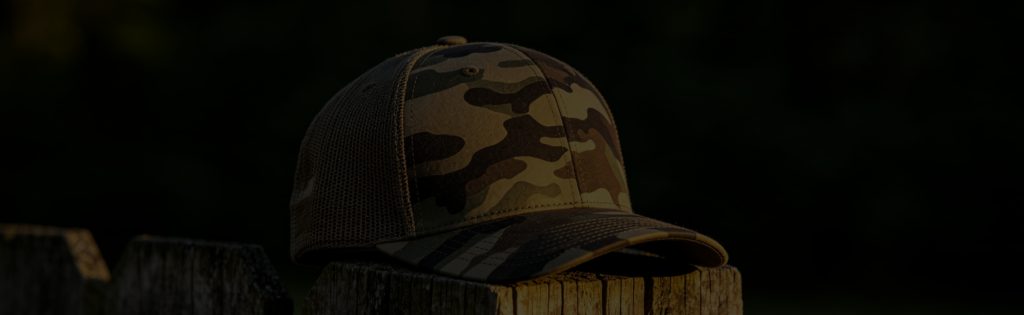
Deer have dichromatic vision – effectively red-green colorblind, seeing mostly blues and greens – so the specific colors in a camo pattern matter far less than hunters assume. What deer are good at is detecting shape, contrast and movement, and what they see unusually well is ultraviolet, because they lack the UV filter human eyes have. That makes the detergent you wash the cap in more consequential than the pattern printed on it: standard laundry detergents contain optical brighteners that fluoresce under UV and can make a garment glow to a deer. A cap’s real jobs are breaking up the round outline of your head, shading your face, and covering the movement your head makes. Any pattern in the right tone does that.
Fletchwise guides are independent and hype-free – we are not sponsored by any apparel brand and we do not sell clothing.
What a Deer Actually Sees
Whitetail vision is built for a prey animal at dawn and dusk, and it differs from ours in three ways that all matter here.
Two color receptors instead of three. Deer are dichromatic and are essentially red-green colorblind, perceiving the world mostly in blues, yellows and greens. Blaze orange, the thing that keeps you visible to other hunters, is largely invisible to a deer as a color – which is the practical reason orange and archery camo coexist without contradiction.
No UV filter. Human eyes filter ultraviolet; deer eyes do not, which helps their low-light vision enormously. The side effect is that anything fluorescing in UV is conspicuous to them in a way it simply is not to us. You cannot see the problem by looking at your own cap.
Excellent motion and contrast detection, poor detail. Deer resolve fine detail worse than we do but detect movement and hard edges far better, and across a wider field of view. That is why the advice that actually works is about staying still and breaking your outline, not about which brand of pattern you bought.
The Detergent Problem
Here is the part that almost no one selling camo will lead with, because it reframes their product as the less important half of the system.
Most household laundry detergents contain optical brighteners – chemicals that absorb UV and re-emit it as visible light, making fabric look “brighter than white” to human eyes. They work by fluorescing. To an animal with no UV filter, a garment treated with them can stand out sharply, particularly in the low-angle light of early morning and late evening when you most want to be invisible.
The consequence is blunt: you can spend real money on a technical camo pattern and then wash it in supermarket detergent and be more visible than you were before. And a cap is the worst garment for this to happen to, because it sits at the top of your silhouette, at the height a deer scans, and it is the part of you that moves most as you look around.
The fix is cheap. Wash hunting clothing in a UV-free detergent (they are sold specifically for this), or in an unscented free-and-clear product without brighteners, and skip fabric softener. Air dry rather than using dryer sheets. If you have been washing a cap normally for years, that is worth correcting before you buy a new one.
What the Cap Is Actually For
| Job | How much it matters | What decides it |
|---|---|---|
| Breaking the round outline of a head | High | Any disruptive pattern in the right tonal range |
| Shading the face | High | Brim length and a matte, non-reflective underside |
| Not fluorescing under UV | High | Your detergent, far more than the garment |
| Staying silent when you turn your head | Medium | Soft brushed fabric, no crinkly shell, no velcro strap |
| Warmth or sun protection | Medium – season dependent | Beanie versus brimmed cap, fabric weight |
| Matching the exact pattern of your jacket | Low | Marketing. Tone matters, pattern matching does not |
The last row is the one worth internalising. Buying a cap because it matches your jacket’s pattern name is a merchandising outcome, not a hunting one. What matters is that the cap’s overall tone suits the environment you sit in – light and grey for late-season hardwoods, greener for early season, brown-dominant for oak leaf litter – and that it disrupts the smooth curve of your head.
Turkeys Are a Different Animal
If you are hunting turkeys rather than deer, throw out the color reasoning above. Turkeys have excellent color vision, including into the UV range, and they detect movement extraordinarily well at close range – which is the range turkey hunting happens at. Full facial cover, gloves and absolute stillness matter far more for turkeys than for deer, and a brimmed cap alone is not enough concealment when a bird is at 20 yards looking straight at you.
The other turkey-specific rule is safety: never wear red, white or blue in the turkey woods, because those are the colors of a gobbler’s head and another hunter may react to them. That constraint has nothing to do with the bird’s vision and everything to do with the other people out there.
Choosing One
Given all of the above, the sensible buying order is: fabric behaviour first, tone second, pattern last.
Fabric. Quiet when it brushes against a collar or a stand rail, and matte rather than sheened. A cap that rustles every time you turn your head is working against you at precisely the moment a deer is looking. Brushed cotton, wool and soft synthetics are quiet; crisp shell fabrics are not.
Brim. Long enough to shade the face and cut glare from your eyes, short enough not to foul your bowstring or your sight picture at full draw. This is a real and underrated conflict for bowhunters – test the cap at full draw before you take it out, because discovering it at the shot is the wrong time.
Fit and hardware. Snug enough not to shift when you turn, with no plastic snapback that clicks and no velcro that rips loudly when adjusted. Consider whether it fits under a hood.
Tone. Match the environment and the season, not the jacket. Two caps in different tonal ranges do more for you than one expensive one.
For the wider clothing system – layering, scent, and the base and mid layers that do most of the concealment work – see our hunting apparel guide. And if you are bowhunting, remember that clothing bulk at the arms is its own problem: our page on the archery arm guard covers why a hunter’s arm guard is mostly about compressing a sleeve rather than protecting skin.
No affiliate links on this page. Blaze orange requirements vary by state and by season, including for archery hunters in some jurisdictions – check your state regulations before choosing headwear, because that requirement overrides every concealment consideration here.
Frequently Asked Questions
They see the pattern, but not the colors the way you do. Deer are dichromatic – effectively red-green colorblind – so they perceive mostly blues, yellows and greens. What they are genuinely good at is detecting shape, contrast and movement, which is why breaking your outline and staying still matter far more than which pattern you chose.
Yes, and it is probably the highest-value change most hunters can make. Standard detergents contain optical brighteners that fluoresce under UV, and deer have no UV filter in their eyes, so treated fabric can appear to glow to them – especially in low-angle morning and evening light. Use a UV-free hunting detergent or an unscented free-and-clear product, skip fabric softener and dryer sheets.
No. Pattern matching is a merchandising idea, not a concealment one. What matters is that the cap’s overall tone suits your environment and season and that it disrupts the round outline of your head. Two caps in different tonal ranges are more useful than one expensive matched piece.
Because their two-receptor vision is weakest exactly where orange and red sit. Blaze orange registers to a deer as a muted, low-contrast tone rather than the alarm color it is to us – which is why hunter safety requirements and effective concealment are not in conflict. Check your state’s blaze requirements, which can apply to archery seasons too.
Very. Turkeys have excellent color vision including into UV, and they detect movement superbly at the close ranges turkey hunting happens at. Full facial cover, gloves and stillness matter far more than for deer, and a brimmed cap alone is not enough. Also never wear red, white or blue in the turkey woods – those are gobbler head colors and it is a safety issue with other hunters.
Quiet matte fabric that does not rustle when you turn your head, and a brim long enough to shade your face but short enough that it does not foul your string or sight picture at full draw. Test it at full draw before you hunt in it. Avoid noisy velcro adjusters and clicky plastic snapbacks.
Mostly for fabric behaviour rather than the pattern – quiet, matte, well-fitting material is worth paying for, and the print is not. Spend the difference on a UV-free detergent and a second cap in a different tonal range before you spend it on a premium pattern name.
Submit the Form to Get Our Product Catalog
What We Can Offer
- ✅ Low MOQ – from 1 piece, no minimum order
- ✅ Full customization – names, initials, club crests & team logos
- ✅ Mockup before production – see it before we make it
- ✅ Production time about 2 weeks after mockup approval
- ✅ Free remake on defects within 14 days of delivery
We reply to every inquiry within 1 business day.
Email: [email protected]
WhatsApp: +1 770 157 5807
Keep Reading
Hunting Apparel Guide
Layering, scent control and camo pattern choice for staying hidden, warm and quiet on a long sit.
Hunting Apparel GuideArchery Arm Guard
Sizing, materials, and why string slap is really about elbow rotation and grip, not skin toughness.
Archery Arm GuardTurkey Broadheads
Why cutting diameter matters more than any other spec on a bird with a softball-sized vital zone.
Turkey Broadheads