
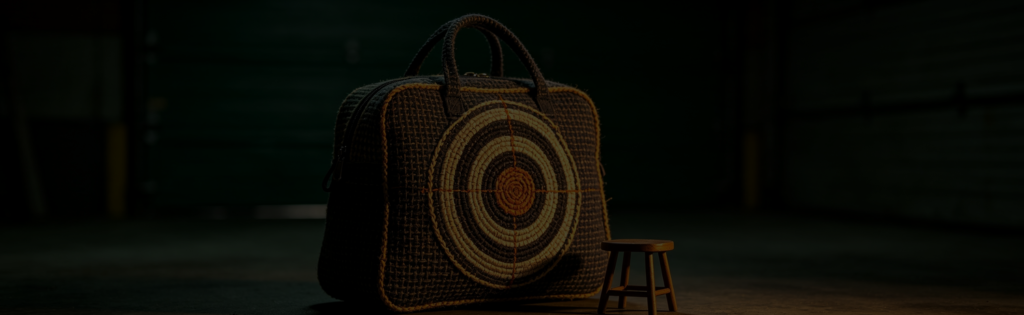
A large archery target gives you a bigger catching face, which helps beginners building form, anyone practicing at longer ranges, and groups or families shooting together. The trade-offs are weight and price – big targets are heavy and harder to move. Choose a large bag or block target rated for your draw weight, with a sturdy build and (for bags) a strong handle or hanging point. For broadheads, make sure the large target is broadhead-rated.
Fletchwise guides are independent and hype-free – we are not sponsored by any archery brand.
When You Need a Large Target
- Beginners – a big face catches off-center shots and keeps arrows out of the dirt while you build form.
- Long-range practice – groups open up at distance, so a larger face means fewer fliers lost.
- Families or clubs – multiple shooters and multiple aiming spots fit on a bigger target.
- Broadhead tuning – extra surface lets you space groups out (use a broadhead-rated target).
What to Look For
- Draw-weight rating – match it to your bow; bigger does not automatically mean more stopping power.
- Build & handle – large targets are heavy; look for a tough shell and a strong handle or hanging system.
- Multiple faces / spots – more aiming points spread the wear over a big surface.
- Field points vs broadheads – a large bag is field-points-only; choose a large foam/block target for broadheads.
- Storage space – make sure you can store and move it; big targets need room.
Big Target, Same Rules
Size adds catching area, not magic stopping power. A large target still has to be rated for your draw weight to avoid pass-throughs, and a large bag still cannot take broadheads. Place it against a solid backstop and replace it when the center wears out, just like any target.
How Much Space Multiple Shooters Actually Need
“Bigger target, more people” undersells what is really going on – spacing between shooters is a safety rule, not a courtesy. NFAA range guidelines call for lanes roughly 10 feet wide on outdoor lines, widening to about 15 feet where beginners or kids are shooting, because a lane has to contain the lateral drift of a missed arrow, not just fit a stance. Even tight indoor competition spacing – sometimes as little as 24 inches per archer – is a formalized minimum for trained shooters at a fixed distance, not a template for a backyard or a mixed-skill group. If you are setting up one large target for several people, treat each aiming spot as needing its own lane-width buffer on the sides, not just its own square foot of target face – a wider target that lets everyone bunch shoulder-to-shoulder is not actually solving the spacing problem.
That lane width only covers the sideways risk. A large target does not reduce how much clear space you need behind it either – our how to pick a target guide covers the 25-30 yard depth buffer a home range needs beyond any target, large or small.
Why "Large" Gets Heavy Fast
Target weight does not scale the way the size number suggests. A flat target’s face area scales with the square of its width and height at the same thickness – double both dimensions and you roughly quadruple the material, and therefore roughly quadruple the weight, even though it just sounds like “one size up.” Many XL and oversized targets also step up in thickness or density on top of that, because a bigger face usually means people are shooting from farther back too, and the target needs more depth to stop a slower, more spread-out arrow, not just more face to catch it. That is the real reason a large target can out-mass a light stand, as our target stand guide puts it – plan on a stand built for the size you are buying, not the size you started with.
Specific large-target picks are coming as our shop launches. For now, size up only if you need the bigger face – and match the rating and point type to your bow.
Frequently Asked Questions
It helps if you are a beginner, practice at longer ranges, or shoot with a group – a bigger face catches more arrows. If you shoot tight groups at fixed distances, a standard target is lighter and cheaper.
Not by itself. Stopping power comes from the target’s density and draw-weight rating, not its size. A large target still needs to be rated for your bow’s poundage to prevent pass-throughs.
No – bag targets of any size are for field points only, because broadheads shred the fibers. For broadheads, choose a large foam or layered block target that is broadhead-rated.
They can be heavy. Look for a sturdy carry handle on bags or a manageable weight on blocks, and plan a storage spot, since large targets take up space.
NFAA outdoor lanes run roughly 10 feet wide, expanding to about 15 feet where beginners or children are shooting – that width exists to contain a missed arrow’s lateral drift, not just to fit a stance. Treat each shooter on a shared large target as needing that lane buffer on the sides, not just their own patch of target face.
Face area scales with the square of the target’s dimensions, so doubling width and height roughly quadruples the material and the weight – and many large targets also add thickness or density on top of that to keep stopping power at the longer ranges they are usually bought for.
No – the lane-width guidance covers sideways spacing between shooters, not depth. A home range still needs at least 25-30 yards of clear space beyond the target and backstop before anything you cannot afford to hit, regardless of how big the target face is.
Submit the Form to Get Our Product Catalog
What We Can Offer
- ✅ Low MOQ – from 1 piece, no minimum order
- ✅ Full customization – names, initials, club crests & team logos
- ✅ Mockup before production – see it before we make it
- ✅ Production time about 2 weeks after mockup approval
- ✅ Free remake on defects within 14 days of delivery
We reply to every inquiry within 1 business day.
Email: [email protected]
WhatsApp: +1 770 157 5807
Keep Reading
Archery Targets: Full Guide
All four target types compared – bag, foam, layered and 3D – matched to your draw weight and broadhead use.
Archery Targets: Full GuideTarget Stands
The one part homemade stands always skip – a spread limiter – and why steel EMT beats PVC in cold weather.
Target StandsBag Targets
Why arrows suddenly punch through the top of a bag target – it is settled fill, not a worn-out target.
Bag Targets