
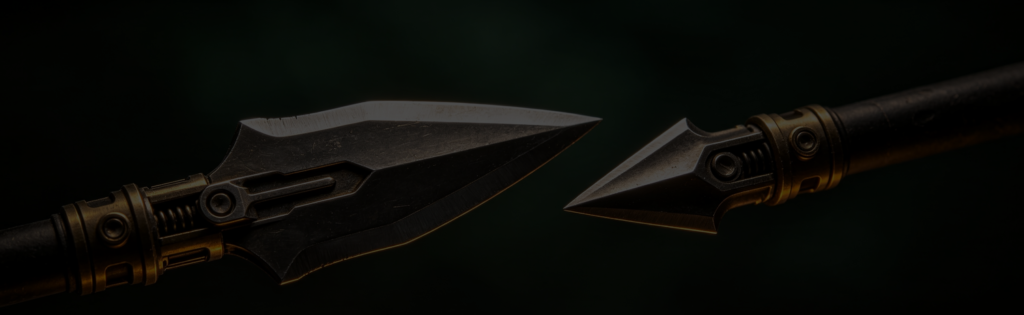
There are two workable turkey setups and they are not interchangeable. A large-cut mechanical or wide fixed head aimed at the vitals gives you the most forgiveness, because a wider wound channel is more likely to catch a softball-sized kill zone on a marginal hit. A guillotine head with a 4-inch-plus cut aimed at the head and neck kills instantly when it connects, but the bird has to be facing you or broadside with the neck extended, and these heads are hard to tune and unreliable past about 20 yards. Choose the shot you are actually willing to take first; the head follows from that.
Fletchwise guides are independent and hype-free – we are not sponsored by any archery brand and we do not sell broadheads.
Why a Deer Broadhead Often Falls Short
Turkeys look enormous in full strut and they are mostly bluff. A strutting gobbler is more than 50% feathers, and the vitals inside are barely the size of a softball. Compare that to a whitetail’s basketball-sized boiler room and the problem is obvious: the margin for error is a fraction of what you are used to.
That changes the calculus you would normally apply. On deer, penetration is the priority and a narrow head is often the safe choice – see our guide to mechanical broadheads for the energy thresholds that drive that decision. On turkey, the bird is light and thin-skinned, so deep penetration is rarely the constraint. Cut width is doing the work instead, because width is what turns a slightly-off shot into a lethal one.
A standard whitetail head will absolutely kill a turkey with a well-placed arrow. The question is what happens when the arrow is not perfectly placed, and that is where a narrow head leaves you with nothing.
Decide the Shot, Then the Head
Most turkey broadhead articles are product lists. The useful decision happens one step earlier: commit to the shot you intend to take, because the two shots demand opposite tools.
| Shot you intend to take | Head | Why | Range limit |
|---|---|---|---|
| Body / vitals | Large-cut mechanical or wide fixed | Width covers a softball-sized target; forgiving on marginal hits | Your normal effective range |
| Head / neck | Guillotine / decapitator, 4″+ cut | Instant kill when it connects; no meat damage | About 20 yards, maximum |
What you should not do is buy a guillotine head and then decide in the moment to take a body shot with it, or vice versa. They are aimed at different parts of the bird and they fly differently. Pick one, sight in for it, and practice it.
Where to Aim
Aim points on a turkey are not intuitive, because the feathers you can see are not where the bird lives.
| Bird’s position | Point of aim |
|---|---|
| Broadside, strutting | The black triangle formed by the upper and lower wing – at it, or an inch behind. Both are lethal. |
| Broadside, not strutting | In line with the legs, halfway up the body. Or find the top wing point – roughly the heart – and aim a couple of inches behind it for a double lung. |
| Facing you, squared up | An inch or two above the beard. |
| The common mistake | Aiming low. A low hit on a turkey is breast meat and nothing else – the bird walks away. |
A broadside strutting bird is the hardest shot of the set, because the fan and puffed feathers actively mislead you about where the body is. It is generally treated as a shot for experienced turkey bowhunters rather than a default. onX Hunt’s breakdown of turkey shot placement works through the angles with photos, and the Illinois Natural History Survey’s ethical shot placement page is a good non-commercial reference.
Large-Cut Heads for Body Shots
This is the choice most turkey bowhunters land on, and for good reason: it lets you use your normal effective range and your normal sight picture. Wide mechanicals open to cut diameters well beyond what a fixed head can carry in flight, and on a bird that offers no real penetration challenge, that width is pure upside.
The trade-off is the same one described on our fixed vs mechanical page: a wide cut costs kinetic energy and arrow speed. On deer that can matter a great deal. On a turkey it rarely does, which is why turkey is one of the few situations where the widest head you can shoot accurately is usually the right one.
Pair it with an arrow setup you have actually tuned with that head fitted – a wide mechanical changes point of impact, and finding that out in the blind is too late.
Guillotine Heads: A 20-Yard Proposition
Guillotine and decapitator heads carry blades of 4 inches or more and are aimed at the head and neck. When one connects properly the bird drops instantly and no meat is damaged. The appeal is obvious. The limits are less advertised:
- They do not fly like your other heads. Those big exposed blades are far less aerodynamically stable than a fixed head, let alone a mechanical, and many bows will not shoot them well at all.
- Range is short. Tuning is difficult and flight degrades quickly – past roughly 20 yards these heads become unreliable.
- The target moves constantly. A turkey’s head and neck rarely hold still. The bird needs to be facing you, or broadside with the neck extended, for the shot to be on at all.
- Partial hits wound. A nick that does not remove a good part of the head, or a neck hit that misses the spine, leaves a wounded bird. There is no marginal-but-lethal outcome the way there is with a body shot.
None of that makes them a bad tool. It makes them a specialist tool for a hunter shooting inside 20 yards over decoys who has practiced that exact shot. If that is not your setup, the body shot is the higher-percentage play.
What to Look For
- Cut diameter – the single most useful spec for turkey. Wider is better here, within what you can shoot accurately – treat 1.5 inches as a bare floor, 1.75 inches as a comfortable minimum, and 2 inches or more as the range most turkey-specific heads are built for.
- Blade retention – the O-ring or collar holding a mechanical shut. Check it before every sit.
- Grain weight – match what your arrow was tuned around, usually 100 grain. Changing head weight moves point of impact.
- Practice heads – buy a matching practice head and shoot it into a broadhead target. Never into a bag target.
- Legality – turkey equipment rules vary by state and change between seasons. Confirm with your state wildlife agency, not with a product page.
We do not sell broadheads and there are no affiliate links here. Aim points and range limits above are widely accepted guidance, not guarantees – the shot you should take is the one you have practiced at that exact distance, on that exact bird posture.
Frequently Asked Questions
For most hunters, a large-cut mechanical or wide fixed head aimed at the vitals. A turkey’s kill zone is about the size of a softball, so cut width buys you forgiveness that a narrow head cannot. Guillotine heads aimed at the head and neck are the alternative, but only inside about 20 yards and only if you have practiced that specific shot.
It will work on a well-placed shot – turkeys are light and thin-skinned, so penetration is not the problem. What a narrow deer head does not give you is margin. Against a softball-sized vital zone buried in feathers, a wider cut is far more likely to turn a slightly-off arrow into a clean kill.
On a broadside strutting bird, at the black triangle where the upper and lower wing meet, or an inch behind it. On a broadside bird that is not strutting, in line with the legs and halfway up the body. On a bird facing you square, an inch or two above the beard. The most common error is aiming low, which hits nothing but breast.
For a specific hunter, yes. They kill instantly and damage no meat when they connect. But they carry 4-inch-plus blades that fly poorly, are difficult to tune, and are unreliable past about 20 yards, and the bird’s head rarely stops moving. A partial hit wounds rather than kills. They suit close decoy setups and practiced shooters, not general use.
Because a strutting gobbler is more than 50% feathers. The fan and puffed body make the bird look far larger than it is and hide where the vitals actually sit, so it is easy to aim at feathers. It is usually treated as a shot for experienced turkey bowhunters rather than a first choice.
Check it, at minimum. A wide mechanical or a guillotine head changes point of impact compared to a field point or your deer head, and a guillotine especially may not group at all from some bows. Shoot the exact head you will hunt with, at the distance you expect to shoot, into a broadhead-rated target before the season.
Shorter than you think, and shorter than your deer range. The vital zone is small enough that most bowhunters keep turkey shots well inside their normal maximum, and a guillotine head caps you at roughly 20 yards regardless of how well you shoot. Decoys exist to bring the bird into that window rather than to stretch it.
Treat 1.5 inches as a bare floor, 1.75 inches as a comfortable minimum, and 2 inches or more as the range most turkey-specific heads are built for. Cut width is what turns a slightly-off shot into a lethal one on a softball-sized vital zone, so within what you can shoot accurately, wider is better here.
Submit the Form to Get Our Product Catalog
What We Can Offer
- ✅ Low MOQ – from 1 piece, no minimum order
- ✅ Full customization – names, initials, club crests & team logos
- ✅ Mockup before production – see it before we make it
- ✅ Production time about 2 weeks after mockup approval
- ✅ Free remake on defects within 14 days of delivery
We reply to every inquiry within 1 business day.
Email: [email protected]
WhatsApp: +1 770 157 5807
Keep Reading
Broadhead Basics
Fixed vs mechanical broadheads, real recovery-rate data, and the cutting-diameter minimums that matter more than brand.
Broadhead BasicsFixed vs Mechanical
The real tradeoff between the two – not marketing claims, but recovery rates, wind drift and legal cutting diameters.
Fixed vs MechanicalBroadhead Targets
Why the FPS rating on the label matters more for crossbow shooters than the word broadhead printed on it.
Broadhead Targets