
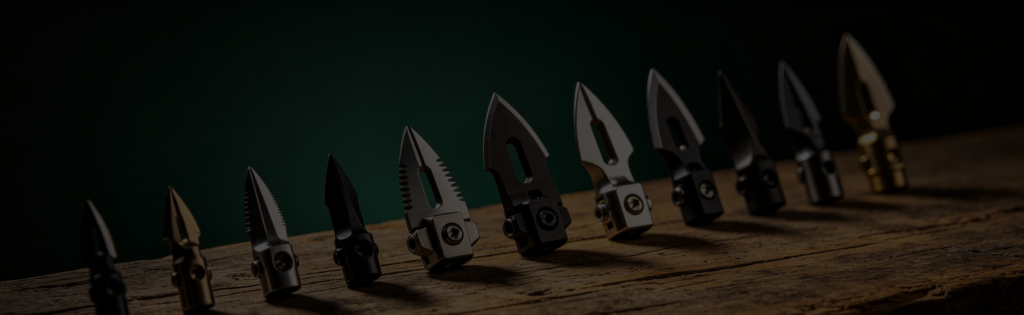
The best broadhead matches your bow’s energy, your arrow’s tune, and the game you hunt. For high-energy compounds wanting flat flight and wide cuts, a quality mechanical is hard to beat. For lower-poundage bows, heavy bone, and maximum reliability, a fixed-blade head wins. Most hunters run 100-grain heads. Whatever you choose, it has to fly with your field points and hit hard – so tune, then practice with the exact heads you will hunt.
Fletchwise guides are independent and hype-free – we are not sponsored by any archery brand.
Best Broadhead by Situation
Best for High-Energy Compounds
A quality mechanical head. It flies like a field point with minimal tuning and opens to a wide cutting diameter – excellent for flat-shooting modern bows with energy to spare.
Best for Reliability & Penetration
A fixed-blade head. With no moving parts it is the most dependable choice and penetrates best, ideal for tough angles, heavy bone, and lower-poundage or traditional bows.
Best All-Rounder
A hybrid (fixed main blade plus deploying blades) aims to balance reliability and cut width for hunters who want one head for varied conditions.
Best for Turkey
A specialized turkey broadhead – large-cut mechanicals or guillotine-style heads designed for a bird’s small vital area.
Inside "Fixed-Blade": Cut-on-Contact vs Chisel Tip
Choosing fixed-blade does not finish the decision – the tip geometry still splits into two philosophies. A cut-on-contact tip is a sharpened edge that slices into hide and soft tissue with less resistance, giving it an edge on initial penetration through skin and muscle. A chisel tip is a blunter, harder point built to punch through bone by busting it aside rather than trying to slice through it – bone yields more easily to a wedge than to a blade edge. If your overall cutting surface is similar between the two, the practical difference is small on a clean hit; it shows up on the shots that catch a rib or shoulder blade, where a chisel tip has the edge and a cut-on-contact tip is more likely to deflect or bind.
Blade Count: The Real Trade-Off Behind "Wider Cuts"
More blades is not simply better – it is a direct trade against penetration and tuning ease. A 2-blade head has the least surface area dragging through the animal, so it penetrates deepest and tunes easiest (least drag means less sensitivity to a slightly-off arrow), making it the choice for marginal energy setups or a priority on pass-throughs. A 4-blade head roughly doubles the cutting area of a 3-blade for a given penetration depth, producing a wider wound and a more visible blood trail – but it is the hardest of the three to tune and bleeds off the most penetration. A 3-blade sits in between and is the common default for exactly that reason. None of the three is universally “best”; the choice is really about which side of the penetration-versus-wound-channel trade you want to be on for your bow’s energy and the game you are hunting.
Single Bevel vs Double Bevel: The Rotation Nobody Explains
A double-bevel edge is ground with two symmetric angles meeting at a straight line – it pierces straight and does not rotate. A single-bevel edge is ground with only one angle, like a chisel, and that asymmetry makes the head rotate as it drives forward, clockwise or counter-clockwise depending on which side the bevel is ground. The denser the material, the more it rotates: bone and heavy muscle spin the head hard, while soft organ tissue barely turns it at all.
That rotation is not a gimmick. Where the shaft meets bone, a single bevel’s spin drives it into a splitting, boring motion rather than a straight punch, and splitting bone costs far less energy than punching through it whole – shaft drag after the bone is the real penetration-killer, and a head that splits bone cleanly carries noticeably more energy through to the tissue beyond. Where a double bevel wins is soft tissue alone with no bone in the way: without rotation stealing any energy, a well-tuned double bevel edges out a single bevel on raw straight-line penetration through muscle. The honest read: single bevel earns its reputation specifically on shots that catch bone, not as a universal upgrade over double bevel.
The Specs That Decide It
- Type – fixed, mechanical, or hybrid (see the comparison).
- Grain weight – usually 100 gr; match it to your arrow tune.
- Blade count & cutting diameter – more/wider cuts more but can reduce penetration.
- Build quality – a strong ferrule and hard, sharp, replaceable blades.
Specific broadhead picks are coming as our shop launches. For now, match the type to your bow’s energy, pick the grain weight your arrow is tuned for, and confirm flight with broadhead practice.
Frequently Asked Questions
Both fixed and mechanical heads take deer cleanly. From a high-energy compound, a quality mechanical offers flat flight and a wide cut; for lower-energy setups or maximum penetration, a fixed blade is ideal. Match the head to your bow and tune it in.
Most hunters use 100-grain broadheads, with 125-grain a heavier option. The right weight is whatever your arrow was tuned around, since changing head weight changes arrow flight and balance.
Quality matters – a strong ferrule and hard, sharp blades hold up on impact and stay sharp. If you run fixed-blade heads, that sharpness does not last on its own – see our broadhead sharpening guide for how to keep an edge hunting-ready. But the best broadhead is one that flies true from your tuned bow, which depends as much on your setup as on price.
Yes. Broadheads can fly differently from field points. Sight in and confirm groups with the exact heads you will hunt, using a broadhead-rated target before the season.
Cut-on-contact slices through hide and soft tissue with less resistance, giving an edge on a clean hit. Chisel tips are built to punch through bone by busting it aside rather than cutting through it. If overall cutting surface is similar, the difference is small on a clean pass, but a chisel tip has the advantage if the arrow catches a rib or shoulder blade.
2-blade heads penetrate deepest and tune easiest because they have the least surface area dragging through the animal – a good choice for marginal energy or when a pass-through matters most. 4-blade heads roughly double the cutting area for a given penetration depth, giving a wider wound and blood trail, but they are the hardest to tune and cost the most penetration. 3-blade is the common middle ground. None is universally best – it is a direct trade-off.
It depends whether bone is in the picture. A single-bevel edge is ground at one angle and rotates as it penetrates, and that rotation helps split bone rather than punch straight through it – splitting costs less energy, so more carries through to the tissue beyond. In soft tissue alone with no bone, a double bevel does not lose any energy to rotation and edges out a single bevel on raw straight-line penetration. Single bevel earns its reputation specifically on bone-catching shots, not as an across-the-board upgrade.
Submit the Form to Get Our Product Catalog
What We Can Offer
- ✅ Low MOQ – from 1 piece, no minimum order
- ✅ Full customization – names, initials, club crests & team logos
- ✅ Mockup before production – see it before we make it
- ✅ Production time about 2 weeks after mockup approval
- ✅ Free remake on defects within 14 days of delivery
We reply to every inquiry within 1 business day.
Email: [email protected]
WhatsApp: +1 770 157 5807
Keep Reading
Fixed vs Mechanical
The real tradeoff between the two – not marketing claims, but recovery rates, wind drift and legal cutting diameters.
Fixed vs MechanicalTurkey Broadheads
Why cutting diameter matters more than any other spec on a bird with a softball-sized vital zone.
Turkey BroadheadsBroadhead Targets
Why the FPS rating on the label matters more for crossbow shooters than the word broadhead printed on it.
Broadhead Targets