
Bag, foam, block, or 3D? Here is how every type of archery target actually performs – how long each one lasts, what arrows and broadheads it can handle, and which one fits your bow, your draw weight, and your backyard.

Quick answer
An archery target is a backstop built to safely stop and hold arrows for practice or hunting prep. The four main types are bag targets (best value, field points only), foam and block targets (lightweight, take both field points and broadheads), layered block targets (high-density, built for fast, heavy bows), and 3D animal targets (realistic bowhunting practice). For most beginners shooting a bow under 60 lbs, a bag target is the cheapest and easiest place to start.
Fletchwise guides are independent and hype-free – we test-shoot gear ourselves and are not sponsored by any target or bow brand.
What Is an Archery Target?
An archery target is any backstop designed to stop your arrows quickly, hold them so they are easy to pull out, and survive being hit hundreds or thousands of times. A good target does three things at once: it stops the arrow within its body, it does not destroy your arrows or fletching on impact, and it lets you remove arrows without a fight. The right target for you depends mostly on two things – the speed and draw weight of your bow, and whether you shoot field points, broadheads, or both.
Get this choice wrong and you will either blow arrows straight through a target that is too soft, or wear out your shoulder trying to pull arrows from one that is too dense. This guide breaks down each type so you can match the target to your setup the first time.
The 4 Main Types of Archery Targets
1. Bag Targets
Bag targets are filled with synthetic fiber inside a tough woven shell. They stop arrows through friction along the shaft, which makes arrows extremely easy to remove – often with two fingers. They are the best value for high-volume practice and the most beginner-friendly option. The catch: bag targets are for field points and target points only. Never shoot broadheads into a bag target – the blades shred the fibers and ruin it fast.
2. Foam Block Targets
Block targets use layered or fused open-cell foam to grab the arrow. Most modern foam blocks handle both field points and broadheads, which makes them the most versatile choice for hunters who want one target for practice and broadhead tuning. They are light, portable, and usually have multiple aiming faces so you can rotate wear across all sides.
3. Layered (High-Density) Block Targets
Layered targets compress dense foam sheets between end plates. The high density is built to stop the fast, heavy arrows thrown by today’s 60-70+ lb compound bows and crossbows without pass-throughs. They last the longest of any flat target, but the trade-off is harder arrow removal – keep some arrow lube on hand. For bows and crossbows that outgrow a standard face, see our large and XL targets page.
4. 3D Animal Targets
3D targets are molded into the shape of game animals – deer, turkey, hog – with self-healing foam and scoring rings hidden in vital areas. They are the gold standard for bowhunting practice and 3D archery courses because they train you to judge distance and pick a spot on a real-world shape. They cost the most and the replaceable vital-zone inserts wear first, but a quality 3D target lasts for years.
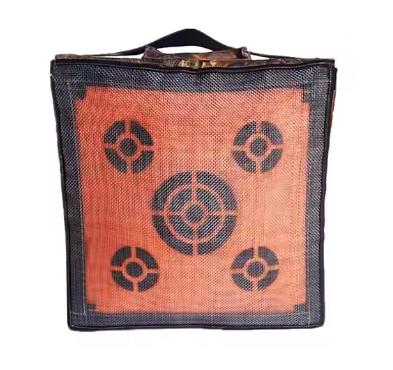
The mistake that ruins targets (and arrows)
Two errors wreck more targets than anything else: shooting broadheads into a bag target (the blades shred it) and buying a target rated below your draw weight (fast arrows punch through and bury or break). Match the target to your bow and your points before you buy, not after you have ruined a $40 target and a $15 arrow.
How to Choose the Right Archery Target
Work through these five questions in order and the right target almost picks itself – or see our full how to pick a target walkthrough for the long version.
- What is your draw weight? Under 40 lbs: a bag target is plenty. 60+ lbs, or a crossbow: choose a high-density layered or foam block rated for high-poundage bows.
- Field points or broadheads? Field points only – a bag target is cheapest. Broadheads, or both – choose a foam or block target rated for broadheads. Never put broadheads in a bag.
- Indoor or outdoor? For a backyard, pick a weather-resistant shell or plan to store it under cover. Sun and rain age targets fast.
- How often will you move it? If you carry it to a range, check the weight and look for a built-in carry handle or strap.
- Stopping power vs. easy removal. Denser targets stop fast arrows but pull harder. Match density to your bow – do not over-buy density you do not need.
Where to Set Up Your Target Safely
Always place a target in front of a natural backstop – a dirt bank, a fence backed by plywood, or a dedicated arrow curtain – in case of a miss or a pass-through. Stand the target on a stand at shoulder height so arrows land square, never at a steep up or down angle that can deflect. Keep a clear, marked downrange zone and make sure nothing living can wander behind the target line.
Archery Target Types Compared
| Type | Best For | Works With | Arrow Removal | Typical Lifespan | Price |
|---|---|---|---|---|---|
| Bag | Backyard practice, beginners | Field points only | Very easy | 1-2 years | $ |
| Foam Block | Mixed practice & tuning | Field points + broadheads | Easy | 1-3 years | $$ |
| Layered Block | High draw-weight bows, crossbows | Field points + broadheads | Medium | 2-4 years | $$$ |
| 3D Animal | Bowhunting & 3D courses | Field points + broadheads | Medium | 3-5 years | $$$$ |
Lifespans assume regular, not constant, use and proper storage. Prices are typical US retail ranges, 2026.
Frequently Asked Questions
How long do archery targets last?
It depends on type and use. A bag target shot daily may last a year, while a quality 3D or layered block target can last three to five years. Lifespan drops fast if you shoot above the target’s rated draw weight or leave it out in the sun and rain.
Can you shoot broadheads into a bag target?
No. Broadhead blades cut and tear the woven shell and loose fiber fill of a bag target, destroying it quickly. Use a foam or block target that is specifically rated for broadheads, and save your bag target for field points only.
What is the best archery target for a beginner?
For most beginners shooting field points with a bow under 40-50 lbs, a bag target is the best starting point – it is affordable, easy to set up, and arrows pull out effortlessly. Step up to a foam block only once you start shooting broadheads or a higher-poundage bow.
How far should I stand from my target?
Beginners should start close – around 10 yards (9 meters) – to build consistent form, then move back in 5-yard steps as groups tighten. Most backyard practice happens between 10 and 30 yards.
Are 3D targets worth it if I do not hunt?
They can be. 3D targets make practice more engaging and train distance judgment and spot picking, which sharpens accuracy even for target archers. If you only shoot at fixed distances on a flat range, though, a block or bag target gives you more shots per dollar.
Why do my arrows pass through my target?
Pass-throughs usually mean the target’s stopping power is too low for your bow’s speed and draw weight. Move up to a higher-density layered target rated for your poundage, and replace targets once the center gets shot out and soft.
What size archery target do I need?
For backyard field-point practice, a face around 16-20 inches is plenty – big enough to catch early misses, small enough to store and carry. Step up to 24 inches or larger for group practice or longer ranges. For 3D targets, the size of the animal’s vital zone matters more than the overall dimensions.
What do the colors on an archery target face mean?
A standard World Archery target face has 10 scoring rings grouped into 5 color bands: gold (10 and 9), red (8 and 7), blue (6 and 5), black (4 and 3), and white (2 and 1), scoring from the center outward. The gold center is worth the most. Most backyard practice faces copy this five-color layout so your scoring translates to a real range.
Submit the Form to Get Our Product Catalog
What We Can Offer
- ✅ Low MOQ – from 1 piece, no minimum order
- ✅ Full customization – names, initials, club crests & team logos
- ✅ Mockup before production – see it before we make it
- ✅ Production time about 2 weeks after mockup approval
- ✅ Free remake on defects within 14 days of delivery
We reply to every inquiry within 1 business day.
Email: [email protected]
WhatsApp: +1 770 157 5807
Keep Reading
Best 3D Archery Targets
Deer, turkey and hog targets with replaceable vital-zone cores, and why self-healing foam does not mean unlimited broadhead life.
Best 3D Archery TargetsBest Foam Archery Targets
Density and depth decide real lifespan far more than price, and how to judge a block before it is shot out.
Best Foam Archery TargetsDIY Archery Target
Build a target from stacked, compressed cardboard for a fraction of retail – plus the grain-direction detail most guides skip.
DIY Archery Target