
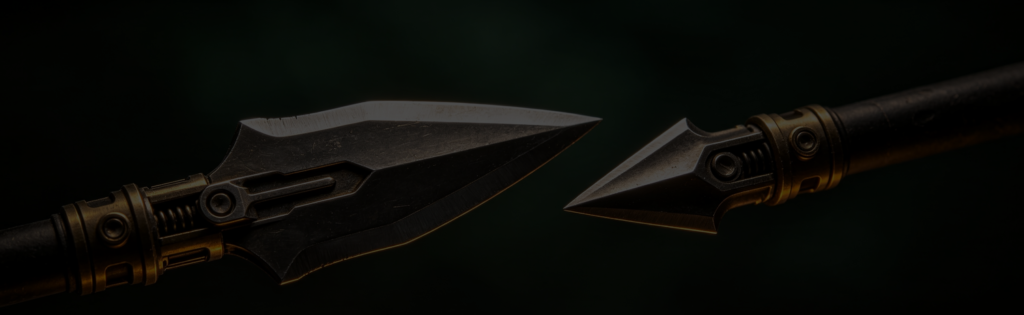
Fixed-blade broadheads have permanently open blades – simple, durable, and reliable, with the best penetration, making them ideal for lower-energy bows, heavy bone, and tough angles. Mechanical (expandable) broadheads fly closed and open on impact, so they fly more like field points and cut a wider hole, but they sacrifice some penetration and add moving parts that can fail. Choose fixed for reliability and penetration; choose mechanical for flat flight and wide cuts from a high-energy compound.
Fletchwise guides are independent and hype-free – we are not sponsored by any archery brand.
How Each Type Works
A fixed-blade broadhead has blades locked permanently in the open position – no moving parts, nothing to fail. A mechanical (expandable) broadhead keeps its blades folded against the ferrule in flight, then deploys them on impact for a wider cutting diameter. That single design difference drives all the trade-offs below.
Why a Fixed Blade Needs Better Tuning, Specifically
The comparison table below says fixed blades need more tuning and mechanicals fly closer to a field point, but not why. A field point is a smooth cone with no flat surface for air to catch, so it is largely indifferent to small errors in spine or rest position. A fixed blade exposes two, three or four flat cutting surfaces to the airstream the moment it leaves the bow, and those surfaces act like small rudders: any arrow flaw that would be invisible with a field point – a slightly stiff or weak spine, a rest a hair out of center – gets steered by that exposed surface into a visible shift in point of impact. A mechanical keeps its blades folded flat against the ferrule until impact, so in flight it presents almost the same profile as a field point and is far less sensitive to the same tuning flaws.
That is also why switching broadhead types mid-season, or even switching between brands of the same type, can shift point of impact enough to need re-sighting – you are changing how much rudder surface the airflow has to work with, not just the head on the front. Shoot the exact head you plan to hunt with before the season, and if you swap heads later, expect to re-confirm zero rather than assume it carries over.
The Debate Within the Debate: Front-Deploy vs Rear-Deploy Mechanicals
Not all mechanicals open the same way, and the difference matters if you are set on going expandable. Front-deploying heads hinge open from the tip backward, which means the blades have to swing into position before they are cutting at full width – a small delay that can cost a touch of penetration and, on an angled or bone-glancing hit, gives the partially opened blades a chance to jackknife or deflect. Rear-deploying heads hinge open from the back forward, so the blades are already cutting on first contact while they finish opening rather than opening first and cutting second. Bowhunters widely report rear-deploy heads as more forgiving on quartering shots and usable at somewhat lower kinetic energy, though truly controlled, apples-to-apples testing between the two styles is hard to find – treat this as a real design difference worth knowing, not a settled verdict.
What "Reliability" Actually Means: the Retention System
The comparison table’s “depends on deployment” line comes down to one small part: whatever holds the blades shut until impact, usually an O-ring, collar, or pin. That retention system is what can fail – and it fails in two opposite directions. Age, cold weather, and repeated stretching can weaken a rubber O-ring’s grip, letting blades creep open in flight and plane the shot off line; conversely, a retention system that is too stiff can fail to release cleanly on a marginal hit. The stress on that retention system scales with how hard the broadhead accelerates off the string, which is exactly why a mechanical that performs fine off a standard compound can behave differently off a crossbow’s much higher draw weight – see our crossbow vs compound comparison for why crossbow launch forces are so much higher. Whatever type you shoot, replace retention rings as routine maintenance rather than waiting for a failure to show you they were worn out.
Fixed vs Mechanical at a Glance
| Factor | Fixed-Blade | Mechanical |
|---|---|---|
| Flight vs field points | Needs tuning to match | Flies like a field point |
| Penetration | Best | Slightly reduced |
| Cutting diameter | Narrower | Wider |
| Reliability | Highest (no moving parts) | Depends on deployment |
| Best bow energy | Any, incl. lower poundage | High-energy compounds |
| Tough bone / hard angles | Excellent | Good with enough energy |
| Tuning effort | More | Less |
Some areas restrict mechanical broadheads or set minimum cutting widths – check local regulations.
Frequently Asked Questions
They tend to fly more like field points because the blades are tucked away in flight, so they often need less tuning to group well. A well-tuned bow can shoot fixed blades accurately too, but it takes more setup work.
Generally yes. With no energy lost to opening blades and a sturdier design, fixed-blade heads usually penetrate deeper, which is why they shine on heavy bone, hard angles, and lower-energy bows.
Modern mechanicals are much better than early designs, but they still rely on the blades deploying on impact, which is a point of potential failure. Pair them with adequate kinetic energy and a quality, well-maintained head.
For a high-energy compound, a quality mechanical is forgiving because it flies like a field point. For lower-poundage or traditional bows, a reliable fixed blade is the safer, simpler choice.
Front-deploy blades hinge open from the tip backward, so they swing into position before cutting at full width – a small delay that can cost a touch of penetration and risks jackknifing on an angled hit. Rear-deploy blades hinge open from the back forward and are already cutting on first contact while they finish opening, which bowhunters widely report as more forgiving on quartering shots, though rigorous side-by-side testing is limited.
Almost always the retention system – the O-ring, collar, or pin holding the blades shut until impact. Age, cold, and repeated flexing can weaken it enough that blades creep open mid-flight and plane the shot off course; a retention system that is too stiff can instead fail to release on a marginal hit. Replace retention rings as routine maintenance rather than after a failure.
Because a fixed blade exposes flat cutting surfaces to the airstream in flight, and those surfaces act like small rudders that steer the arrow off any tuning flaw – a slightly off spine or rest position – that a smooth field point would never reveal. A mechanical keeps its blades folded against the ferrule until impact, so in flight it looks almost like a field point and is far less sensitive to the same flaws. This is also why switching broadhead types or brands mid-season can shift your point of impact enough to need re-sighting.
Submit the Form to Get Our Product Catalog
What We Can Offer
- ✅ Low MOQ – from 1 piece, no minimum order
- ✅ Full customization – names, initials, club crests & team logos
- ✅ Mockup before production – see it before we make it
- ✅ Production time about 2 weeks after mockup approval
- ✅ Free remake on defects within 14 days of delivery
We reply to every inquiry within 1 business day.
Email: [email protected]
WhatsApp: +1 770 157 5807
Keep Reading
Broadheads Explained
Fixed vs mechanical broadheads, real recovery-rate data, and the cutting-diameter minimums that matter more than brand.
Broadheads ExplainedTurkey Broadheads
Why cutting diameter matters more than any other spec on a bird with a softball-sized vital zone.
Turkey BroadheadsBroadhead Targets
Why the FPS rating on the label matters more for crossbow shooters than the word broadhead printed on it.
Broadhead Targets