
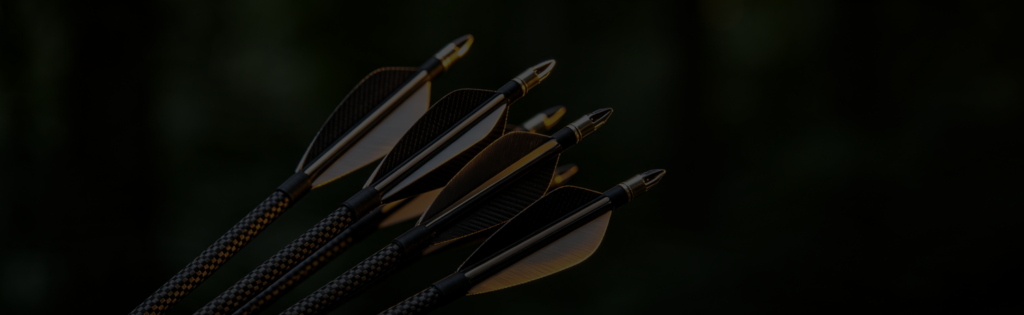
The best arrows for a compound bow are carbon arrows with a spine matched to your draw weight, draw length, and point weight using the manufacturer’s spine chart. Cut them to your draw length, choose a total weight based on speed vs penetration, and fit the right inserts, points, and nocks. Spine is the single most important factor – get it right and the bow shoots; get it wrong and no amount of skill fixes the flight.
Fletchwise guides are independent and hype-free – we are not sponsored by any archery brand.
Spine Comes First
Spine is the stiffness of the shaft, and it must match your setup. A spine that is too weak or too stiff for your draw weight and length will not recover cleanly off the cams, so the arrow porpoises or drifts no matter how good your form is. Every shaft maker publishes a spine chart that cross-references draw weight, arrow length, and point weight – start there, every time.
The Other Specs
- Length – cut to your draw length (plus clearance past the rest). Note that cutting shorter makes the arrow behave stiffer.
- Total weight (GPI) – lighter flies faster and flatter; heavier penetrates better and is quieter. Hunters usually lean a bit heavier. Whatever you land on, do not go under roughly 5 grains per pound of your draw weight – most manufacturers state that as the minimum finished-arrow weight for safe, warranty-covered shooting, not just a penetration preference. See our arrows and broadheads guide for how point weight factors into that total.
- Point weight – commonly 100 gr; it affects spine and front-of-center balance, so factor it into the chart.
- Straightness – .006″-.003″ is plenty for hunting; tighter for competition.
- Components – matched inserts, points/broadheads, and nocks complete the arrow.
Fletching: Straight, Offset, or Helical
Vanes are glued on one of three ways, and the difference is how much spin they put on the arrow. Straight fletching runs parallel to the shaft and costs the least speed, but generates only a little spin. Offset angles the vane slightly to one side, adding more spin for a small speed cost. Helical curves the vane around the shaft and produces the most spin of the three, at the biggest speed cost. Spin matters because it stabilizes the arrow in flight – and it matters a lot more with a fixed-blade broadhead, since those blades generate steering (planing) forces the instant they catch air. A helical fletch spins the arrow up to speed fast enough to overpower that planing before it can drift the shot off line, which is why fixed-blade hunters lean helical while target and mechanical-broadhead shooters can often get away with straight or a light offset.
Nock Fit: The Tiny Spec With Outsized Consequences
The nock is the smallest component on the arrow and the easiest to overlook, but a poor fit at the exact point where the arrow meets the string compromises every shot before it starts. Too loose, and the nock can pop off the string mid-draw or even during the shot – which for a compound bow means an unintended dry-fire, the same bow-damaging failure covered in our shooting guide. Too tight, and the nock can crack under repeated stress, while the string also hangs onto it a fraction too long at the shot, bleeding speed and consistency – and in the worst case dragging the string forward into your arm. The fit test: clipping the nock onto the string should give a soft click, not a loud snap, and once seated you should be able to rotate the string freely inside the nock throat without it falling off.
Material: Carbon Is the Default
Most compound shooters use carbon arrows for their strength, consistency, and durability. Aluminum is a budget option; carbon-aluminum hybrids are premium. For hunting and serious target work, carbon is the go-to.
Specific arrow picks are coming as our shop launches. For now, pull your bow’s spine chart, match the shaft to your draw weight and length, and cut to length with a proper arrow saw.
Frequently Asked Questions
Use the shaft maker’s spine chart to match spine to your draw weight, draw length, and point weight, then cut to your draw length and pick a total weight for your goal (speed or penetration). Carbon arrows are the standard choice.
It depends on your exact draw weight, arrow length, and point weight – there is no single answer. Plug those numbers into the manufacturer’s spine chart, which will point you to the correct spine value.
Lighter arrows fly faster and flatter; heavier arrows hit harder and quieter. Target shooters often go lighter for trajectory, while hunters favour a bit more weight for penetration. Do not go under roughly 5 grains per pound of your draw weight – that is the manufacturer floor for safe, warranty-covered shooting, not just a penetration preference.
Carbon for most shooters – it is light, strong, consistent, and durable. Aluminum is a fine budget choice but bends more easily. Whichever you choose, matching spine to your setup matters most.
Helical if you shoot fixed-blade broadheads – the extra spin overpowers the blades’ planing forces before they can drift the shot off line. Straight fletching costs the least speed and works fine for target shooting or mechanical broadheads, which plane far less. Offset sits in between.
Clip the nock onto the string – you should hear a soft click, not a loud snap, and once seated the string should rotate freely inside the nock without falling off. Too loose and the nock can pop off mid-draw or cause a dry-fire; too tight and it can crack over time and bleed speed and accuracy at the shot.
Submit the Form to Get Our Product Catalog
What We Can Offer
- ✅ Low MOQ – from 1 piece, no minimum order
- ✅ Full customization – names, initials, club crests & team logos
- ✅ Mockup before production – see it before we make it
- ✅ Production time about 2 weeks after mockup approval
- ✅ Free remake on defects within 14 days of delivery
We reply to every inquiry within 1 business day.
Email: [email protected]
WhatsApp: +1 770 157 5807
Keep Reading
Carbon Arrows
The standard shaft material and how spine, not brand, decides whether your arrows fly true.
Carbon ArrowsBroadheads Explained
Fixed vs mechanical broadheads, real recovery-rate data, and the cutting-diameter minimums that matter more than brand.
Broadheads ExplainedArrow Saws
Dust safety, squaring shafts to length, and what a dedicated arrow saw costs versus a cheap manual cutter.
Arrow Saws