
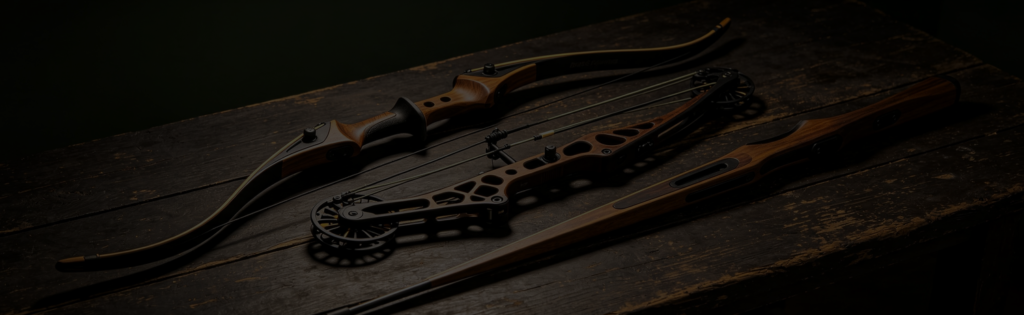
The best archery bow is the one matched to your goal and fitted to you. For learning and target, a takedown recurve is the standard. For hunting and max accuracy, a compound. For tradition, a longbow or horse bow. Whatever the style, quality markers include a well-machined riser, consistent limbs, smooth draw, and good after-sale support (strings, limbs, spares). Fit – correct draw length and a controllable draw weight – matters more than brand or price.
Fletchwise guides are independent and hype-free – we are not sponsored by any archery brand.
Start With Your Goal
- Learning & target: a takedown recurve – affordable, teaches form, grows with you.
- Hunting & accuracy: a compound – power, let-off, and sights. See best compound bows.
- Tradition & instinctive: a longbow or horse bow.
Picking the right bow type first narrows “best” from hundreds of bows to a handful.
Quality Markers to Look For
- Riser quality – a stiff, well-machined riser (aluminum or quality wood/laminate) is the backbone of accuracy.
- Consistent limbs – smooth, even-drawing limbs that return reliably shot after shot.
- Smooth draw cycle – no harsh stacking (recurve) or rough cam roll-over (compound).
- Adjustability – takedown limbs or an adjustable compound let the bow grow with you.
- Support & spares – strings, replacement limbs, and parts you can actually buy.
The Real Test for "Consistent Limbs"
“Consistent limbs” sounds vague until you know the actual check: string the bow, point it toward the ground, and sight down its length from limb tip to limb tip. The string should track straight through the visual center of both limbs. If a limb tip visibly leans left or right relative to the riser’s centerline, that limb has twist – a small amount is normal and present on almost every limb, but a pronounced lean is worth walking away from. Separately, warp near the limb tips is a real defect with no practical fix; warp concentrated near the limb pockets instead points to a riser or limb-butt fit issue, which shimming can sometimes correct. This five-second sight-down-the-limb check tells you more about build quality than any spec sheet.
That check is specific to recurves with visible limbs, but a compound has an equally fast equivalent: pull the string back less than an inch and let it go. A quiet, solid thunk is normal; a rattle or buzz means something is loose – a fastener, a cable guard, a peep, or a cam bolt – and it is worth finding before you buy, not after. Pair it with a look along the bottom edge of each cam for dents or wear from resting against hard surfaces, which points to a bow that has spent time leaning against rocks or concrete rather than being cased.
The Value Hack Most Buyers Don't Know: Used ILF Gear
If you want the quality markers above without paying full retail, a takedown recurve built on the ILF (International Limb Fitting) standard is the one bow style where buying used genuinely makes sense. ILF risers and limbs from different brands and even different decades are broadly interchangeable, so a well-machined secondhand riser can be paired with limbs from an entirely different manufacturer – the standard was never locked down by one company the way modern compound electronics are, so old, honest hardware keeps working with new parts. The one caveat: ILF fitting is a convention, not a rigid spec, so pocket angle and depth vary slightly by maker – test-fit or ask before assuming any riser and limb pair perfectly. This is also exactly why used buying works so differently here than for a compound: our best compound bows guide covers why fast cam and module turnover makes secondhand compounds a much dicier bet.
Fit Beats Price
A perfectly fitted mid-range bow will out-shoot an expensive bow that does not match your draw length or sits at a weight you cannot control. Have your draw length measured, choose a draw weight you can pull smoothly, and only then compare models within your chosen type.
Specific bow picks are coming as our shop launches. For now, choose your bow type, apply the quality markers above, and get fitted at a pro shop if you can.
Frequently Asked Questions
There is no single best – it depends on your goal. Recurves are best for learning and target, compounds for hunting and accuracy, and longbows or horse bows for traditional shooting. Choose the type first, then the model.
Enough for solid build quality and support, but fit matters more than price. A well-fitted mid-range bow outperforms an expensive bow that does not match your draw length or weight.
A stiff, well-machined riser, consistent smooth-drawing limbs, a clean draw cycle, adjustability, and the availability of strings and spare parts. These markers separate a lasting bow from a throwaway.
Not on its own. Price buys refinement and features, but accuracy comes from fit, tuning, and the archer’s form. A fitted, well-tuned affordable bow can shoot extremely well.
String the bow, point it down, and sight along its length from limb tip to limb tip – the string should run through the visual center of both limbs. A tip that visibly leans off-center means the limb has twist; a small amount is normal, but a pronounced lean is a red flag. Warp near the tips is a real, unfixable defect, while warp near the limb pockets may just need shimming.
Often yes, more so than for a compound. ILF (International Limb Fitting) takedown recurves let you mix risers and limbs from different brands and eras, so a well-made used riser stays useful long after it was made. Just test-fit before assuming any riser and limb pair perfectly, since exact pocket dimensions vary slightly by manufacturer. Used compound bows are a much different calculation because of fast cam and module turnover.
Pull the string back less than an inch and let it go. A quiet, solid thunk is normal; a rattle or buzz means something is loose – a fastener, cable guard, peep, or cam bolt. Also run your eye along the bottom edge of each cam for dents or wear, which suggests the bow has spent time leaning against hard surfaces rather than being cased between uses. It takes seconds and catches problems a spec sheet cannot.
Submit the Form to Get Our Product Catalog
What We Can Offer
- ✅ Low MOQ – from 1 piece, no minimum order
- ✅ Full customization – names, initials, club crests & team logos
- ✅ Mockup before production – see it before we make it
- ✅ Production time about 2 weeks after mockup approval
- ✅ Free remake on defects within 14 days of delivery
We reply to every inquiry within 1 business day.
Email: [email protected]
WhatsApp: +1 770 157 5807
Keep Reading
Types of Archery Bows
Recurve, compound, longbow and crossbow compared side by side so you can pick the right style, not just the popular one.
Types of Archery BowsBows for Beginners
Recurve vs compound vs longbow for a first bow, and the draw-weight trap that makes light bows feel heavy.
Bows for BeginnersBest Compound Bows
How to choose without chasing the FPS number on the box, since real hunting setups run 30-60 fps slower.
Best Compound Bows