
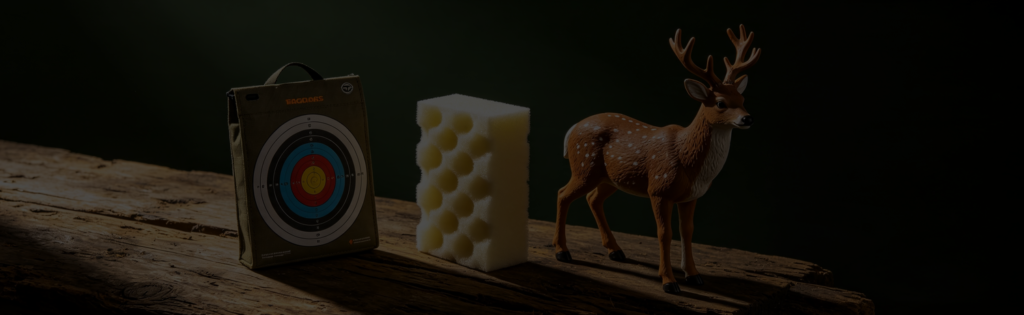
The best archery target depends on your draw weight and whether you shoot field points or broadheads. For most beginners shooting field points under ~50 lbs, a bag target is the best value. For broadheads or higher-poundage bows, a foam or layered block target is best. For hunting practice, a 3D target is best. Buy a target rated at or above your bow’s draw weight, and never shoot broadheads into a bag target.
Fletchwise guides are independent and hype-free – we are not sponsored by any archery brand.
Best Target by Situation
Best for Beginners & Value
A bag target. It is the cheapest per shot, arrows pull out with two fingers, and it handles high-volume field-point practice all day. The only rule: field points only, never broadheads — blades shred the woven shell and loose fill, and once the shell is cut the stopping surface is ruined for field points too. A bag target typically lasts a year or two of regular practice before the fill settles and stopping power goes patchy.
Best for Broadheads & Mixed Use
A foam block target rated for broadheads. One target covers field-point practice and broadhead tuning, and most have multiple faces to spread the wear — see foam targets. Count broadheads through the block, not arrows through it: once the centre goes soft, a field point can bury to the fletching where it used to stop cleanly. A dense block typically lasts a couple of years before the middle needs replacing.
Best for High Draw-Weight Bows & Crossbows
A layered (high-density) block. It is built to stop fast, heavy arrows without pass-throughs and lasts the longest of any flat target, sometimes three to five years. The trade-off that catches people off guard: arrow removal from a high-density block is genuinely hard, especially at short range. Arrow lube on the first few inches of the shaft makes a real difference — a small tube lasts a long time.
Best for Hunting Practice
A 3D animal target. It trains distance judgment and spot-picking on a realistic shape, with a replaceable vital core — see 3D targets. Budget for a replacement core roughly every season or two of regular use; the core is the part that wears out first, and it typically costs about a quarter of a whole new target.
Best for Tight Spaces & Portability
A compact foam block or a bag target with a handle – light enough to move and store easily.
Stopping Power vs Easy Arrow Removal: The Trade-Off Nobody Explains
Every target balances two things that pull in opposite directions. Higher density stops arrows better, especially from fast, heavy setups, but it grips the shaft harder and makes pulling each arrow a workout. Lower density lets you pull with two fingers — which matters when you are shooting a hundred arrows in a session — but a high-poundage bow will walk arrows through it faster. The mistake most beginners make is buying too much stopping power for a 40-pound bow and spending more time pulling than shooting.
The rough guide: under about 50 lbs with field points, a bag or lighter foam block pulls easily and stops fine. From 50-65 lbs, a mid-density foam or block balances both. Above 65 lbs or with a crossbow, high-density layered blocks earn their tough pull by being the only thing that reliably stops the arrow at close range. If you go high-density, budget a few dollars for arrow lube — a small dab on the front few inches of the shaft before shooting cuts removal effort noticeably and costs almost nothing per session.
How to Choose: The Checklist
- Match the draw-weight rating. Buy a target rated at or above your bow’s poundage to avoid pass-throughs.
- Field points or broadheads? Broadheads need a foam or block target, never a bag.
- Indoor or outdoor? Outdoors, pick a weather-resistant target or store it under cover.
- Stopping power vs removal. Match density to your bow – do not over-buy density you do not need.
- Multiple faces. More shootable sides means longer life.
- Height and mounting. About 51 inches to the center is the standard aiming height – see our target stand guide for getting there without the stand shifting when hit.
What to Avoid
Avoid under-rating the target for your bow (the fastest way to a pass-through and a ruined target), shooting broadheads into a bag, and leaving any target out in the sun and rain. Replace a target once the center is shot out and soft – a worn target is a safety risk, not just a performance one.
The Target Is Only Half the Safety Question
Everything above is about what the target itself does. Just as important, and rarely covered in the same breath, is what happens behind it – a missed shot or a pass-through does not stop just because it left the target, it keeps travelling.
Give a home range at least 25-30 yards of clear space beyond the target and backstop before anything you cannot afford to hit – a fence, a shed, a road, a neighbour’s yard. If your ground slopes, shoot uphill rather than down, so a missed arrow buries into the rise instead of sailing over a boundary. Orient the shooting lane away from foot traffic and windows, tell neighbours what you are doing before they find out from a stray arrow, and check local ordinances before you build anything – some municipalities restrict or ban backyard archery outright regardless of how good the target itself is, and crossbows are often restricted more tightly than bows. Our guide to checking backyard archery legality covers exactly how to look that up in about ten minutes. Our target stand guide covers the physical backstop hardware that catches what the target does not.
Specific target picks are coming as our shop launches. For now, use the situation guide and checklist above – matching the target to your draw weight and point type is what matters most.
Frequently Asked Questions
For field-point practice, a bag target offers the best value – cheap, long-lasting, and easy to pull arrows from. If you need to shoot broadheads, a foam block target is the best-value option that does both.
A high-density layered block target rated for your draw weight. It is built to stop fast, heavy arrows without pass-throughs and outlasts softer targets.
A foam or layered block target specifically rated for broadheads. Never use a bag target for broadheads – the blades shred the fibers. 3D targets rated for broadheads work too, ideally using the replaceable core.
Use a target rated at or above your bow’s draw weight, and replace it once the centre softens. Pass-throughs almost always mean the target’s stopping power is too low for your setup — or the centre has been shot out and the arrow is finding a worn channel through material that looks fine from the outside. Rotate faces regularly to spread the wear.
Because the target is higher density than your setup needs. High-density blocks stop fast heavy arrows reliably but grip the shaft hard, especially at close range where the arrow buries deeper. If you are shooting under about 50 lbs with field points, drop to a bag or lighter foam block — you are trading easy pulling for stopping power you do not actually need. Arrow lube on the front of the shaft helps on any target and costs almost nothing.
Roughly: a bag target one to two years before the fill settles and stopping gets patchy, a foam block about two years before the centre needs replacing, a high-density layered block sometimes three to five years, and a 3D target body several years with a replaceable core swapped every season or two ($25-50, roughly a quarter of a new target). Rotating faces to spread the wear and storing out of direct sun and rain extends any target’s life noticeably.
At least 25-30 yards of clear space beyond the target and backstop before anything you cannot afford to hit – a fence, a shed, a road, a neighbour’s yard. A miss or a pass-through does not stop when it leaves the target, so the space behind it matters as much as the target you buy. If your ground slopes, shoot uphill rather than down, and check local ordinances before setting up a home range – see our backyard archery legality guide for how to look that up.
About 51 inches to the center is the standard aiming height for most adult archers – low enough for a natural stance, high enough that you are not aiming down and quietly changing your form. Our target stand guide covers stands and mounting hardware that hold that height without shifting when hit.
Submit the Form to Get Our Product Catalog
What We Can Offer
- ✅ Low MOQ – from 1 piece, no minimum order
- ✅ Full customization – names, initials, club crests & team logos
- ✅ Mockup before production – see it before we make it
- ✅ Production time about 2 weeks after mockup approval
- ✅ Free remake on defects within 14 days of delivery
We reply to every inquiry within 1 business day.
Email: [email protected]
WhatsApp: +1 770 157 5807
Keep Reading
Archery Targets: Full Guide
All four target types compared – bag, foam, layered and 3D – matched to your draw weight and broadhead use.
Archery Targets: Full GuideBest Block Targets
How open-layer foam actually stops and releases an arrow, and why rotating faces matters more than the price tag.
Best Block TargetsBest Bag Targets
Why arrows suddenly punch through the top of a bag target – it is settled fill, not a worn-out target.
Best Bag Targets