
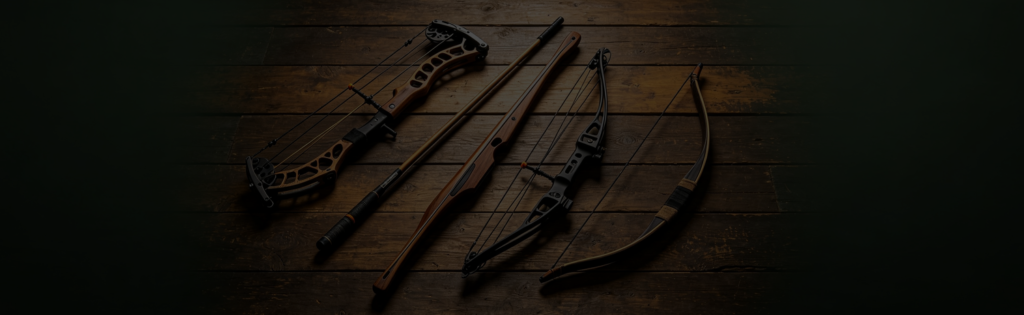
There are five main types of archery bows: the recurve (curved limb tips; Olympic and beginner standard), the longbow (a simple traditional stave), the compound (modern bow with cams and let-off), the crossbow (a horizontal bow on a stock, fired like a rifle), and traditional bows such as the horse bow. Recurves are the best all-round beginner choice, compounds are easiest to shoot accurately, and longbows and horse bows appeal to traditional and instinctive archers.
Fletchwise guides are independent and hype-free – we are not sponsored by any archery brand.
1. Recurve Bow
The recurve gets its name from limb tips that curve away from the archer, which adds speed and power for the bow’s size. It is the only bow used in Olympic target archery and the most recommended bow for beginners – see our beginner bow guide for why coaches default to it. Modern takedown recurves separate into a riser and two limbs, so they are easy to transport and let you raise draw weight by swapping limbs as you improve.
Best for: beginners, target archers, anyone who wants to learn pure form. Trade-off: you hold the full draw weight while aiming.
2. Longbow
The longbow is the simplest and oldest design – a tall, gently curved stave with a straight or lightly bent profile. It is quiet, forgiving of arrow tuning, and prized by traditional shooters, but it is the hardest type to shoot accurately because most have no sight and no cut-in arrow shelf.
Best for: traditional and instinctive archers who value simplicity. Trade-off: a steeper learning curve for accuracy.
3. Compound Bow
The compound uses cams and cables to store energy and “let off” 75-90% of the draw weight at full draw, so you hold very little while aiming. It is powerful, compact, and extremely accurate, and it accepts sights, rests, releases, and stabilizers. This is the dominant bow in bowhunting and target competition. See the full compound bow guide.
Best for: hunters and target archers who want power and precision. Trade-off: more complex and more expensive.
4. Crossbow
A crossbow mounts a short bow horizontally on a stock and fires short arrows called bolts. You cock it once and hold it like a rifle, aiming through a scope – so it needs little draw strength to hold on target. Crossbows are popular with hunters who want bow-season access with a gun-like shooting experience.
Best for: hunters who prefer a rifle-style shot or have physical limits on drawing a vertical bow. Trade-off: heavier, slower to reload, and regulated differently in some areas.
5. Traditional & Horse Bows
This family includes historical designs like the Mongolian, Hungarian, and Scythian horse bow – short, fast, often recurved bows originally built for shooting from horseback. They are growing in popularity for instinctive shooting, history, and their distinctive feel.
Best for: traditional archers and history enthusiasts. Trade-off: instinctive shooting takes dedicated practice.
The One Number That Explains Almost Everything Else
Every comparison above talks about accuracy, learning curve, and fatigue as if they were separate issues. They are almost all downstream of a single number: how much of the draw weight you are actually holding while you aim. Line the five families up on that one measurement and most of their other differences fall out of it automatically.
| Bow type | Weight held at full draw | Typical arrow speed | What that means in practice |
|---|---|---|---|
| Recurve | 100% – the full peak weight, the whole time | ~180-220 fps | You aim and release quickly, because holding tires you within seconds |
| Longbow | 100% – no let-off mechanism exists | ~160-170 fps | Same fast-release discipline as a recurve, slightly slower arrow |
| Compound | 10-25% (75-90% let-off) | ~280-300+ fps | You can hold, settle the pin, and wait several seconds for the shot to feel right |
| Crossbow | 0% – cocked and mechanically locked | ~300-500 fps | You can wait indefinitely for a clean shot with zero holding effort at all |
| Traditional / horse bow | 100% – same no-cam physics as a longbow | Broadly recurve/longbow range, often lower (shorter draw, lighter bows) | Fast, instinctive shots – the style is built around not holding at all |
That is why “which type is easiest to shoot accurately” and “which type suits a patient hunter waiting for the perfect angle” are really the same question wearing different clothes. A crossbow or compound lets you hold through a moment of doubt; a recurve, longbow, or traditional bow punishes hesitation, so those styles are built around a fast, committed release rather than a long aim.
What Each Type Costs to Get Started
- Recurve – roughly $200-400 for a decent takedown with basic accessories.
- Longbow – roughly $100-400 for a serviceable entry stave, similar to a recurve.
- Compound – roughly $400-600 for a ready-to-hunt package with sight, rest and quiver fitted.
- Crossbow – roughly $300-650 for an entry-to-midrange hunting-ready package.
- Traditional / horse bow – roughly $100-400 for a basic fiberglass model; handcrafted premium bows run well into four figures.
None of these numbers include arrows, a target, or – for compound and crossbow – the release, rest and sight that a “just the bow” price often leaves out. See our bow accessories guide for what a full compound setup actually costs beyond the sticker price.
How to Pick the Right Type
- Learning and target practice? Start with a takedown recurve.
- Hunting or fast accuracy? Choose a compound, or a crossbow if you prefer a rifle-style shot.
- Tradition and simplicity? Go with a longbow or horse bow.
- Unsure? A recurve is the most flexible, affordable starting point and teaches skills that carry to any bow.
Frequently Asked Questions
Most archers group bows into five main types: recurve, longbow, compound, crossbow, and traditional bows (such as the horse bow). Within those families there are many sub-styles, like takedown recurves and reflex-deflex longbows.
The compound bow, because let-off lets you hold steady while sights, a rest, and a release aid make aiming and triggering very consistent. Crossbows are also easy to shoot accurately thanks to their rifle-like setup.
The recurve. It is affordable, teaches proper form without mechanical aids, and the takedown design lets new archers increase draw weight gradually by changing limbs.
Yes – a crossbow is a bow mounted horizontally on a stock and fired like a rifle. It uses the same stored-energy principle but is cocked once and held mechanically, so it shoots short bolts rather than full-length arrows.
Because of how much draw weight each one makes you hold while aiming. A recurve or longbow gives you no mechanical help, so you hold 100% of the peak weight the whole time you aim, which tires you within seconds and forces a fast release. A compound’s cams let off 75-90% of that weight at full draw, so you are only holding 10-25% of it – enough to settle the pin and wait several seconds for a good shot. A crossbow removes the holding altogether, since it cocks once and locks mechanically.
Crossbows, typically in the 300-500 fps range, followed by compounds at roughly 280-300+ fps in a realistic hunting setup. Recurves usually run about 180-220 fps and longbows around 160-170 fps at hunting draw weights – recurves are generally 10-20 fps quicker than a longbow of similar weight and length because of the reverse-curved limb tips.
Recurve, longbow, and basic traditional/horse bows are all in a similar entry range, roughly $100-400 for a serviceable setup. Compounds run somewhat higher at roughly $400-600 for a ready-to-hunt package, and crossbows span roughly $300-650 for entry-to-midrange. None of these figures include arrows, a target, or the extra accessories a compound or crossbow needs before it is actually shootable.
Submit the Form to Get Our Product Catalog
What We Can Offer
- ✅ Low MOQ – from 1 piece, no minimum order
- ✅ Full customization – names, initials, club crests & team logos
- ✅ Mockup before production – see it before we make it
- ✅ Production time about 2 weeks after mockup approval
- ✅ Free remake on defects within 14 days of delivery
We reply to every inquiry within 1 business day.
Email: [email protected]
WhatsApp: +1 770 157 5807
Keep Reading
Archery Bows: Full Guide
Recurve sizing, ILF vs proprietary limb fittings, and why a 25 lb bow can feel harder to hold than 40.
Archery Bows: Full GuideCompound Bows Guide
How let-off, cam type and axle-to-axle actually work, and every spec worth caring about before you buy.
Compound Bows GuideHorse Bow Archery
What separates a real horse bow from a marketing label, and the draw style that makes it work.
Horse Bow Archery