
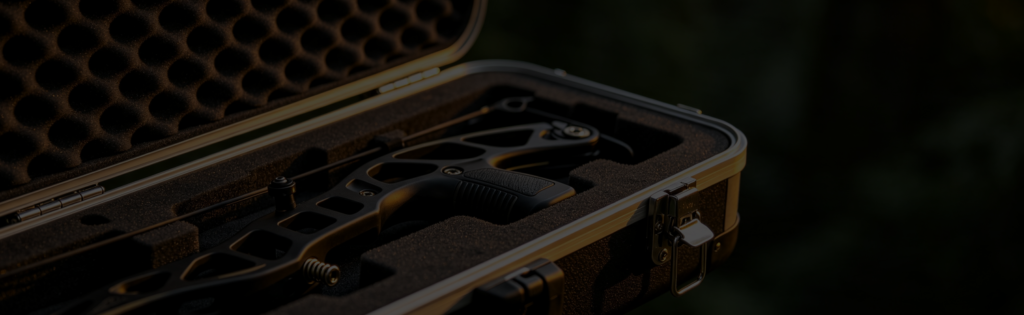
Work through three questions in this order. One: how long is your bow really? Measure cam edge to cam edge, not axle-to-axle, and add 1-2 inches – this alone rules out most cases, and at 40 inches and up it rules out the large majority. Two: do you fly with it? If yes, weight and crush resistance dominate; if no, convenience does. Note that TSA does not require a hard case for bows, only that they are checked. Three: does the case hold the bow still? A bow loose inside a hard shell is less protected than one strapped firmly in a soft one. Answer those and the shortlist is usually two or three cases, whatever any ranking says.
Fletchwise guides are independent and hype-free – we do not sell cases and there are no affiliate links here. We do not publish ranked product picks we cannot stand behind.
Question 1: How Long Is Your Bow, Really?
This is first because it is disqualifying. Axle-to-axle is measured between the cam axles and therefore excludes the cams themselves, which stick out past the axles at both ends – often by an inch or more. Your bow’s packing length is cam edge to cam edge, and it is that number, plus 1-2 inches of clearance, that a case has to beat on the inside.
Get this wrong and nothing else matters: people regularly buy well-reviewed cases with more interior length than their bow’s ATA figure and find the cams will not clear. The step-by-step is on our measuring a compound bow for a case page, and it takes two minutes with a tape.
Two shortcuts worth knowing. Most listings quote exterior dimensions, so treat any interior figure as the only number that counts and assume less space if it is not stated. And if your bow is 40 inches ATA or more, skip straight to large and XL cases – the mainstream market is built around 30 to 38 inch bows and most of it will simply not take yours.
Question 2: Do You Fly With It?
Flying changes the answer more than any other factor, and it does so for a reason people usually get wrong. TSA’s published requirement for bows and arrows is that they travel as checked baggage – there is no hard-shell rule of the kind that applies to firearms. So “airlines require a hard case” is not a regulation; it is a reasonable inference from how checked bags get handled.
What that means practically is that you are trading, not complying:
| How you travel | Go with | Because |
|---|---|---|
| Car only, range and local hunting | Soft | Faster in and out, carries on a shoulder, stores flat |
| Occasional direct flight, budget rig | Airline-grade soft | Saves allowance weight; accept some crush risk |
| Flights with connections | Hard | More handling events, more chances to be stacked under freight |
| Expensive target or hunting rig, any flight | Hard | Crush protection is the one thing fabric cannot give you |
| Weekly shooting plus a trip or two a year | Both | Soft lives in the truck, hard comes out for travel. Common setup |
The weight trap catches people who assume hard is strictly safer: airline checked-bag limits are enforced on the scale, and a heavy hard case can eat a large share of your allowance before the bow, arrows and gear are inside. Sizing up to a bigger hard case can put you over the limit and cost you a fee on every leg.
Question 3: Will It Hold the Bow Still?
This is the question that separates cases within a category, and it is the one product rankings handle worst because it depends on your bow’s shape rather than the case’s specification.
What actually damages a bow in transit is a short list: point loads on the cams and limb tips, crushing from above, and knocks that push the sight out of zero. Every item on that list is about the bow moving relative to the case or the case deforming onto the bow. A general impression of sturdiness does not address any of it.
So look for: pluck or contoured foam that can be shaped around your cams; internal straps that hold the bow against a panel rather than just filling space; enough depth that the lid closes without pressing on the sight; and a stated plan for the stabilizer and quiver, which are usually removed. Then load it, close it, and shake it. If anything shifts, it will shift for eight hours in a baggage hold too.
Common Mistakes, In the Order People Make Them
- Buying to ATA. The single most common cause of a case not fitting. Measure cam edge to cam edge.
- Trusting exterior dimensions. Foam takes a substantial bite out of a hard case’s interior.
- Assuming a hard case means a protected bow. Loose inside a shell is worse than snug in fabric.
- Forgetting the accessories decision. Travelling with quiver and stabilizer mounted changes every dimension.
- Ignoring airline weight limits. They bite before the case’s own size does, and they bite every leg.
- Leaving a bow in a damp case. Storage damage is slower and more common than transit damage. Dry the case, not just the bow.
- Not shooting after a trip. Sights lose zero invisibly. Check on the range, not at a stake.
Why There Is No Ranked List Here
Because a ranked list would be dishonest at this point. Case models change every year, fit depends on a bow we have not measured, and the honest answer to “which is best” is genuinely “the one that clears your cams by an inch and holds the bow still”. Any site that ranks cases without knowing your bow’s real length is ranking on brand recognition and affiliate rates.
What we can do is narrow it properly. Work through the three questions above, then go to whichever page matches your answer: hard cases for crush protection and travel, soft cases for weight and convenience, large and XL if you are over 40 inches, and measuring if you have not taken a tape to the bow yet. The category overview lives on our bow cases guide.
Carrier policies on sporting equipment differ by airline and route, and they change. TSA’s rule is the floor, not the whole picture – check the specific airline before you book, and again before a route you have not flown recently.
Frequently Asked Questions
Interior length against your bow’s real measurement – cam edge to cam edge, not axle-to-axle, plus 1-2 inches. It is first because it is disqualifying: a case that does not physically fit cannot be the right case regardless of how good it is otherwise.
No. TSA’s stated requirement is that bows travel as checked baggage – the locked hard-case rule people are thinking of applies to firearms. Individual airlines set their own sporting-equipment policies, so confirm with your carrier. The case for a hard shell is baggage handling, not regulation.
Soft for car travel, walking in and weekly use; hard for flights with connections or an expensive rig. If you fly occasionally on a tight weight allowance, a good airline-grade soft case is a legitimate choice. Many regular shooters own both and use them for different jobs.
Only if the extra money is going into fit and restraint. Foam that shapes around your cams, straps that hold the bow to a panel, and a lid that closes without pressing on the sight are worth paying for. Brand name and general sturdiness are not, and a premium case that lets the bow move is worse than a budget one that does not.
Load it, close it, and shake it. If the bow shifts at all, it will shift for the whole flight. Also check the lid closes without pressure on the sight, and that nothing is resting against the cams or limb tips – those are the point-load failures that matter.
An oversized or specialist one. The mainstream market is built around bows in the 30 to 38 inch range, and most production cases – hard ones included – will not take a bow at 40 inches ATA or above. Remember your real length is longer than the ATA figure, so a 40 inch ATA bow needs well over 40 inches of interior.
Only if the case and the bow are dry. Long-term storage in a damp case does more cumulative harm than most transit does – it holds moisture against the string, cables and any steel hardware. Dry both after a wet session, and store somewhere with stable temperature rather than an unheated garage in a cold climate.
Submit the Form to Get Our Product Catalog
What We Can Offer
- ✅ Low MOQ – from 1 piece, no minimum order
- ✅ Full customization – names, initials, club crests & team logos
- ✅ Mockup before production – see it before we make it
- ✅ Production time about 2 weeks after mockup approval
- ✅ Free remake on defects within 14 days of delivery
We reply to every inquiry within 1 business day.
Email: [email protected]
WhatsApp: +1 770 157 5807
Keep Reading
Measuring for a Case
Why axle-to-axle is the wrong number to size a case by, and the measurement that actually matters.
Measuring for a CaseHard Bow Cases
Shells, foam and sizing, plus the airline rules that actually apply versus the ones everyone assumes.
Hard Bow CasesSoft Bow Cases
When soft genuinely beats hard, and the real TSA rule most airlines-require-a-hard-case claims get wrong.
Soft Bow Cases