

Foam targets come in three constructions: open-layered friction foam (easiest arrow removal, takes broadheads), solid or high-density foam (hardest stopping, hardest pull when new), and self-healing foam (marketing for closed-cell foam that closes its entry hole – it wears like any other foam). Match depth and density to your setup, not to the picture: a fast hunting bow at short range needs more target than a 20 inch cube. And the honest measure of a foam target’s life is not how many arrows it has taken, it is how many broadheads – those cuts never close, and a broadhead-shot target can stop failing to hold field points it caught easily when new.
Fletchwise guides are independent and hype-free – we are not sponsored by any target brand.
The Three Constructions
Open-Layered Friction Foam
Sheets of foam stacked without glue between them. The arrow parts the layers rather than boring through, and friction along the shaft stops it. This is the construction behind Field Logic’s BLOCK line and the reason those targets pull so easily – covered in detail on our block archery targets page. Best choice if you shoot both field points and broadheads into one target.
Solid and High-Density Foam
A single dense mass, sometimes with a printed or replaceable face. It stops arrows by displacement, which means excellent stopping power at range and a genuinely hard pull when the target is new. Removal loosens as the foam takes shots. Broadheads tear the printed face on the way out, so face-style targets and broadheads are a poor pairing.
Self-Healing Foam
Closed-cell foam that closes its entry hole visually after the arrow is pulled. It is a real property, not a lie – but “self-healing” describes the cosmetic surface, not restored stopping power. The material is still being compressed and cut with every shot. Treat the label as a description of how the target looks after a season, not how it performs.
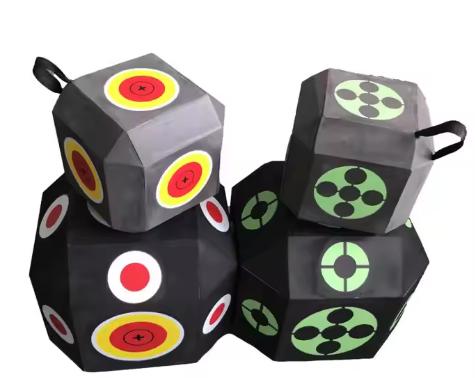
EVA vs Polyethylene: The Material Question Nobody Names
Every foam target guide compares open-layered, solid, and self-healing construction – almost none say what the foam itself actually is, and it matters more than the construction category. The two materials you will actually run into are closed-cell, cross-linked polyethylene (PE) and EVA (ethylene-vinyl acetate). PE’s cross-linked cells do not connect to each other, which is what gives commercial cube targets like BLOCK and Rinehart both their stopping power and their near-total resistance to water – moisture has no open path through the foam. EVA is softer, more flexible, and easier to pull an arrow from, which is exactly why it is the foam in the interlocking gym mats people stack for a DIY target – it is not a lesser foam, it is a different trade-off: less outdoor durability and stopping power per inch, in exchange for a cheaper, softer, easier-pull target.
The practical takeaway: if a listing does not name the foam, assume PE for a purpose-built outdoor cube and EVA for interlocking mat-style targets. Buy PE if the target lives outside year-round – EVA’s more open structure absorbs and holds water rather than shedding it, which shortens its life outdoors faster than UV alone.
Depth and Density vs Your Bow
This is the calculation almost nobody does before buying, and it is the one that decides whether arrows pass through. Stopping distance depends on arrow speed and arrow weight against foam density – a 340 fps hunting bow delivers far more energy into a target than a 45 lb recurve, and it does it at short backyard distances where the arrow has lost almost nothing.
| Your setup | Practice distance | What you need |
|---|---|---|
| Youth or recurve, under 40 lb | 10-20 yd | Any youth-rated foam cube, or a bag target |
| Mid-weight compound, 50-60 lb | 20-30 yd | 18-20 inch layered foam is comfortable here |
| Fast hunting compound, 65-70 lb | Under 20 yd | Go deeper or larger – this is where pass-throughs happen. See large targets |
| Fast hunting compound, 65-70 lb | 30-40 yd | A standard layered target is fine – distance has done the work for you |
| Crossbow | Any | Crossbow-rated target only – check the rating explicitly, bolt energy is high |
The counter-intuitive line in that table is the one people get wrong: a heavy bow is hardest on a target at close range, not far. If you are limited to a 15 yard backyard, buy more target than the poundage suggests. Light, fast carbon arrows penetrate more readily than heavy ones for the same bow, which is worth knowing if you shoot both.
What Actually Kills a Foam Target
Every buying guide talks about lifespan in vague terms – “thousands of shots”, “long-lasting”. Here is the specific mechanism, because it changes how you should use the target.
Field points displace foam. Each shot compresses and slightly tears the material at the entry, and the wear accumulates gradually in a cone around your aiming point. That is the slow, expected kind of wear, and it is why the center of any target goes soft first: it is where everyone aims.
Broadheads do something different. They cut. A fixed blade slices the foam along its edges as it passes, and in a layered target those cuts sever the very friction faces that do the stopping. Nothing about that heals. The measurable result is the thing that catches people out: archers report punching clean through the center of a foam target at 40 yards after a season of broadhead practice – on a target that would still have been stopping field points had broadheads never touched it. The target did not “wear out”. It was cut open from the inside.
| How you use it | What fails first | How to stretch it |
|---|---|---|
| Field points only, one aiming spot | Soft cone in the center | Move the aiming point 3-4 inches each session; rotate sides |
| Field points, multiple spots | Even surface wear – the good case | Keep it dry and out of UV; foam degrades in sun |
| Broadheads, same spot as field points | Stopping power, everywhere – fastest way to ruin a target | Dedicate one face or one corner to broadheads only |
| Broadheads, dedicated target | That target, on schedule | Correct approach – see broadhead targets |
The single cheapest thing you can do is stop aiming at the same spot. Most foam targets are printed with several aiming points and shot on two or four sides for exactly this reason, and using them properly is worth more than the difference between brands.
Removal, and Why New Targets Feel Wrong
A brand new high-density target can be genuinely difficult to pull from, to the point that people assume they bought the wrong thing. It usually loosens after the first few dozen shots as the foam takes a set. Before you fight it: pull straight in line with the shaft, twist slightly rather than levering, and use an arrow puller or a rubber grip pad. Levering an arrow sideways is how carbon shafts get damaged, and a damaged carbon shaft should be retired rather than shot.
If easy removal is your priority from the start, open-layered construction is the design that solves it – not a higher price on a solid target. The open-layer page explains the friction mechanism behind that.
Cold weather adds a separate factor on top of a target simply being new: foam stiffens as temperature drops, so a target that pulled easily all summer can suddenly feel tight again the first cold week of the season. It is not damage and the target is not failing – the material genuinely grips harder when stiff. Keep an arrow puller in your kit through winter and expect extra effort at retrieval no matter how broken-in the target already is.
When Foam Is the Wrong Answer
Foam is the default backyard target for good reason, but three cases point elsewhere. If you shoot high volume with field points and nothing else, a bag target costs less per year and pulls easily – the trade being that it cannot take broadheads at all. If you are practising for hunting at unknown distances and angles, a 3D animal target teaches shot placement that a cube cannot. And if pass-throughs are your problem rather than the target itself, the answer is a backstop or a bigger target, not a denser cube – our DIY target guide covers building a backstop cheaply.
Whatever you buy, get it to the right height. A target on the ground makes you aim downward and quietly changes your form; about 51 inches to the center is the standard, and our target stands guide covers getting there without the stand shifting when hit. For the full category comparison, start at how to pick a target.
There are no affiliate links on this page. Always check the manufacturer’s stated arrow-speed and poundage rating for the specific model – ratings differ between a brand’s own lines, and a youth model is not a light-duty adult model.
Frequently Asked Questions
Count broadheads, not arrows. Field point practice wears a soft cone into the center over thousands of shots. Broadheads cut the foam, and those cuts do not heal – a target shot with broadheads for a season can fail to stop field points it caught easily when new. Moving your aiming point and rotating sides does more for lifespan than paying more.
Into open-layered friction foam, yes – it is designed for it. Into a foam-face target, avoid it: the printed face tears when you pull a broadhead back out. Either way broadheads shorten the target’s life significantly, so dedicate one side or one corner to them.
Either the target is undersized for your bow, or the center is worn. Counter-intuitively, a fast heavy bow is hardest on a target at close range – at 15 yards the arrow has lost almost no speed. If you are shooting 65-70 lb inside 20 yards, buy deeper than the poundage rating suggests, and stop shooting a target whose middle is letting arrows bury to the fletching.
Cosmetically, largely yes – closed-cell foam closes the visible entry hole. But that describes appearance, not restored stopping power. The material is still compressed and cut with each shot, so treat “self-healing” as a statement about how the target looks after a season rather than how it performs.
Bag targets are cheaper per year, pull easily and are excellent for high-volume field point practice, but they cannot take broadheads and they do badly in the rain. Foam costs more and handles broadheads. If you practise with the same broadheads you hunt with, that decides it.
High-density foam is at its tightest when new and usually loosens over the first few dozen shots. Pull straight in line with the shaft with a slight twist rather than levering sideways, and use an arrow puller. If easy removal matters to you from day one, buy open-layered construction rather than a denser solid target.
Sun does more damage than rain to most foam. UV breaks the foam down and makes it crumble at the entry holes, while water mainly matters for bag targets whose fill absorbs it. A foam target can live outdoors through a season, but it will last noticeably longer under a cover or in a shed between sessions.
Cold stiffens foam, separately from whether the target is new. A target that pulled easily all summer can grip noticeably tighter the first cold week of the season – that is the material genuinely stiffening, not damage or a target wearing out. Keep an arrow puller in your kit through winter and expect extra effort at retrieval regardless of how broken-in the target already is.
Polyethylene (PE) is closed-cell and cross-linked, which is what gives commercial cube targets their stopping power and near-total water resistance – the sealed cells give moisture no path through the foam. EVA is softer and easier to pull arrows from, and it is the foam used in interlocking gym mats people stack into DIY targets, but its more open structure absorbs water and degrades faster outdoors. If a listing does not name the foam, assume PE for a purpose-built outdoor cube and EVA for mat-style builds.
Submit the Form to Get Our Product Catalog
What We Can Offer
- ✅ Low MOQ – from 1 piece, no minimum order
- ✅ Full customization – names, initials, club crests & team logos
- ✅ Mockup before production – see it before we make it
- ✅ Production time about 2 weeks after mockup approval
- ✅ Free remake on defects within 14 days of delivery
We reply to every inquiry within 1 business day.
Email: [email protected]
WhatsApp: +1 770 157 5807
Keep Reading
Block Targets
How open-layer foam actually stops and releases an arrow, and why rotating faces matters more than the price tag.
Block TargetsBag Archery Targets
Why arrows suddenly punch through the top of a bag target – it is settled fill, not a worn-out target.
Bag Archery TargetsBroadhead Targets
Why the FPS rating on the label matters more for crossbow shooters than the word broadhead printed on it.
Broadhead Targets