
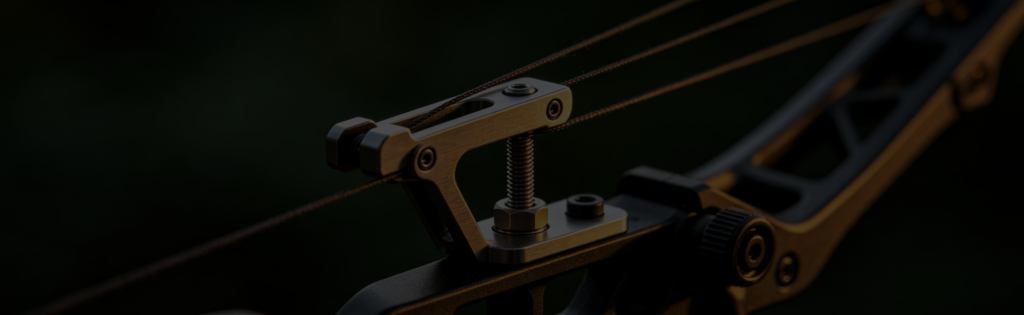
A compound bow press flexes the bow’s limbs to relax the string and cables, so you can change strings, adjust cams and modules, install a peep, or service the rest and cable guard. Portable presses start around $50 and shop-grade units pass $1,000, while a pro shop typically charges $15-$30 in labor to fit a string. That means a press rarely pays for itself on string changes alone – most archers change strings only every couple of years. Buy one because you tune often and want to stop waiting on a shop, not because you expect to save money. Recurve and longbow shooters never need one.
Fletchwise guides are independent and hype-free – we are not sponsored by any archery brand and we do not sell bow presses.
Never use a makeshift press or one not rated for your bow. Modern bows (especially parallel-limb and past-parallel designs) require a press that supports the correct limb contact points. The wrong press can damage limbs or injure you.
What a Bow Press Does
At rest, a compound’s limbs hold the string and cables under heavy tension. A press squeezes the limbs inward to take that tension off, so the string and cables go slack enough to work on. With the bow pressed you can swap a string or cables, install or move a peep, adjust cam timing and draw modules, and service the rest and cable guard.
This is the part that surprises new compound shooters: unlike a recurve or longbow, you cannot unstring a compound by hand. The cams hold the limbs loaded even at the lowest draw weight setting, so any job that needs slack in the string needs a press – or a trip to the shop.
What You Can and Cannot Do Without a Press
Plenty of routine maintenance and tuning needs no press at all. Knowing which side of the line a job falls on is the fastest way to work out whether you need to own one.
| No press needed | Press required |
|---|---|
| Waxing the string and cables | Replacing a string or cables |
| Sight adjustment and sighting in | Installing or moving a peep sight |
| Arrow rest position and center shot | Changing cam modules or draw length on module-swap bows |
| Tying or replacing a D-loop | Correcting cam timing and synchronization |
| Nock point and paper tuning | Fitting string stops or dampeners that sit between the strands |
| Draw weight changes within the limb bolt range | Replacing limbs, or any work behind the cable guard |
If everything you want to do sits in the left column, you do not need a press. That covers most archers for their first couple of seasons.
Does a Bow Press Pay for Itself?
This is the question the buying guides skip, because most of them earn a commission on the press. Here is the arithmetic with real numbers.
Portable presses generally start around $50, bench units run into the low hundreds, and shop-grade presses pass $1,000. On the other side, fitting a string is one of the cheaper jobs a pro shop does: archers commonly report $15-$30 in labor, and Bass Pro has been quoted at roughly $10-$15. The catch is that many shops charge a premium – reports of $60-$100 are common – if you did not buy the string from them. The string itself, usually $50-$200, is a cost you pay either way.
| You are | String changes | Labor saved | Time to repay a $100 press |
|---|---|---|---|
| A weekend shooter | About every 3 years | ~$25 each | Roughly 12 years |
| Shooting heavily (~2,500 shots a year) | About yearly | ~$25 each | About 4 years |
| Buying strings online, not from your shop | Any | $60-$100 each | 1-2 changes |
So the honest answer: on string changes alone, a press almost never repays a casual archer. It repays quickly in one specific case – you buy your own strings online and your shop charges the outside-string rate.
The real argument for owning one is not money at all. It is turnaround. A press means you can re-time cams the night before a shoot, try a different peep height without booking a slot, and keep tinkering until the bow is right. If you tune constantly, that is worth far more than the labor you save. If you shoot a well-set-up bow and leave it alone, it is not.
Service pricing does vary by region and shop. The Archery Trade Association’s nationwide look at pro shop service pricing is a useful reference point, and the fastest check is still to phone the shop you would actually use.
Portable vs Bench Presses
Portable Presses
Compact, affordable, and travel-friendly – they clamp the limbs and press with a screw or strap. Some fold down to a couple of inches thick and weigh only a few pounds, so they live in a tackle bag or backpack. Great for basic home maintenance, hunting camp, and travel. The trade-off is less control for fine work, and a narrower range of limb designs they fit. Make sure the model is rated for your bow.
Bench Presses
Mounted to a workbench, with adjustable fingers that suit many bow designs and far more control for precise work. Typical units cover a wide axle-to-axle span – commonly somewhere in the 11 to 54 inch range depending on model – and are rated to the draw weights most compounds run. Better for shops, clubs, or anyone working on bows regularly.
Will It Fit Your Bow? Limb Design Comes First
Press compatibility is decided by limb geometry, not by brand. On older bows with a pronounced limb angle, a press could push on the limb tips safely. Modern parallel-limb and past-parallel designs place the limbs almost flat to each other, so pressing at the wrong point can twist a limb or crack it.
Two things to check before you buy: whether the press supports your bow’s limb contact points, and whether it clears your cable guard and cams at full compression. Manufacturers publish compatibility lists for exactly this reason – read them before you spend, not after. If your bow is a hybrid, binary or single-cam design with unusual geometry, that list is the only thing that matters.
What Actually Goes Wrong
Every guide tells you to be careful. Few say what the failure actually looks like, so here it is. The common ways people damage a bow or hurt themselves with a press are: pressing at the wrong contact point so a limb twists out of the fingers; releasing pressure unevenly so one cam jumps and the string derails; letting a cable slip off the guard while the bow is compressed; and pressing a bow whose limbs already have a crack or splinter that nobody looked for first.
None of those are exotic. All of them are avoidable by inspecting the limbs before you press, going slowly and evenly, and stopping the moment something binds. If you are not sure the press is seated correctly, that uncertainty is the signal to stop – a shop visit costs $20, and a set of limbs costs a great deal more.
A Press Is Not a Draw Board - Even Though One Can Fake Being the Other
“Bow press” and “draw board” get used almost interchangeably by newer archers shopping for tools, and they do two different jobs. A press relaxes the string and cables so you can work on a bow that is otherwise fully loaded – it does not hold the bow at full draw. A draw board does the opposite: it clamps the bow and winches the string back to full draw and holds it there, so you can watch cam rollover, check draw length at different peep or stop settings, or feel the draw force curve without an arrow in hand. You buy a press to change strings and cams; you add a draw board to test and diagnose how the bow actually draws. Some press manufacturers sell a draw board attachment that mounts to their own press for exactly this reason – the two jobs are related but not the same tool – and a few archers rig a rough version themselves, running paracord to a press’s extended arm and drawing it with a drill. It works as a shortcut, but a purpose-built draw board is safer and more controlled for regular use.
Do You Actually Need One?
Work through it in this order. Are the jobs you want to do in the left column of the table above? Then no – spend the money on arrows. Do you change strings roughly once a year or buy strings online at the outside rate? Then a press starts to make sense on cost alone. Do you tune often enough that waiting on a shop is the thing that actually annoys you? Then buy one, and buy the one rated for your limb design rather than the cheapest that ships tomorrow.
Recurve and longbow shooters never need a press – a stringer does the job for a few dollars. And plenty of experienced compound archers deliberately never buy one, because their shop is good, close and cheap. If you are still assembling a maintenance kit, the rest of it is covered in our archery tools guide.
We do not sell bow presses and there are no affiliate links on this page. Prices quoted are US market figures gathered from pro shop and archer-reported sources in 2026, and they move – treat them as a starting point and call your local shop for a current quote.
Frequently Asked Questions
It flexes a compound bow’s limbs to relax the string and cables so you can change strings, install or move a peep, adjust cams and modules, and service the rest and cables. It is essential for most serious compound maintenance.
Portable presses generally start around $50, bench presses run into the low hundreds, and shop-grade units pass $1,000. For comparison, a pro shop typically charges $15-$30 in labor to fit a string, so the press is the larger up-front cost by a wide margin.
Usually not on string changes alone. Saving roughly $25 in labor every couple of years takes about a decade to repay a $100 press. It repays fast in one case: you buy strings online and your shop charges the higher outside-string rate of $60-$100. Otherwise, buy a press for turnaround and convenience, not savings.
No. It is a common shortcut and a genuinely dangerous one on modern bows. Even at minimum draw weight the cams keep the limbs loaded, so you do not get usable slack, and most manufacturers specify a maximum number of turns the limb bolts may be backed out. Going past that can let a limb shift or come free under load. Check your bow’s manual for the stated limit and use a proper press or a shop.
Only if you plan to do your own compound string changes and tuning. Routine jobs – waxing, sight and rest adjustment, D-loops, paper tuning, draw weight within the limb bolt range – need no press at all. If a shop handles the rest for you, you do not need one. Recurve and longbow shooters never need a press.
No – do not improvise. Modern compound limbs need a press that supports the correct contact points; makeshift methods can damage the bow or injure you. Use a proper press rated for your bow or have a shop do the work.
Yes, for home maintenance and travel – they are affordable and capable for string changes and basic tuning, as long as the model fits your bow’s limb design. Bench presses give more control for frequent or shop-level work.
No. A press relaxes the string so you can work on the bow at rest; a draw board clamps the bow and winches it back to full draw so you can inspect cam rollover, draw length, and the draw force curve. Some press makers sell a draw board attachment that mounts to their press, since the two tools serve related but different jobs.
Only if you tune seriously. A press alone covers string changes, cam and peep adjustments, and cable service. A draw board is worth adding on top if you want to inspect cam timing through the draw cycle or test different draw lengths without shooting a bow that is not yet dialed in – it is a diagnostic add-on, not a replacement for the press.
Submit the Form to Get Our Product Catalog
What We Can Offer
- ✅ Low MOQ – from 1 piece, no minimum order
- ✅ Full customization – names, initials, club crests & team logos
- ✅ Mockup before production – see it before we make it
- ✅ Production time about 2 weeks after mockup approval
- ✅ Free remake on defects within 14 days of delivery
We reply to every inquiry within 1 business day.
Email: [email protected]
WhatsApp: +1 770 157 5807
Keep Reading
Bow Strings
When to actually replace a string, and why creep (permanent) and stretch (recoverable) are two different problems.
Bow StringsParts of a Compound Bow
Every component explained, from the riser and cams to the D-loop, so you can buy and tune with confidence.
Parts of a Compound BowArchery Tools
What a home arrow-building bench actually costs at three budget tiers, and the one tool most archers over-buy.
Archery Tools