
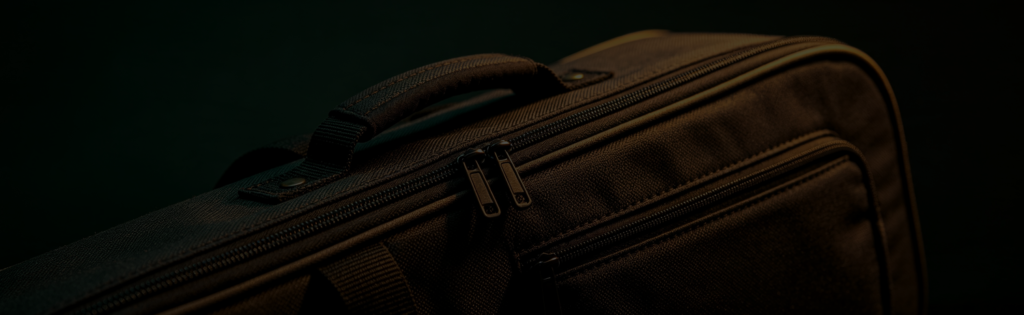
A soft bow case is a padded fabric bag with a full-length zip, internal straps and pockets for a release, arrows and tools. TSA’s stated requirement for bows is simply that they travel as checked baggage – there is no hard-shell rule, and no rule about lockable cases either. The practical argument for hard cases is baggage handling, not regulation. Where soft cases genuinely win: they are much lighter, which matters because airline weight limits bite before case dimensions do; they carry comfortably to a range or a stand; and they take up almost no space at home or in a truck. Where they lose: a soft case cannot stop something heavy being stacked on top of it.
Fletchwise guides are independent and hype-free – we are not sponsored by any case brand and we do not sell cases.
The Airline Rule That Is Not a Rule
Worth stating plainly because it drives a lot of unnecessary spending: the only requirement TSA publishes for bows and arrows is that you check them rather than carry them on. There is no federal requirement for a hard-sided case, unlike firearms, where the locked-hard-case rule is real and specific. People frequently conflate the two.
Individual airlines set their own baggage policies on top of that, and those do vary – some name sporting equipment explicitly, some apply oversize fees, some are more restrictive than TSA. So the honest instruction is: check your carrier, not the internet. The Archery Trade Association’s consumer arm keeps a useful guide to flying with bows that goes through the process end to end.
What remains true is the practical case for a hard shell. Checked baggage gets dropped, stacked and run over by loaders. A hard case resists crushing; a soft case does not. That is a real argument – it is just an argument about handling, not about compliance, and it means the decision is yours to weigh rather than a box to tick.
Where a Soft Case Is Genuinely the Better Choice
| Situation | Better choice | Why |
|---|---|---|
| Driving to the range, bow in the back seat | Soft | Faster in and out, no rigid shell to wrestle, stores flat |
| Walking in to a stand or a 3D course | Soft | Shoulder straps, and it packs down once you are set up |
| Flying, tight on baggage weight | Soft, if airline-grade | A hard case can eat much of your allowance before the bow goes in |
| Flying with an expensive target rig | Hard | Crush protection is the one thing fabric cannot provide |
| Checked bag on a connecting itinerary | Hard | More handling events, more chances to be stacked under something |
| Long-term storage at home | Either – keep it dry | A damp soft case against a bow is worse than no case |
The weight line is the one people underestimate. Airline checked-bag limits are enforced on the scale, and a heavy hard case can consume a large share of the allowance before the bow, arrows and accessories are inside it. Archers who fly regularly with a soft airline-grade case are usually optimising for that, not being careless.
The Linear-Inch Rule Most People Have Backwards
The other place airlines differ is not weight but size, and it interacts with the soft-vs-hard choice from a different angle than most people expect. Airlines measure baggage by linear inches (length + width + depth), and the standard limit most carriers use is 62 inches – but Delta and American specifically raise that to 102 linear inches for bow cases, while United publishes no such exemption and holds you to the standard 62. Our bow cases guide has the full breakdown, including why a typical hard case (roughly 44 x 20 x 10 inches, or 74 linear inches) clears the raised limit but not the standard one.
A soft case changes the stakes of that carrier lottery. Because it is not a rigid shell, it compresses somewhat at the edges and is far less likely to trip an oversize category built around a fixed box shape in the first place. If you fly a carrier without the bow exemption, or you are not sure which airline you will end up on for a connection, a soft case’s flexibility is a second, independent reason to prefer it – on top of the weight savings already covered above.
Not All Soft Cases Are the Same Product
The gap between a $40 bag and an airline-grade soft case is larger than the price suggests, and it is not mostly about the fabric. Look at four things.
Padding thickness and coverage. Thin foam over the flat panels and nothing at the ends is common. The ends are where the cams sit, and where the case gets dropped. Feel the corners, not the middle.
Internal restraint. Straps that actually hold the bow against a panel are what stop it moving. A bow sliding inside a padded bag will find the zip. This is the same principle that decides whether any case fits properly: immobilised beats armoured.
Zip and seam quality. On a soft case the zip is the structural failure point. A separating zip on a full case at a baggage carousel is the classic soft-case disaster, and heavy-gauge zips with a storm flap are worth paying for.
Lock points. If you fly, you want the zip pulls to accept a TSA-approved lock. Not because of a rule, but because it deters casual opening and lets TSA inspect without cutting anything.
Packing a Soft Case So It Works
A soft case rewards packing discipline in a way a hard case does not, because you are supplying the structure yourself.
Strap the bow down first, against the padded back panel, and check it does not shift when you shake the case. Pad the cams specifically – a sock, a towel, foam offcuts – since that is where impact concentrates. Protect the sight as its own item; knocking a sight out of zero is the most common transit damage and the least visible until you shoot. Take the stabilizer off, because it is a lever arm waiting to twist against something. Put arrows in a hard tube rather than loose in a pocket, and keep broadheads in a dedicated case for obvious reasons.
Do not use the outer pockets as padding by overstuffing them – that turns the case into a rigid, awkward parcel that gets handled worse, and it puts pressure on the bow from outside.
Whatever case you use, shoot a few arrows before you hunt or compete on a trip. Sights lose zero, rests shift, and limb damage can be invisible until it is loaded. Building 20 minutes of range time into the first day is cheaper than discovering it at a stake.
Soft, Hard, or Both?
Plenty of archers own both and use them for different jobs, which is the honest answer for anyone who shoots regularly and flies occasionally: a soft case lives in the truck and does the weekly work, a hard case comes out for trips. Buying only one, decide by the harshest thing you will routinely ask of it – the case has to survive its worst day, not its average one.
Whichever way you go, sizing comes first: measure cam edge to cam edge rather than trusting the axle-to-axle spec, as covered on our measuring page, and check the large and XL page if your bow is 40 inches or more. The full decision in order is laid out on choosing a bow case, and for the category overview start at the bow cases guide.
No affiliate links on this page. Airline baggage policies for sporting equipment change and differ by carrier and route – confirm with your airline before you book, and treat any general advice, including ours, as a starting point rather than the final word.
Frequently Asked Questions
Yes. TSA’s only stated requirement for bows is that they go as checked baggage – there is no hard-shell rule, which is a common confusion with the firearms rules. Individual airlines set their own sporting-equipment policies on top of that, so confirm with your carrier. The case for a hard shell is baggage handling, not regulation.
For driving, walking in and general storage, comfortably. For checked flights it depends on how much you are protecting: a good airline-grade soft case with the bow strapped down survives most trips, but nothing fabric will stop a heavy bag being stacked on top. If the bow is expensive or the itinerary has connections, go hard.
Weight. Airline checked-bag limits are enforced on the scale, and a hard case can consume a large part of your allowance before the bow is inside it. Archers who fly often with soft cases are usually managing that trade deliberately, accepting less crush protection for more usable allowance.
Padding that covers the ends and corners rather than just the flat panels, internal straps that genuinely hold the bow still, heavy-gauge zips with a storm flap, and lock points that take a TSA-approved lock. The zip is the structural weak point on any soft case, so that is where the money should go.
No rule requires one for bows, unlike firearms. A TSA-approved lock is still worth using on a checked case – it deters casual opening and lets inspectors get in without cutting anything. Make sure it is TSA-approved rather than a generic padlock.
Strap the bow to the padded back panel and shake the case to check it does not move. Pad the cams specifically, protect the sight as its own item, and remove the stabilizer – it is a lever arm. Arrows go in a hard tube, broadheads in a dedicated case. Do not overstuff the outer pockets; that presses on the bow from outside.
Many regular shooters do, and it is the sensible setup if you shoot weekly and fly occasionally – the soft case lives in the vehicle, the hard case comes out for trips. If you are buying one, choose for the harshest thing you will routinely ask of it rather than the typical case.
Often, and for a different reason than the weight savings covered elsewhere on this page. Airlines measure linear inches (length + width + depth); most cap standard baggage at 62, though Delta and American raise that specifically to 102 inches for bow cases while United does not. A soft case is not a rigid fixed shape, so it compresses somewhat and is less likely to trip an oversize category built around a box shape – useful insurance if you are flying a carrier without the bow-specific exemption. See our bow cases guide for the full linear-inch breakdown.
Submit the Form to Get Our Product Catalog
What We Can Offer
- ✅ Low MOQ – from 1 piece, no minimum order
- ✅ Full customization – names, initials, club crests & team logos
- ✅ Mockup before production – see it before we make it
- ✅ Production time about 2 weeks after mockup approval
- ✅ Free remake on defects within 14 days of delivery
We reply to every inquiry within 1 business day.
Email: [email protected]
WhatsApp: +1 770 157 5807
Keep Reading
Measuring for a Case
Why axle-to-axle is the wrong number to size a case by, and the measurement that actually matters.
Measuring for a CaseHard Bow Cases
Shells, foam and sizing, plus the airline rules that actually apply versus the ones everyone assumes.
Hard Bow CasesChoosing a Bow Case
A three-question decision tree instead of a ranked top-10 list – bow length, flying or not, and fit.
Choosing a Bow Case