
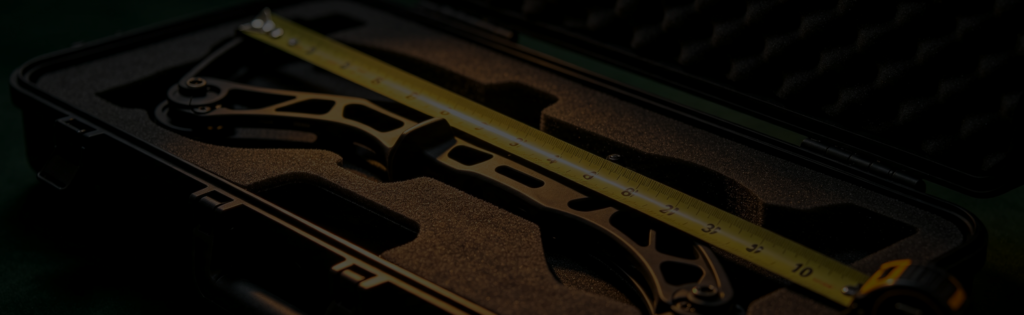
Do not size a case from axle-to-axle. ATA measures between the axles; your bow’s real length runs to the outer edges of the cams, which is longer. Measure cam edge to cam edge with a tape, then buy a case with at least 1-2 inches more usable interior length than that. Measure width too, at the widest point with the sight and rest mounted, and remember most cases quote exterior dimensions while the foam eats interior space. Bows at 40 inches ATA and above are genuinely hard to fit – the majority of production cases, hard ones included, will not take them.
Fletchwise guides are independent and hype-free – we are not sponsored by any case brand and we do not sell cases.
Why ATA Is the Wrong Number
Axle-to-axle is a spec that exists to describe how a bow shoots, not how it packs. It is measured between the centers of the two cam axles – so it excludes the cams themselves, which project past the axles at both ends. Depending on the cam system, that is easily an inch or more of bow that ATA does not account for, and it is at exactly the end of the bow that has to clear the inside of the case.
The result is a specific and common failure. Someone with a 29 inch ATA bow buys a case whose interior is comfortably longer than 29 inches, and the bow does not go in – the cams hit the ends. It happens with well-regarded cases and mainstream bows; forum threads about a Mathews V3 at 29 inches ATA not fitting a Pelican 1745 are a good example of how counter-intuitive it feels when it happens to you.
So the number you need is not on the spec sheet. You have to take it off the bow.
Measuring It Properly
| Measure | How | Add |
|---|---|---|
| Overall length | Outer edge of the top cam to outer edge of the bottom cam – not axle to axle | 1-2 inches |
| Width | Widest point with the sight, rest and quiver mount fitted as you store them | 1 inch |
| Depth | Across the limbs and cams at the thickest point, plus anything protruding | Enough that the lid closes without pressing |
| Quiver and stabilizer | Decide now whether they travel mounted or removed | Changes every number above |
Two traps in the specs themselves. First, most cases advertise exterior dimensions – the usable interior is smaller, and in a hard case the foam takes a substantial bite out of it. Look for a stated interior figure, and if the listing does not give one, assume less than you hope. Second, some listings quote the ATA rating of bows they fit, which puts you right back where you started; the interior length in inches is the number to trust.
If your bow is right at the limit of a case, foam is where the fit is won. Pluck foam can be reconfigured, and archers routinely rearrange or remove blocks to make a tight bow sit diagonally or nest around the cams. It is a legitimate fix, not a bodge – but it is easier to buy a case an inch longer.
The 40 Inch Problem
If your bow is 40 inches ATA or more – long target rigs, some older hunting bows, and plenty of recurve setups – you are in a small corner of the market. Most production cases, hard and soft, are built around the 30 to 38 inch bows that dominate sales, and above that the options thin out fast. Plan for a specialist or oversized case rather than assuming you will find something at a big-box store, and check our large and XL bow cases page for what that segment looks like.
The same applies in reverse to very short bows: they fit almost anything, but a bow rattling around in a much larger case is not protected either. Foam that holds the bow still is the point, and a bow with room to move in a hard case can arrive worse off than one in a snug soft case.
What the Case Has to Protect Against
Sizing solved, the other half is what you are protecting the bow from – and it is usually not what people assume. A bow is not fragile in the way glass is. The things that actually cause damage in transit are point loads on the cams and limbs, crushing from other bags stacked on top, and the sight taking a knock and losing its zero. Nothing in that list is helped by a case being generally sturdy; all of it is helped by the bow being immobilised.
That reframes the hard-versus-soft question. A hard case with the bow loose inside is worse than a soft case that holds it firmly. Once you have measured, the real questions are whether the foam grips your bow’s shape and whether the sight is protected from a direct hit – which is where the hard case and soft case pages pick up, and our choosing a bow case guide walks the whole decision in order.
Before You Order
Run this list. Have you measured cam edge to cam edge rather than reading ATA off the spec sheet? Does the case state an interior length, and is it at least 1-2 inches over your measurement? Have you decided whether the quiver and stabilizer travel mounted? If you are flying, does the case take TSA-approved locks – and have you checked the airline’s own size and weight limits, which bite before the case’s own dimensions do? Does the foam configuration suit your bow’s shape, or will you be reconfiguring it?
Get those five right and the case will fit. Get the first one wrong and none of the others matter. If you have not bought the bow yet, it is worth knowing that bow choice quietly constrains case choice – a 30 inch ATA hunting bow has a hundred cases to pick from and a 40 inch target rig has a handful.
Manufacturer ATA figures are nominal and cams vary between model years even within a line. Two minutes with a tape measure on your actual bow beats any number you can look up, and it is the only way to know how much cam sits outside the axles on your particular rig.
Frequently Asked Questions
Measure from the outer edge of the top cam to the outer edge of the bottom cam – not axle to axle – then add 1-2 inches. Measure the width at the widest point with the sight and rest mounted as you plan to store them, and add about an inch. Compare those figures against the case’s stated interior dimensions, not its exterior.
Because axle-to-axle excludes the cams, which project past the axles at both ends. Your bow’s real length is cam edge to cam edge, easily an inch or more longer than its ATA figure – and that extra length sits exactly where it has to clear the inside of the case. This is why a 29 inch ATA bow can fail to fit a case with more than 29 inches of interior.
Measure both ways and decide before you buy. Travelling with them mounted needs noticeably more case in every dimension; removing them is quick but means unpacking and remounting at the other end, and a stabilizer that comes off may need re-checking. Whichever you choose, size the case to that configuration.
Usually the outside, which is the trap. Interior space is always smaller, and in a hard case the foam takes a substantial bite out of it. Look for a stated interior measurement; if the listing only gives exterior figures or quotes the ATA of bows it fits, assume less room than you want.
Your options narrow sharply. Most production cases, hard and soft, are built around the 30 to 38 inch bows that make up the bulk of the market, and above 40 inches the majority simply will not take the bow. Look at oversized and specialist cases rather than expecting to find something on a general shelf.
Yes – pluck foam is meant to be reconfigured, and rearranging or removing blocks to let a tight bow nest around the cams or sit slightly diagonally is normal practice. Just do not remove so much that the bow can move. A bow loose in a hard case is less protected than one held firmly in a soft one.
Not automatically. What damages a bow in transit is point loads on the cams and limbs, crushing, and knocks to the sight – all of which come down to whether the bow is held still. A hard case with a bow rattling inside is worse than a snug soft case. Fit first, shell type second.
Submit the Form to Get Our Product Catalog
What We Can Offer
- ✅ Low MOQ – from 1 piece, no minimum order
- ✅ Full customization – names, initials, club crests & team logos
- ✅ Mockup before production – see it before we make it
- ✅ Production time about 2 weeks after mockup approval
- ✅ Free remake on defects within 14 days of delivery
We reply to every inquiry within 1 business day.
Email: [email protected]
WhatsApp: +1 770 157 5807
Keep Reading
Choosing a Bow Case
A three-question decision tree instead of a ranked top-10 list – bow length, flying or not, and fit.
Choosing a Bow CaseHard Bow Cases
Shells, foam and sizing, plus the airline rules that actually apply versus the ones everyone assumes.
Hard Bow CasesLarge & XL Bow Cases
Why shipping a large case can cost more than flying with one, and where a shipment turns into freight.
Large and XL Bow Cases