
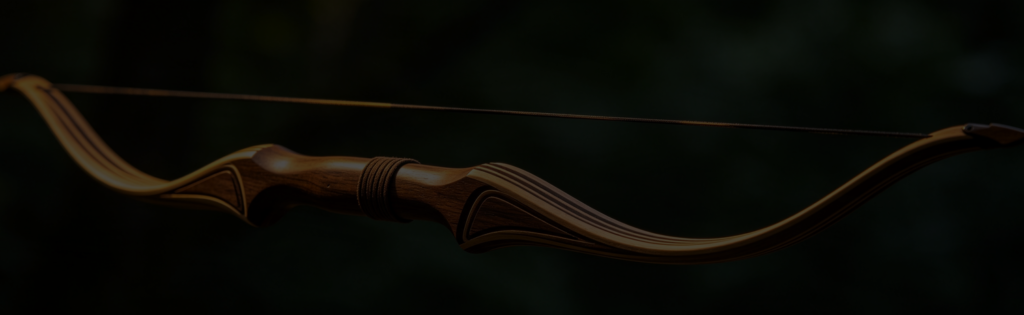
A horse bow is a short, recurved traditional bow originally designed to be shot from horseback. Because riders needed a compact, fast bow, horse bows are much shorter than longbows but store a lot of energy thanks to their deeply curved limbs. Famous styles include the Mongolian, Hungarian, Scythian, and Turkish bows. They are shot instinctively (without sights), which takes practice, but they are light, fast, and historically rich – ideal for traditional archers who want something different from a longbow or recurve.
Fletchwise guides are independent and hype-free – we are not sponsored by any archery brand.
What Is a Horse Bow?
A horse bow (also called a horsebow or nomad bow) is a short composite or laminated bow with strongly recurved limbs. The short length was a practical necessity: a mounted archer could not swing a tall longbow around a horse’s neck, so steppe cultures developed compact bows that still delivered serious power and speed. Modern horse bows keep that short, fast profile but are usually made from fiberglass and wood laminates rather than traditional horn, sinew, and wood. For the Mongolian style in particular, see our Mongolian bow guide, and for the wider family of sight-free bows, the traditional bows guide.
A Brief History
Horse bows shaped history across the Eurasian steppe. The Scythians, Huns, Mongols, Hungarians, and Turks all built mounted archery cultures around them. The Mongol Empire’s lightning conquests owed much to horse archers who could loose arrows accurately at a gallop. Each culture developed its own profile, which is why you will see bows sold today as “Mongolian,” “Hungarian,” “Scythian,” or “Turkish” styles – each a nod to a historical design.
How a Horse Bow Shoots
Compared with a longbow or modern recurve, a horse bow feels lively and quick in the hand. The deep recurve stores energy efficiently for the bow’s short length, giving a fast cast. Most horse bows are shot instinctively – without sights – often using a thumb draw with a thumb ring, the traditional steppe technique, although many Western archers shoot them with a standard three-finger Mediterranean draw. The short limbs create a sharper string angle at full draw, which is one reason instinctive aiming and consistent form matter so much.
Why a Short Bow Can Match a Longbow's Power: the Siyahs
"Recurved limbs store more energy" explains part of the horse bow’s power, but not why a bow barely half the length of a longbow can approach or match it. The other half of the answer is the siyahs – the rigid, non-bending tip sections at the end of each limb.
A horse bow’s limb is not uniformly flexible along its whole length. Only the inner portion, closest to the grip, actually bends and stores energy; the siyahs beyond that stay stiff and act as levers. When you draw the bow, those rigid tips lever the string back further and load the flexing part of the limb harder than the same length of purely flexible limb could manage on its own – trading a small amount of added tip mass for a longer effective draw and more stored energy from a short overall package. Rigid tips like this appear in the archaeological record as far back as roughly the 3rd century BCE, marking the shift from simple curved bows to this hybrid lever design – and it is the reason composite horse bows historically reached draw weights up in the range that would be extraordinary for a stave of the same length without them.
Stringing a Horse Bow Is Not Like Stringing a Straight-Limbed Bow
The same deep recurve and siyah lever tips that make a horse bow powerful for its size also mean the limbs are under tension even when the bow is unstrung, unlike a longbow or straight-limbed recurve, which sits relaxed until you string it. Forcing that tension the wrong way during stringing is one of the more common ways a horse bow gets damaged, and it happens at setup, not on the shooting line.
The traditional “step-through” method – bracing the bow against a shin and thigh and bending it with body weight – works, but it demands controlled technique: sudden or uneven pressure can twist, crack, or snap a limb, and composite or horn-and-sinew bows are more vulnerable to this than fiberglass-laminate versions. A bow stringer tool removes most of the guesswork and risk, and is worth the small cost for anyone not already confident with the step-through method by feel.
No Shelf: Your Hand Is the Arrow Rest
A horse bow has no cut-out shelf and no arrow rest. The arrow sits across the knuckle of your bow hand, and the string passes a few millimetres from your forearm. Two things follow from that, and neither is a defect.
The arrow has to be tuned to the bow, not to a chart. With no centre-shot cut, the arrow bends around the bow rather than passing through it, so shaft spine matters more than on a modern recurve. Expect to try two or three stiffnesses before one flies straight. Wood shafts can work; a matched carbon shaft usually gets there faster.
The string will find your forearm. A short bow with a steep string angle slaps harder than a 68 inch longbow, and it lands on the inside of the bow arm where a beginner is not looking. An arm guard is the cheapest fix in archery and the one beginners skip most often.
Set the nocking point so the fletching clears your knuckle. If arrows are striking your hand, raise the nocking point a few millimetres before you change anything else.
How to Choose a Horse Bow
- Start at 18 to 25 lb, not 30. A horse bow rated 28 lb at 28 inches pulls more than that on a thumb draw, because the thumb hook sits further back on the string than three fingers. The test is not the number on the limb: you should be able to draw and hold for two seconds, one hundred times, without your form falling apart. Most adult beginners land between 20 and 25 lb and move up after a season.
- Choose a style. Mongolian, Hungarian, Scythian, and Turkish profiles differ mostly in limb shape and grip feel – handle a few if you can.
- Match the bow length to the draw you actually pull. A horse bow rated at 28 inches stacks once you draw past that, and a thumb draw usually adds an inch or two. Check the table below before you pick a length.
- Decide on draw technique. If you want the authentic thumb draw, get a thumb ring and learn the technique; otherwise a finger tab works.
- Buy good traditional arrows. Wood or properly spined carbon arrows matched to the bow’s weight fly best from a horse bow.
Bow length by draw length. The number on the limb is a rating at 28 inches. Match the bow to the draw you actually pull, and go longer rather than shorter if you are between two sizes.
| Your draw length | Shortest horse bow to consider |
|---|---|
| Under 26 in | 46 in |
| 26 to 28 in | 48 in |
| 28 to 29 in | 50 in |
| 30 in and over | 53 in |
These are ranges horse bow shooters report working, not manufacturer ratings. Confirm the maker’s stated maximum draw before you buy. Our draw length calculator estimates yours from your wingspan.
| Bow type | Typical length | What it feels like | Best for | Guide |
|---|---|---|---|---|
| Horse bow | 48-54 in | Short and quick to draw; steep string angle at the fingers | Thumb draw, horseback, instinctive shooting | Horse bows |
| Mongolian bow | 48-56 in | Same short profile with pronounced siyahs and a heavier draw feel | Steppe-style shooting, thumb ring, history-minded archers | Mongolian bows |
| Traditional recurve | 58-62 in | Longer, more forgiving, works with a finger tab or glove | Field, target and hunting; easier first traditional bow | Traditional recurves |
| Flatbow | 60-68 in | Straight-sided limbs, quiet and stable, little hand shock | Beginners and barebow shooters who want a simple limb | Flatbows |
| Longbow | 66-72 in | Longest and smoothest draw; needs more room to shoot | Traditional English-style archery and target work | Traditional bow guide |
Lengths are typical ranges, not a guarantee. Confirm the exact spec with the maker before buying.
Which Style of Horse Bow
Mongolian, Hungarian, Turkish, Scythian and Korean are not brand names but limb shapes, and they behave differently enough that the choice matters more than the finish does. Length ranges below are typical for the style, not a rule.
Long, angular siyahs with a deep string bridge, and a heavier draw feel than the length suggests. It is the profile most cheap online listings copy, and the most common first horse bow. Mongolian bow guide
Shorter and more curved siyahs than the Mongolian, often on a wider limb. It sits between the Mongolian and Turkish feel, and is forgiving enough for a first bow.
The shortest of the five, with heavily reflexed limbs and a slim grip. Fast, and it punishes a rushed release. Usually shot with a shorter draw than a Mongolian.
The oldest profile here. Historical Scythian bows were asymmetric, with a longer upper limb; modern versions are usually built symmetric, with milder siyahs than a Mongolian.
Narrow limbs, short brace height, aggressive reflex. Built for speed and the most sensitive of the five to inconsistent form. It will show you every bad release.
The longer profiles, Mongolian and Hungarian, carry more mass in the tips and usually make the more forgiving first bow. The shortest Turkish and Korean profiles reward a settled release and expose a rushed one.
What a Horse Bow Actually Costs
Prices below are what US and European shops were listing in November 2026, not suggested retail. The bands are wide because the same profile can be a fibreglass import or a horn-and-sinew build.
| What you pay | What that buys |
|---|---|
| $70 to $120 | Fibreglass or laminated entry bows, mostly 48 to 54 inches, drawing from about 18 lb upward. This is where most first horse bows sit and where the cheapest online listings start. The usual reason to replace one is draw weight rather than breakage. |
| $170 to $350 | Production bows from established makers: cleaner siyah joints, better limb laminations, and a draw weight rated at a stated draw length instead of a range. Most club-level horse bow shooters end up in this band. |
| $450 and up | Custom builds, horn-and-sinew composites and decorated Turkish or Korean styles. You are paying for the maker’s time and materials, and waiting months rather than weeks. |
Listed prices at US and EU archery retailers, checked November 2026. The bow is not the whole bill: arrows, a stringer and a guard add to it. See what to buy first and what it costs.
Why Thumb Draw, Specifically
Thumb draw usually gets described as the authentic steppe technique and left there, as if the choice were purely cultural. It also solves two real, physical problems that a short bow creates – problems a longbow does not have.
- Finger pinch from the sharp string angle. A horse bow’s short length means the string meets your fingers at a steeper angle at full draw than on a longbow. Pulled with the standard three-finger Mediterranean draw, that steep angle pinches noticeably; hooking the string with just the thumb avoids it, because only one digit needs to wrap the string rather than three fingers closing around it at that angle.
- Control on a moving horse. With a finger draw, the arrow tends to work loose off the bow-hand knuckle the moment the horse picks up speed. A thumb draw, combined with a thumb ring, holds the string and manages the release with a more secure, compact grip that stays put through the jolt of a gallop – which is exactly the condition the technique was developed for.
There is a side effect worth knowing before you buy. A thumb hook sits further back on the string than three fingers, so most archers reach a draw an inch or two longer with a thumb ring than with a Mediterranean release. On a bow rated at 28 inches, that extra inch is extra poundage, and it is one reason a bow that felt fine in the shop feels heavy after ten arrows.
None of that makes the Mediterranean draw wrong for a horse bow shot from standing on the ground – it works fine there, and plenty of Western archers use it. But if you plan to shoot from horseback, or just want to understand why the steppe cultures standardized on the thumb ring rather than treating it as a stylistic footnote, this is the actual mechanism.
Who Should Shoot a Horse Bow?
Horse bows suit archers drawn to history, instinctive shooting, and a light, fast traditional bow that is easy to carry. They are not the easiest bows to shoot accurately at first – there are no sights and the short limbs are less forgiving – so they reward practice. If you want a simpler traditional start, a recurve may be easier; if you want raw power and precision, see compound bows.
Who Should Not Buy a Horse Bow First
These are not bad bows. They are a bad first bow for four specific jobs, and buying one anyway is the most common reason a horse bow ends up back in a cupboard.
You want to hunt big game this season. Short bows are harder to shoot accurately at distance, most states set a minimum draw weight for hunting that sits above a comfortable first bow, and a season is not the moment to learn a new release. A one-piece traditional recurve or a compound gets you hunting sooner.
You want sights, a clicker or a repeatable anchor. A horse bow has none of those, by design. If you want a bow that measures its own consistency, start on a recurve and come back to instinctive shooting once your form is settled.
You are buying on looks alone. The bows that fail are rarely the cheap ones. They are the 50 to 80 lb ones sold to people who have never drawn a bow. If you cannot test the draw weight before you pay, buy at 18 to 25 lb and accept that you will move up.
You have nowhere to shoot it. A bow with no club, range or coach behind it teaches you whatever it teaches you, good or bad. Sort out somewhere to shoot first.
Try One Before You Buy
The draw weight that suits you is not the draw weight you can pull once. That is the whole argument for shooting a horse bow before ordering one, and it costs nothing. Two routes get a bow into your hand first: a club or range near you, or a mounted archery group, which often keeps loaner bows for beginners.
In the United States, USA Archery and the National Field Archery Association both list affiliated clubs. For shooting from the saddle, the Mounted Archery Association of the Americas is the body to ask.
Three Things a Horse Bow Buyer Ends Up Needing
A Case for a Short Bow
Horse bows run 48 to 54 inches. The bow case guide covers padded and hard cases, sizing, and the airline limits that catch archers out.
Bow Case GuideA Quiver That Suits Your Draw
Back, hip and side quivers compared by capacity, depth and what they do to a fast second arrow.
Arrow QuiversAn Arm Guard
Made to order with a name, a club crest or team colours. One piece minimum, about two weeks in production.
Custom Club GearFrequently Asked Questions
Historically, horse bows were used for mounted warfare and hunting from horseback. Today they are used for traditional and instinctive target archery, historical reenactment, and modern horseback archery competitions.
They can be, but they are shot instinctively without sights and have short, less-forgiving limbs, so they take more practice than a recurve. Beginners who love the history and instinctive style can absolutely start on one – just begin with a light draw weight.
A horse bow is a short, traditional recurved bow meant for shooting from horseback and is shot instinctively. A modern Olympic-style recurve is longer, often a takedown, and is typically shot with a sight. Both use recurved limbs, but they differ in length, technique, and intended use.
Most horse bows have no sights, so archers aim instinctively – focusing on the target and letting practice guide the shot – often using a thumb draw with a thumb ring. Consistent form and lots of repetition are the keys to accuracy.
Mostly the siyahs – the rigid, non-bending tip sections at the end of each limb. Only the inner part of the limb actually flexes; the stiff tips act as levers that load that flexing section harder and effectively lengthen the draw, storing more energy than a purely flexible limb of the same overall length could manage. That lever design, dating back roughly to the 3rd century BCE, is why composite horse bows historically reached draw weights that would be unusual for a plain curved stave of the same size.
Two practical reasons, not just tradition. A short bow’s steeper string angle at full draw pinches fingers noticeably under a three-finger draw, which a thumb ring avoids since only the thumb hooks the string. And with a finger draw, the arrow tends to work loose off the bow-hand knuckle once a horse picks up speed – a thumb draw holds a more secure, compact grip through that motion, which is exactly the condition it was developed for.
It can be, but it takes real technique – a horse bow’s deep recurve means the limbs carry tension even unstrung, so forcing that tension unevenly during stringing is a common way the bow gets damaged, usually at setup rather than on the shooting line. The traditional step-through method (bracing the bow against a shin and thigh) works in experienced hands, but sudden or uneven pressure can twist or crack a limb, especially on composite or horn-and-sinew bows. A bow stringer tool removes most of that risk and is worth using until you are confident with the technique.
It is on the heavy side, and heavier than the label suggests. A horse bow rated 30 lb at 28 inches pulls more than 30 on a thumb draw, because the hook sits further back than three fingers and adds an inch or two of draw. Most adult beginners do better at 20 to 25 lb and step up after a season. The test is not the number on the limb: you should be able to draw and hold for two seconds, one hundred times, without your form collapsing. If you cannot, the bow is too heavy whatever it says on it.
Yes, by roughly one to two inches. Three fingers hook the string close to the arrow nock, while a thumb hook sits further back, so the same archer usually reaches a longer draw with a thumb ring than with a Mediterranean release. Two things follow before you buy. A bow rated at 28 inches stacks once you pass that point, and your arrows have to be long enough to cover the longer draw. Measure your thumb-draw length, not your three-finger length, before ordering arrows or choosing a bow length.
Khatra is the sideways clearance the bow hand gives at release so the string and arrow leave without hitting the bow or your hand. On a bow with no shelf and no centre cut, the arrow has to bend around the limb, and khatra is the follow-through that lets it. It comes from a relaxed grip and a clean release rather than being an extra movement you add on top. Beginners are usually better off leaving it alone until draw and anchor are consistent, because forcing the motion adds randomness to every shot.
Eye dominance usually decides, not hand dominance. If your left eye is the dominant one, a left-handed bow is normally the easier start, because you draw with the left hand and the string comes back to the left eye. A right-handed bow forces you to either close the dominant eye or aim across your face. Cross-dominance is common and not a defect. If you cannot test before buying, an ambidextrous starter bow lets you try both draws before you commit to a side.
Common, and not automatically your fault. A shooter six months into a 48 inch Korean bow reported groups of 12 to 14 inches at 20 yards, and the first questions back were about bow length and draw length, not technique. A 48 inch bow pulled past 28 inches stacks, and stacking magnifies every small inconsistency in your form. If your groups stall while your draw and anchor feel settled, check that the bow is long enough for your draw before you change your release.
Yes, and plenty of shooters do, but the shorter the bow the more it pinches.
On a 53 inch bow there is room for three fingers under the nock. By 48 inches the string angle at full draw closes to a sharp enough V that the nock squeezes the fingers together, and the release gets inconsistent. A shooter on r/Archery reports using three fingers below the nock on a 45 lb replica without trouble; another in the same thread gave up on fingers for exactly that reason. Both are true, and the difference is the bow.
Two things follow from that. If you already shoot Mediterranean style and want to keep your release, buy 50 inches or longer. If you plan on the short Turkish or Korean profiles, learn thumb draw from the first session. Switching between the two on the same bow teaches you neither one well.
Most thumb shooters end up with one, and the entry price is lower than people expect. Vermil lists its basic Classic and Victory rings at $18, with decorated models from $89 to $154.
A ring protects the thumb joint and gives the string a hard surface to slide off. A leather thumb glove works for a few dollars, but it stretches with use and a ring does not. Fit is the hard part. You want it snug at the base of the thumb without cutting circulation, and almost nobody gets the size right on a first online order. The standard advice on r/Archery is to try a shop if you can, or order two sizes.
Bare-thumbed shooting works for one session and hurts by the third. If you are ordering a bow from overseas anyway, put the ring on the same order.
Laminated and fibreglass horse bows can stay strung for weeks at a time. Wooden self bows and horn-sinew composites should come down after each session.
Material drives it. A laminated bow is glued from layers, so it does not creep the way a single stave does, and shooters who practise 2 to 3 times a week often leave theirs strung indefinitely and just check brace height. Wood and horn follow humidity, and a bow left strung through a damp month can take a set that will not come out.
Two exceptions matter more than the rule. Heat is worse than time, so no bow belongs in a hot car. And a short bow sits under more stress than a long one at the same draw weight, which is why owners of the 44 to 50 inch Turkish profiles unstring more often than Mongolian owners do.
Arrows long enough for your draw and soft enough for a light draw weight, which is a shorter answer than most spine charts give you.
A horse bow has no shelf and no centre cut, so the arrow has to bend around the bow on the way out. That makes spine matter more than it does on a modern recurve, and a chart built for a centre-cut bow will point you too stiff. One shooter on r/Archery runs 650 spine cut to 29 inches with 100 grain points on 40 lb bows. A 20 to 25 lb starter bow wants softer than that.
Length is the other half. Cut to your draw plus about an inch, and measure your draw on the horse bow itself, because thumb draw adds length to it. Carbon holds up better than wood for a beginner. Our arrow guide covers spine, grain weight and FOC together.
A 53 inch horse bow will draw to roughly 34 inches before the limbs complain, and a 48 inch one to about 30. Both figures come from owners, not manufacturer ratings.
Buy to your draw length, not to that ceiling. Our table pairs a draw under 26 inches with a 46 inch bow, 26 to 28 with 48, 28 to 29 with 50, and 30 or more with 53. The gap between the recommended length and the maximum is the room a bow needs to stay comfortable to hold.
This matters most for taller shooters and anyone who anchors further back than the jaw. Our draw length calculator gives you the number before you shop.
Most are one piece, and the 44 to 56 inch length is the reason. Alibow and AF Archery both sell two-piece versions of their Kheshig and Tatar models, and Ksavr builds a takedown horse bow, but takedowns are the exception rather than the default.
If you never fly, one piece is simpler and has fewer things that can fail. If you do fly, a 53 inch bow does not fit a standard airline case; it travels diagonally in checked luggage or it stays home. A two-piece takes the longest item out of your kit, and the joint sits at the grip where there is the most material.
Ask before you order, because retailers list the model far more often than they mention whether a takedown version exists. Our bow case guide covers the airline rules and the case sizes that take a one-piece traditional bow.
Submit the Form to Get Our Product Catalog
What We Can Offer
- ✅ Low MOQ – from 1 piece, no minimum order
- ✅ Full customization – names, initials, club crests & team logos
- ✅ Mockup before production – see it before we make it
- ✅ Production time about 2 weeks after mockup approval
- ✅ Free remake on defects within 14 days of delivery
We reply to every inquiry within 1 business day.
Email: [email protected]
WhatsApp: +1 770 157 5807
We Do Not Sell You a Bow. That Is the Point.
Fletchwise does not sell, stock, drop-ship or take commission on bows. No bow maker pays for a page on this site, which is why this one can tell you to start at 18 lb instead of selling you a 40 lb bow.
What we make is the gear that goes around a horse bow: a padded case for a 48 to 54 inch bow, a quiver that suits a thumb draw, and an arm guard for the forearm the string keeps finding. Names, club crests and team colours are stitched to order, from one piece.
Bow Cases for Short Bows Custom Club GearKeep Reading
Types of Archery Bows
Recurve, compound, longbow and crossbow compared side by side so you can pick the right style, not just the popular one.
Types of Archery BowsArchery Bows: Full Guide
Recurve sizing, ILF vs proprietary limb fittings, and why a 25 lb bow can feel harder to hold than 40.
Archery Bows: Full GuideArchery Targets Guide
All four target types compared – bag, foam, layered and 3D – matched to your draw weight and broadhead use.
Archery Targets Guide