
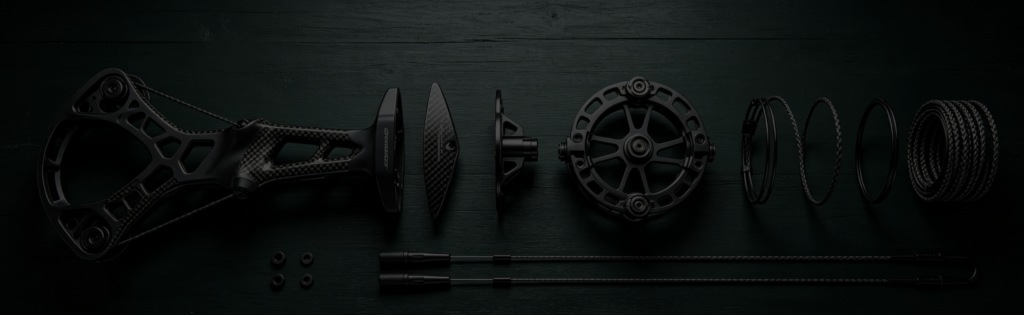
The riser is the rigid central frame of a bow – you grip it, and the limbs, sight, rest, stabilizer and quiver all bolt to it. On a compound it is not a separate purchase: it comes as part of the bow, and choosing a riser means choosing a bow. Machined aluminum is stiff, low-vibration and affordable; carbon is warmer to hold in the cold and slightly lighter, and typically costs $600-$1,000 more on an otherwise comparable bow. Archers who have shot both consistently report the carbon riser does not make the bow faster and does not tighten groups. Buy it for cold-weather comfort and carry weight, not accuracy.
Fletchwise guides are independent and hype-free – we are not sponsored by any archery brand and we do not sell bows.
What the Riser Does
Think of the riser as the chassis of the bow. It has to stay rigid while the limbs flex and the shot fires, so that the sight, rest and arrow all stay aligned from draw to release. Any flex or twist in the riser shows up as lost accuracy. It is also where you grip the bow, so its shape and balance affect how the bow holds and how much hand torque you introduce.
Everything you bolt to a bow bolts to the riser: the sight, the rest, the stabilizer, the quiver, the cable guard. That is why riser stiffness matters more than any single accessory on it – if the platform moves, every reference point on it moves with it.
The One Thing to Understand First
On a compound bow, the riser is not something you buy. It is machined as part of the bow and cannot be swapped, so any conversation about “choosing a riser” for a compound is really a conversation about choosing a bow. This trips up a lot of new archers who read about riser materials and go looking for a riser to buy.
Recurves are the opposite. Takedown recurve risers are sold separately from limbs, usually on the ILF (International Limb Fitting) standard, which lets you keep one riser and change draw weight by swapping limbs. If that is what you are after, our archery bows guide and types of bows pages cover it.
Aluminum vs Carbon: What Each One Actually Gives You
Almost every compound riser is either CNC-machined aluminum (usually 6061 or 7075) or carbon fiber. Here is the honest side-by-side, using what archers who own both report rather than what the brochures claim.
| Property | Machined aluminum | Carbon fiber |
|---|---|---|
| Stiffness | Excellent | Excellent – no meaningful advantage either way |
| Bare bow weight | Baseline | Up to about a pound lighter, often less in practice |
| Vibration / hand shock | Usually lower – the denser material absorbs more | Historically higher; much improved on recent models |
| Cold-weather feel | Pulls heat out of your bow hand fast | Clearly better – low thermal conductivity, stays warm |
| Arrow speed | Baseline | No gain – the riser does not store energy |
| Group size | Baseline | No consistent reported gain |
| Typical price of a comparable bow | Around $1,200 at the high end | Around $1,700, and $600-$1,000 more is common |
What the Extra $600-$1,000 Actually Buys
This is the part the manufacturer pages will not put plainly, because carbon flagships are the highest-margin bows on the rack. So here it is: on a compound, the riser does not store or release energy. The limbs and cams do that. A stiffer or lighter riser cannot make the arrow go faster, and there is no mechanism by which riser material tightens a group on its own.
What carbon reliably delivers is thermal. Aluminum has far higher thermal conductivity than carbon composite, so an aluminum riser drains heat out of your bow hand in cold weather while carbon does not. Archers who sit still in a stand at 20 degrees F for hours describe this as the single best thing a carbon riser does – and they are not wrong, they are just describing a comfort feature, not a performance one.
| If this is you | Is carbon worth the premium? |
|---|---|
| Late-season sits in freezing weather, bare hands on the grip | Yes – this is the case carbon genuinely solves |
| Long mountain packs where every ounce is counted | Maybe – but weigh the actual spec sheets, the gap is often smaller than advertised |
| Target and 3D shooting, mostly in mild weather | No – and many target archers prefer the extra mass for stability |
| You want tighter groups | No – put the money into arrows, a release and range time |
| First compound, on a budget | No – aluminum at half the price is not a compromise. Consider a used bow and spend the difference on setup |
If you want to hear this from owners rather than from us, the long-running carbon vs aluminum riser threads on ArcheryTalk are worth an hour. The pattern is consistent: people who bought carbon like their bows, and describe the benefit in terms of warmth and weight rather than scores.
Cast vs Machined: The Detail That Actually Predicts Quality
Aluminum vs carbon is not the only material question, and it is not even the one that predicts breakage. Within aluminum risers there is a second, less-discussed split: cast risers are made by pouring molten aluminum into a mold, while machined (or forged-and-machined) risers start as a solid billet cut to shape on a CNC machine. Casting is cheaper, which is why it shows up on entry-level bows, but the process can trap microscopic voids or inclusions inside the metal that a machined billet simply does not have – a flaw a cast riser can carry invisibly for years before it matters. A properly cast riser with no defects performs fine for most archers, and the era of routine cast-riser breakage is largely behind the industry, but if you are comparing two aluminum bows at a similar price and one specifies a machined or forged billet riser, that is the more consistently reliable build regardless of what either one is finished in.
Grip Shape Matters More Than Grip Material
The riser’s own material gets debated endlessly, but the part of the riser doing the most damage to your accuracy is usually its grip shape, not what it is cut from. Modern performance grips are deliberately slim, flat-backed and sharp-edged rather than rounded and cushioned – counterintuitively, a grip that feels comfortable to wrap your whole hand around is the one most likely to invite torque, because more hand-riser contact means more surface area for pressure to sneak in unevenly. The archery-design consensus is that less hand contact, not more, protects a shot: pressure should run in a narrow line under the thumb pad, with the rest of the hand barely touching the riser. That is why an aftermarket slim grip is one of the cheapest, highest-leverage upgrades available on a bow with a bulky factory grip – it solves the exact grip-torque problem raised above, at a fraction of the cost of a material upgrade.
Riser Geometry: Reflex vs Deflex
Material gets all the attention, but geometry has more effect on how a bow behaves. The question is where the grip sits relative to the limb pockets.
- Reflex riser – the grip sits behind the limb pockets, shortening brace height. More speed, slightly less forgiveness of form errors.
- Deflex riser – the grip sits forward, lengthening brace height. More forgiving and stable, at a small speed cost.
Most modern compounds land somewhere in between deliberately. If you are comparing two bows and one feels noticeably more forgiving at full draw, geometry and brace height are usually why – not the material the riser is cut from. Brand differences largely come down to these design choices.
When the Riser Really Is Your Problem
Most accuracy problems are not the riser. But there are three cases where it genuinely is, and they are worth knowing because they are cheap to check.
Grip torque. The riser is the interface between your hand and the bow. If you are gripping hard or heeling the bow, the riser transmits that torque straight into the shot. Aftermarket grips and a relaxed, repeatable hand position fix more group size than any material upgrade will.
Loose accessory mounts. Everything indexes off the riser’s threaded holes. A sight mount or rest that has worked loose reads exactly like a bow that “went off” for no reason. Check the bolts before you chase anything else – a walk through our bow accessories guide covers what should be torqued and how tight.
Actual damage. A dropped bow can bend or crack a riser, and a hairline crack near a limb pocket is easy to miss. Inspect around the limb pockets and cable guard hole under good light before any serious tuning session, and before you put a bow in a press. A damaged riser is not a tuning problem, it is a replacement.
Choosing a Bow by Its Riser
Work through it in this order. First, is the bow the right axle-to-axle length and draw length for you? Second, does it feel dead in the hand at the shot and settle steadily at full draw? Third – and only third – what is the riser made of. If two bows are close on the first two and one is $700 cheaper because it is aluminum, take the aluminum and spend the difference on arrows and a good rest.
And if you are still learning what all the parts do, start with parts of a compound bow rather than any single component. The riser makes a lot more sense once you can see how the cams load the limbs against it.
We do not sell bows and there are no affiliate links on this page. Prices are US market figures as of 2026 and they move with each model year – treat them as a starting point and check current retail before you decide.
Frequently Asked Questions
The riser is the rigid central frame you grip, to which the limbs, sight, rest, stabilizer and quiver attach. Its stiffness keeps every reference point aligned through the shot, which is why it is foundational to accuracy even though it does not store energy.
Not in any way that shows up on the target. Carbon is warmer to hold in cold weather and can be slightly lighter; aluminum is usually lower in vibration and much cheaper. Archers who have shot both report no consistent gain in speed or group size from carbon. It is a comfort and carry-weight choice, not a performance one.
Commonly $600-$1,000 more than a comparable aluminum bow – roughly $1,700 versus $1,200 at the high end of each line. That premium buys cold-weather comfort and some weight saving, not speed or accuracy.
Generally no. On compounds the riser is machined as part of the bow and is not a standalone purchase, so choosing a riser means choosing a bow. Takedown recurve risers, by contrast, are sold separately from limbs and are often ILF-compatible.
A reflex riser places the grip behind the limb pockets for a shorter brace height and more speed; a deflex riser places it forward for a longer brace height and more forgiveness. Most modern bows blend the two. Geometry affects how a bow shoots more than riser material does.
No. Arrow speed comes from the limbs and cam system, not the riser – the riser does not store or release energy. A lighter riser changes how the bow carries and balances, not how fast it shoots.
Inspect around the limb pockets, the grip throat and the cable guard hole under good light, looking for hairline cracks, and check that accessory mounts are still tight. A bow that suddenly will not hold a group after being dropped needs this check before any tuning. A cracked riser is a replacement, not a repair – stop shooting it.
Not necessarily, but it is a real distinction worth knowing. Cast risers are poured into a mold, which is cheaper but can trap microscopic voids in the metal; machined (or forged-and-machined) risers are cut from a solid billet and do not have that risk. A defect-free cast riser performs fine for most archers, but if you are comparing similarly priced aluminum bows, a machined or forged billet riser is the more consistently reliable build.
For most shooters, yes. A slim, flat-backed grip with minimal hand contact reduces torque far more than any material upgrade does – more hand-to-riser contact means more surface for uneven pressure to creep in. An aftermarket slim grip is one of the cheapest, highest-leverage accuracy upgrades available.
Submit the Form to Get Our Product Catalog
What We Can Offer
- ✅ Low MOQ – from 1 piece, no minimum order
- ✅ Full customization – names, initials, club crests & team logos
- ✅ Mockup before production – see it before we make it
- ✅ Production time about 2 weeks after mockup approval
- ✅ Free remake on defects within 14 days of delivery
We reply to every inquiry within 1 business day.
Email: [email protected]
WhatsApp: +1 770 157 5807
Keep Reading
Parts of a Compound Bow
Every component explained, from the riser and cams to the D-loop, so you can buy and tune with confidence.
Parts of a Compound BowArchery Bows Guide
Recurve sizing, ILF vs proprietary limb fittings, and why a 25 lb bow can feel harder to hold than 40.
Archery Bows GuideBow Accessories Guide
The order you buy accessories in decides what you pay twice for – draw length first, stabilizer last.
Bow Accessories Guide