
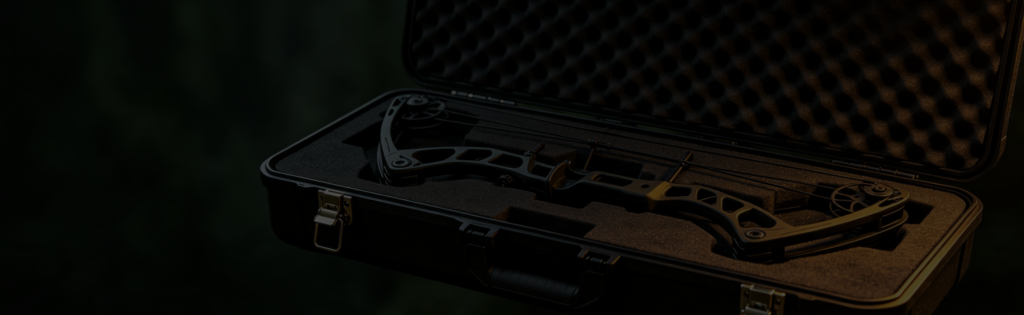
A hard bow case uses a rigid shell, protective foam, and lockable latches to shield your bow from crushing and impact in ways a soft case cannot match. The best ones have thick walls, customizable pluck-or-cut foam, sturdy lockable latches (TSA-friendly for flying), a pressure-equalizing valve for air travel, and enough internal length for your bow plus mounted accessories. TSA requires archery equipment to be checked rather than carried on but does not mandate a hard case — in practice it is still the sensible choice for checked baggage, and the rule that actually costs money is the airline’s linear size limit (see below).
Fletchwise guides are independent and hype-free – we are not sponsored by any archery brand.
When You Need a Hard Case
A soft case is fine for the back seat on the way to the range. A hard case earns its weight when your bow rides in a truck bed with gear stacked on top, gets checked on a flight where baggage handlers throw it, or is simply too valuable to risk having a sight knocked off zero by something that shifted in transit. The shell resists crushing; the foam resists movement — and the latter is the part that actually keeps your bow shooting when you arrive. For a deeper look at the protection mechanics, see our bow case guide.
The Foam Does the Protecting — the Shell Just Holds the Shape
Hard case marketing is built around the shell: wall thickness, crush ratings, impact resistance. Those matter, but the part that actually decides whether your bow arrives shooting is the foam inside. In transit, bows are almost never broken by crushing — they come out with a sight knocked off zero, a rest nudged out of centre shot, or a peep rotated in the string. Every one of those comes from the bow moving inside the case, and no shell thickness prevents that. What prevents it is foam that holds the bow static.
- Pluck-foam lets you shape a cavity around your exact bow and accessories, which is the difference between a fit and a guess. The trade-off is that pluck foam is softer and wears faster at the impact point.
- Pre-cut or CNC foam is denser and more durable, but it is cut for a specific bow model and will not fit yours if you change anything.
- Open-cell vs. closed-cell — open-cell (most pluck and egg-crate foam) compresses to absorb impact but takes a compression set over time and stops springing back. Closed-cell is denser and does not absorb moisture, but it is harder to shape. For a case that travels, open-cell is the standard; just plan to replace it when the cavity goes loose.
The quick check: close and latch the case with the bow inside, then shake it. If you feel or hear anything move, the case is not protecting the bow regardless of what it cost.
What Makes a Good Hard Bow Case
- Rigid, thick shell – resists crushing and impact; the whole point of a hard case.
- Quality foam interior – pluck-foam or pre-cut cradles hold the bow and accessories so nothing shifts.
- Lockable latches – sturdy, and TSA-friendly if you fly. Some cases accept padlocks.
- Pressure valve – equalizes air pressure changes in a cargo hold, important for sealed travel cases.
- Weather sealing – a gasket keeps out rain and dust.
- Right internal size – fits your bow plus any mounted sight, quiver, and stabilizer.
How to Size a Hard Case
- Measure the bow. Axle-to-axle for a compound, or assembled length for a recurve (or fit a broken-down takedown). A long recurve or a compound with a mounted stabilizer can push past standard case length – see our large and XL bow case guide if you are near 50 inches.
- Add clearance. Pick an internal length a few inches longer so nothing presses on the cams or limb tips.
- Plan for accessories. Decide whether your sight, quiver, and stabilizer stay on, and confirm the foam and depth allow it.
- Check airline limits. If you fly, confirm the packed case fits your airline’s checked-baggage size and weight rules.
Flying: What the Rules Actually Say and Why the Size Limit Is the Real Trap
TSA requires archery equipment to travel in checked baggage, never in carry-on — but unlike a firearm, a bow needs no declaration at the counter, and there is no locked-container statute for archery equipment. The major US carriers ask for a durable protective container designed for archery rather than specifying hard-sided as a rule. In practice a hard case is still the right choice for checked baggage, but because it protects the bow, not because a regulation demands it.
The rule that actually costs travellers money is the linear size limit — length plus width plus depth added together. A typical compound hard case at roughly 44 × 20 × 10 inches comes to about 74 linear inches. Delta and American raise the standard 62-inch limit to 102 inches for bow cases; United publishes no such exemption. The same case that flies free on Delta can pick up an oversize charge on United. The 50 lb weight limit does not budge for anyone, and a large hard case alone is 15-25 lb before the bow goes in — that is where the weight budget gets tight, and why a mid-size hard case is often the more practical choice than the biggest one in the catalogue.
Practical details that catch people out: bow cases usually come out at the oversize or special-items counter, not the regular carousel, and you may need ID to collect yours. Allow extra time at check-in. Label the case inside and out with your name and contact details, photograph your bow in the foam before closing it, and confirm your airline’s current sporting-equipment policy before the trip — these rules change between seasons. Our bow case guide has the full airline-by-airline breakdown.
Even where the published policy allows the larger exemption, enforcement at the actual counter is inconsistent. Archery forums have plenty of accounts of travellers hit with unexpected oversize charges — $150-200 or more on top of the standard $30-35 checked-bag fee — even when their case fell inside the airline’s own stated sporting-equipment allowance, simply because the agent at the counter did not apply it. Screenshot or print your airline’s current sporting-equipment policy before you travel and have it ready to show at check-in; it will not guarantee a fee-free trip, but it is the strongest argument you can make on the spot.
Specific hard-case picks are coming as our shop launches. Until then, use the checklist above – prioritize shell thickness, lockable TSA-friendly latches, and correct internal sizing for your exact bow.
Frequently Asked Questions
Not as a regulation — TSA requires bows to travel in checked baggage, not carry-on, but unlike firearms there is no locked-hard-container statute for archery equipment. The major US carriers ask for a durable protective container designed for archery rather than specifying hard-sided as a rule. A hard case is still the sensible choice for checked baggage because of how checked bags get handled, but not because a rule forces it. Check your airline’s sporting-equipment page before you fly, as policies change.
Measure your bow’s actual widest points — the outer edge of the cams, not the axle-to-axle number on the spec sheet — with the sight, quiver and stabilizer fitted as you carry them. Add a couple of inches of clearance so nothing presses on the cams or limb tips. Then check the case’s outside dimensions against your airline’s linear size limit: Delta and American allow up to 102 inches (L+W+D), United keeps the standard 62-inch limit with no bow-case exemption.
Pluck-foam lets you shape a custom cavity around your exact bow and accessories, which is the real point, but it is softer and takes a compression set faster — when it stops springing back, the fit is gone even though the case looks fine. Pre-cut foam is denser and lasts longer but only fits the one bow model it was cut for. The test: close the loaded case, shake it, and listen — you should hear nothing at all.
If you travel by air, haul your bow in a vehicle with other gear, or own an expensive setup, yes — a hard case is cheap insurance against costly damage. For home storage and short range trips, a soft case is lighter and easier, and many archers own both. Before buying the biggest case, do the linear-size math: a mid-size case at 74 linear inches fits inside airline allowances more reliably than an oversized one at 80+.
Because the cargo hold of a plane is not pressurised the same way the cabin is, and a sealed hard case can become impossible to open at your destination or deform under the pressure difference if there is no valve to equalise it. A pressure valve lets air pass slowly while keeping water and dust out. It is worth looking for on any case you intend to fly with, and it is one of the main things that separates a case built for air travel from one made to sit in a truck.
Not necessarily. The exemption is real on paper, but enforcement at the actual check-in counter is inconsistent – archery forums have plenty of accounts of $150-200+ oversize charges hitting travellers whose case fell inside the airline’s own stated allowance, simply because the agent did not apply it. Screenshot or print the current policy and have it ready at check-in; it strengthens your case but does not guarantee a fee-free trip.
Submit the Form to Get Our Product Catalog
What We Can Offer
- ✅ Low MOQ – from 1 piece, no minimum order
- ✅ Full customization – names, initials, club crests & team logos
- ✅ Mockup before production – see it before we make it
- ✅ Production time about 2 weeks after mockup approval
- ✅ Free remake on defects within 14 days of delivery
We reply to every inquiry within 1 business day.
Email: [email protected]
WhatsApp: +1 770 157 5807
Keep Reading
Bow Cases: Full Guide
Sizing by cam edge to cam edge (not axle-to-axle), hard vs soft, and the real airline rules most guides get wrong.
Bow Cases: Full GuideCompound Bows Guide
How let-off, cam type and axle-to-axle actually work, and every spec worth caring about before you buy.
Compound Bows GuideArrow Quivers
Hip, back and bow-mount quivers compared by how they carry, and which suits target, field or hunting.
Arrow Quivers