
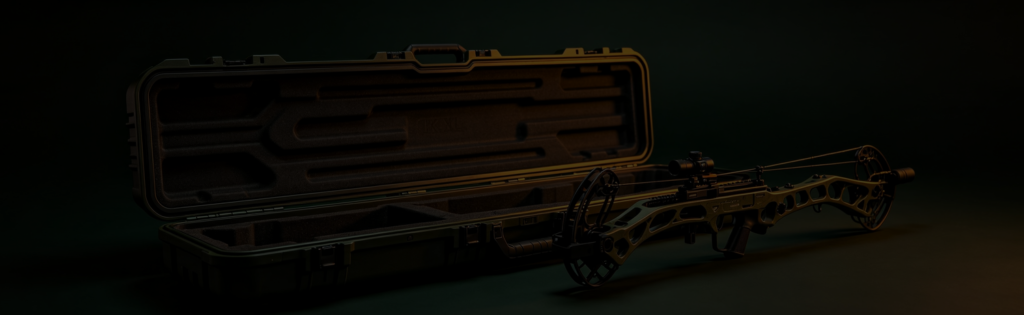
A large or XL bow case (often 50 inches or longer internally) is for long recurves and assembled target bows, big compound rigs with extended stabilizers, or anyone who wants room for the bow plus arrows and accessories in one case. Size it by your longest dimension – assembled length for a recurve, or axle-to-axle plus a long stabilizer for a compound – and add clearance. For air travel, choose a lockable XL hard case and confirm it meets airline size limits.
Fletchwise guides are independent and hype-free – we are not sponsored by any archery brand.
Who Needs a Large or XL Case?
- Long recurve / target archers – an assembled recurve can be 60″+ and needs a long case.
- Compound target rigs – long front stabilizers add length beyond axle-to-axle.
- All-in-one packers – those who want bow, arrows, and accessories together in one big case.
- Travelers with extra gear – an XL case can hold a second bow or more accessories.
How to Size a Large Case
- Measure your longest dimension. Assembled length for a recurve; axle-to-axle plus any mounted stabilizer for a compound.
- Add clearance. A few inches so nothing presses on limb tips, cams, or stabilizer ends.
- Check internal width and depth for accessories and arrow storage.
- Confirm airline limits if you fly – XL cases can exceed standard checked-baggage size.
Large Case Trade-Offs
More room means more weight and bulk. A 50-inch-plus hard case is heavy before you even add the bow, and it can run into airline oversize fees. Buy the size you actually need – big enough to protect everything without clearance to spare, but not so large it is a burden to move and store.
Shipping a Large Case Costs More Than Flying With One
Airline baggage rules get all the attention, but plenty of large-case owners eventually ship a bow instead of flying with it – sending it to a bow tech, a coach, or a buyer. Ground carriers do not bill by the bow’s actual weight; they bill by dimensional weight, calculated as length x width x height divided by 139 for standard domestic service. A 50 x 16 x 6 inch case works out to roughly 34-35 lb of billable weight from the box’s size alone, whether the bow, foam, and case together actually weigh 15 lb or 25. A large case is mostly air on the inside, and with ground shipping you pay for that air just as much as you pay for the bow.
When a Case Becomes a Freight Shipment, Not a Parcel
There is a hard ceiling on standard parcel service, and a 50-inch-plus case can approach it faster than it looks: once a package passes 150 lb or 165 inches of length plus girth, UPS and FedEx both pull it out of normal parcel rates and into freight service, which runs on a completely different pricing structure and usually needs its own quote. A single bow case alone rarely gets there, but pack an XL case together with a second bow, a target, or other gear in one box for a move or a shared shipment, and that combined length-plus-girth number climbs fast. If you are shipping more than the case itself, check the combined figure before you tape the box shut.
Specific XL case picks are coming as our shop launches. For now, size by your longest dimension plus clearance, and confirm airline limits before you fly with an oversized case.
Frequently Asked Questions
Mostly long recurve and target archers whose assembled bow is too long for a standard case, plus compound shooters running long stabilizers and anyone who wants to pack bow, arrows, and gear together.
Measure your bow’s longest dimension – assembled length for a recurve, or axle-to-axle plus any mounted stabilizer for a compound – then add a few inches of clearance.
It can. Very large hard cases may exceed airline checked-baggage size limits and incur oversize fees. Check your airline’s dimensions before buying if you plan to fly.
No. Extra room adds weight and bulk and can trigger oversize fees. Buy a case sized to protect your bow and gear snugly, without lots of empty space.
Not necessarily. Ground carriers bill by dimensional weight (length x width x height divided by 139), and a long, mostly-air 50-inch-plus case can price out to 30+ lb of billable weight even if the actual contents weigh far less. Compare the shipping quote against your airline’s checked-bag fee before assuming shipping is the cheaper route.
Once a package passes 150 lb or 165 inches of length plus girth, UPS and FedEx move it out of standard parcel rates and into freight service with its own pricing. A single large case rarely reaches that alone, but combining it with a second bow or other gear in one box can get there fast.
Submit the Form to Get Our Product Catalog
What We Can Offer
- ✅ Low MOQ – from 1 piece, no minimum order
- ✅ Full customization – names, initials, club crests & team logos
- ✅ Mockup before production – see it before we make it
- ✅ Production time about 2 weeks after mockup approval
- ✅ Free remake on defects within 14 days of delivery
We reply to every inquiry within 1 business day.
Email: [email protected]
WhatsApp: +1 770 157 5807
Keep Reading
Best Hard Bow Cases
Shells, foam and sizing, plus the airline rules that actually apply versus the ones everyone assumes.
Best Hard Bow CasesCompound Bow Cases
Why axle-to-axle is the wrong number to size a case by, and the measurement that actually matters.
Compound Bow CasesBow Cases: Full Guide
Sizing by cam edge to cam edge (not axle-to-axle), hard vs soft, and the real airline rules most guides get wrong.
Bow Cases: Full Guide