
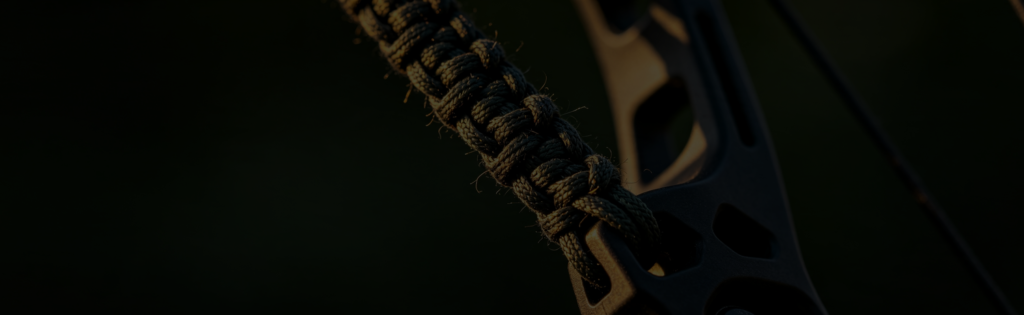
A bow sling catches the bow as it jumps forward at the shot, which is what lets you shoot with a relaxed, open bow hand instead of gripping the riser. That relaxed hand is the whole point, because a grip is where torque comes from. Wrist slings are the practical default on a compound – easy on, nothing between your fingers. Finger slings suit target recurve and leave the hand completely free. The fitting rule matters more than the type: the sling should hang slack at full draw and only take load after the shot. If you can feel it pulling on your hand while you aim, it is too tight and it is torquing the bow.
Fletchwise guides are independent and hype-free – we are not sponsored by any archery brand.
What a Bow Sling Actually Does
Product pages describe a sling as insurance against dropping your bow. That is the visible effect, not the purpose.
Here is the chain. At the shot the bow leaps forward. If nothing is going to catch it, you have to catch it – which means your hand is closed around the riser before, during and after the shot. A closed hand is a hand applying pressure, and pressure applied off the centerline twists the riser. That twist is torque, and it throws arrows left and right in a way that looks exactly like a sight problem.
The sling breaks that chain. Something else catches the bow, so your hand does not have to, so the hand can stay open and relaxed through the shot. The sling is a means; the relaxed hand is the end.
This is the same fault our stabilizer guide lists as one a stabilizer cannot fix: a stabilizer resists torque, but it does not stop you applying it. A sling addresses the cause instead.
A Sling That Pulls on Your Hand Is Causing Torque
This is the part that gets left out, and it inverts how most people fit one.
A sling that is tight enough to press the bow against your hand is doing the opposite of its job. Any pressure or pull from the sling onto your bow hand introduces torque – the same torque you bought it to eliminate. It is not supposed to hold the bow. It is supposed to be there, doing nothing, until the shot is already gone.
| At full draw the sling is | What it means |
|---|---|
| Slack – you cannot feel it | Correct. It catches the bow afterward and contributes nothing before |
| Snug, you can feel light tension | Too tight – it is loading your hand and steering the riser |
| Pinning the bow to your palm | Far too tight; you have effectively re-created the grip you were avoiding |
| So loose the bow lands on the ground | Too loose, but the far less harmful error – tighten in small steps |
Aim for the first row. The bow should rotate forward, fall a short distance, and be caught – not be jerked to a stop.
The Grip It Lets You Use
The sling only pays off if you actually change your hand. The reference is the target recurve grip: knuckles at roughly 45 degrees, hand open, fingers relaxed and not wrapped around the riser. Pressure sits in the web between thumb and index finger, on the centerline of the bow, and nowhere else.
Most people fit a sling and keep gripping anyway, out of habit or nerves. The bow does not know you are wearing a sling – it only knows what your hand is doing. If nothing about your grip changed, neither will your groups.
Our guide to shooting a compound covers grip and bow arm in more detail.
The Three Types
Wrist Sling
Wraps around the back of the bow hand and attaches at the stabilizer bushing. Easy to get in and out of, does not restrict the fingers, and the practical default for compound shooters. The trade-off is less control over how the bow behaves as it drops, and it makes the free-fall swing some experienced recurve archers use awkward.
Finger Sling
A short loop between thumb and index finger. Leaves the hand entirely unencumbered, which is why target recurve archers favor it. Fiddlier to set up each time, and it must not pin the bow tight against the hand – a finger sling under tension torques as readily as a grip does.
Braided Bow Sling
A braided cord version of the wrist sling, usually paracord. Cheap, adjustable, hard-wearing, and quiet. Popular for hunting setups where a bulky strap is unwelcome.
Why Free-Fall Swing Needs a Finger Sling, Not a Wrist Sling
Some experienced target recurve archers take the open hand a step further and let go of the grip almost entirely, letting the bow rotate and swing forward on the sling as part of the follow-through – a technique usually called free-fall or swing-through. A finger sling, anchored right at the grip, lets the bow pivot around that point in a predictable arc. A wrist sling, anchored back at the stabilizer bushing and looped around the wrist rather than the hand, catches the bow lower and further from the grip, which changes the pivot point and makes the same swing feel uncontrolled rather than predictable.
This is not a beginner technique and it is not required to shoot well – plenty of excellent recurve archers keep light contact with the grip through the whole shot. But if you are working toward free-fall as part of refining your release, a finger sling is not just the traditional choice, it is mechanically the one that makes the technique possible.
How to Fit One
- Attach at the stabilizer bushing for a wrist or braided sling – it sits under the stabilizer bolt, so fit both together.
- Set it long, then shorten. Start loose enough that the bow drops a few inches, and take up slack a little at a time.
- Test at full draw, not at rest. Come to anchor and check that you cannot feel the sling. That is the pass condition.
- Shoot and watch the bow. It should roll forward and be caught softly. A bow that snaps to a stop is on too short a sling.
- Re-check after you change anything – gloves, a heavier stabilizer, or a different grip all change the geometry.
Do You Actually Need One?
If you already shoot with a relaxed open hand, yes – it is what makes that possible without the bow hitting the floor. If you shoot with a firm grip and have no intention of changing that, a sling adds nothing; you are already catching the bow yourself, torque and all.
Hunters are the common exception. Wearing a sling in a treestand with cold hands and a layered sleeve is one more thing to snag, and plenty of bowhunters skip it and accept a light grip. Target archers almost universally shoot one, because on a shooting line there is nothing to snag and every bit of torque shows up on the scorecard.
If you are new to shooting open-handed, practice at close range first. The instinct to grab the bow is strong and takes a few sessions to unlearn – and the first time you trust the sling is easier standing three yards from a bale than at full distance.
Frequently Asked Questions
To catch the bow as it jumps forward at the shot, so you do not have to catch it with your hand. That lets you shoot with an open, relaxed bow hand instead of gripping the riser, and a relaxed hand is what removes torque from the shot. Preventing a dropped bow is the visible effect, not the purpose.
Loose enough that you cannot feel it at full draw. If there is any tension on your hand while you aim, the sling is pulling on the bow and introducing the torque it exists to prevent. It should only take load after the shot has gone, catching the bow as it rolls forward rather than jerking it to a stop.
Wrist slings are easier and are the practical default on a compound: quick to get into and nothing between your fingers. Finger slings leave the hand completely free and are favored by target recurve archers, at the cost of being fiddlier. Neither is more accurate on its own – fit matters far more than type.
A wrist or braided sling attaches at the stabilizer bushing on the front of the riser, usually held by the stabilizer bolt – so fit the two together. A finger sling attaches to nothing; it is a loop worn between thumb and index finger.
Only if you change your grip. The sling makes an open, relaxed hand possible – it does not create one. Plenty of archers fit a sling and keep gripping out of habit, and see no change at all, because the bow only responds to what the hand is doing.
Yes, and target recurve archers almost all do – usually a finger sling. A recurve without a stabilizer bushing cannot take a wrist sling that mounts there, which is one practical reason the finger sling dominates on that side of the sport.
Some do, many do not. In a treestand, with cold hands and heavy sleeves, a sling is one more thing to catch on clothing, and hunters often accept a light grip instead. A braided paracord sling is the usual compromise when a hunter does want one – low bulk and quiet.
It is a technique some experienced recurve archers use where the hand lets go of the grip almost entirely after the shot, and the bow rotates and swings forward on the sling as part of the follow-through. A finger sling, anchored right at the grip, gives the bow a predictable pivot point to swing around. A wrist sling is anchored further back at the stabilizer bushing, which changes the pivot point and makes the same swing feel uncontrolled. It is not required to shoot well, but it is mechanically why finger slings remain the traditional choice on target recurve.
Submit the Form to Get Our Product Catalog
What We Can Offer
- ✅ Low MOQ – from 1 piece, no minimum order
- ✅ Full customization – names, initials, club crests & team logos
- ✅ Mockup before production – see it before we make it
- ✅ Production time about 2 weeks after mockup approval
- ✅ Free remake on defects within 14 days of delivery
We reply to every inquiry within 1 business day.
Email: [email protected]
WhatsApp: +1 770 157 5807
Keep Reading
Bow Stabilizer
Why length alone does almost nothing – it is weight at the end of the bar that steadies your hold.
Bow StabilizerArchery Arm Guard
Sizing, materials, and why string slap is really about elbow rotation and grip, not skin toughness.
Archery Arm GuardBow Accessories Guide
The order you buy accessories in decides what you pay twice for – draw length first, stabilizer last.
Bow Accessories Guide